How Many Properties Do You Need to Airbnb Full Time?
By James Svetec · April 19, 2022 · 8 min read
Part of our Airbnb Hosting 101 guide →
Key Takeaways
- Owning just 1-2 well-chosen STR properties can generate $70,000+ per year in cash flow — enough to go full time
- A $500,000 property generating $150,000 in gross annual revenue can produce roughly $70,000+ in profit after expenses
- Co-hosting (managing other people's Airbnbs for a percentage fee) requires 5-7 properties under management to hit $70K/year
- The management fee model requires zero upfront capital — you earn $700-$800 per property per month without buying anything
- Co-hosting experience gives you a major edge when you eventually want to invest — you'll already know which properties outperform
One of the most common questions aspiring short-term rental hosts ask is: how many properties do you need to Airbnb full time? The answer depends entirely on which path you take — buying properties yourself or managing them for other owners — and this blog video breaks down both scenarios with real numbers you can actually use.
Watch the full video above or keep reading for the complete breakdown.
The Two Paths to Full-Time Airbnb Income
There are two fundamentally different ways to build a full-time income through Airbnb. The first is investing in properties — buying real estate, furnishing it, and operating it as a short-term rental. The second is co-hosting — managing Airbnb properties on behalf of other owners and earning a percentage management fee.
Both work. Both can replace a full-time salary. But they require very different starting resources, carry different levels of risk, and take different amounts of time to scale.
Understanding the distinction matters before you commit to either direction. The wrong choice for your current financial situation can slow you down by years. The right one can have you operating full time in a matter of months.
For hosts who want to connect with others navigating the same decision, the BNB Tribe community brings together experienced STR hosts from both camps — investors and co-hosts — who share real numbers and hard-won insights.
Setting Your Full-Time Income Target
Before calculating how many properties you need, you need a target number. What does "full time" actually mean in dollar terms?
A comfortable benchmark for most people is somewhere in the $70,000 to $100,000 per year range. That's the income level where the majority of people feel genuinely comfortable stepping away from traditional employment. For the purposes of this breakdown, $70,000 is used as the working target — conservative enough to be realistic, meaningful enough to matter.
Keep in mind: this figure refers specifically to cash flow, not total return. In real estate, you earn returns through cash flow, equity pay-down, and appreciation. But equity is locked up until you refinance or sell. Cash flow is what you actually deposit in your bank account every month.
If the goal is to live off your STR income, cash flow is the only number that counts right now.
Path 1: Investing in STR Properties
If you have capital to deploy, buying short-term rental properties is one of the most efficient ways to generate serious cash flow from real estate. The key question is: how many properties do you actually need?
The short answer is one or two — if you buy the right ones.
Short-term rentals dramatically outperform long-term rentals in cash flow per property. A comparable property rented on a traditional annual lease might generate $1,500/month in rent. The same property operated as an STR in the right market can generate $10,000-$15,000 per month in gross revenue.
That spread is enormous, and it's why the case against long-term rentals has become so compelling for cash-flow-focused investors.
What Does the Capital Requirement Look Like?
This is where many people get discouraged — but the numbers are more manageable than they appear at first glance.
- Purchase + renovation: A well-selected $500,000 property, after renovation costs, might represent a total all-in cost of around $165,000 when leveraged with a traditional mortgage
- Furnishing: Expect roughly $25,000-$35,000 to furnish a property properly for STR use
- Minimum recommended capital: At least $50,000 before considering a property purchase — and ideally closer to $100,000
- Down payment options: Some financing structures allow 5-10% down, which dramatically reduces the upfront cash required
The other factor that makes STR investing compelling is the BRRRR-style refinance option. After renovating a property and allowing 2-3 years of appreciation and mortgage pay-down, many investors pull out most or all of their original capital through a cash-out refinance — effectively recycling their investment into the next property.
For a structured approach to analyzing deals before you buy, the BNB Investing Blueprint provides frameworks for running real numbers on potential properties and identifying markets with strong cash-flow potential.
A Real-World Property Example
Abstract projections are easy to dismiss. Real numbers are harder to ignore.
Here's a concrete example: a $500,000 property that was purchased and renovated for a total all-in cost of approximately $165,000 (using favorable financing), plus $30,000 to furnish. That's roughly $195,000 total capital — or significantly less with a 5% down payment structure.
Year 1 performance: ~$150,000 in gross revenue. After all expenses, approximately $70,000-$90,000 in net profit.
That single property, in its first full year of operation, generated enough cash flow to replace a solid full-time salary. One property. Not five, not ten — one.
This is why high-ROI vacation rental investments get so much attention from serious real estate investors. The returns on a well-selected STR property can be extraordinary compared to any other residential real estate strategy.
The Equity Bonus
Beyond cash flow, that same property is simultaneously building equity through mortgage pay-down and appreciation. That equity isn't accessible day-to-day, but it represents significant long-term wealth. After 2-3 years, a refinance can potentially return most or all of the original capital invested while keeping the cash-flowing asset — and the $70,000+/year income — intact.
This is why STR investing, done correctly, is one of the most efficient paths to both immediate income replacement and long-term wealth building. Investors curious about the detailed mechanics can explore more in this overview of what to know before investing in Airbnb properties.
Free Tool
Grab the Airbnb Nightly Pricing Tool
Grab the exact spreadsheet James uses to set profitable nightly rates — plus a step-by-step setup cheatsheet.
Path 2: Co-Hosting Other People's Properties
Not everyone has $50,000-$200,000 sitting in an investment account. For the majority of people who want to build an STR income without significant capital, co-hosting is the cleaner entry point.
Co-hosting means managing Airbnb properties on behalf of property owners — handling listings, guest communication, pricing, cleaning coordination, and everything else that makes a short-term rental operate. In exchange, you earn a percentage of each booking as a management fee. No property purchase. No furnishing costs. No mortgage. Just time, systems, and the right approach to finding clients.
The Economics of Co-Hosting
As a general rule of thumb, co-hosting generates approximately $700-$800 per month per property under management. That figure can vary based on the market, the property's gross revenue, and your management fee percentage — but it's a reliable working estimate for planning purposes.
To hit $70,000 per year using this model, the math works out to approximately 5-7 properties under management.
- 5 properties × $800/month = $4,000/month = $48,000/year
- 6 properties × $800/month = $4,800/month = $57,600/year
- 7 properties × $800/month = $5,600/month = $67,200/year
- 8 properties × $800/month = $6,400/month = $76,800/year
Seven to eight properties gets you squarely into the $70,000+ range. And since co-hosting has essentially no overhead beyond your time and tools, that income is largely profit from day one.
The question most people ask at this point: how do you actually find property owners willing to hand over management of their Airbnb? That's exactly what BNB Mastery's Co-Hosting Program addresses — a step-by-step process for landing clients, structuring management agreements, and scaling operations without burning out.
Why the Management Fee Model Beats Arbitrage
There's an important distinction to draw here. Co-hosting through a management fee model is fundamentally different from rental arbitrage — where you lease a property yourself and sublease it on Airbnb.
Arbitrage creates real financial risk. You're on the hook for rent whether or not the property books. A slow month, a platform policy change, or a local regulation shift can leave you paying rent out of pocket with no guests to cover it. The risks of Airbnb arbitrage are significant and often underestimated by newcomers.
The management fee model carries none of that exposure. You manage, you earn a percentage, and if a month underperforms, the property owner absorbs the cost — not you. It's a lower-risk business structure.
The Hidden Advantage: Market Intelligence
There's a benefit to starting with co-hosting that goes beyond the immediate income. When you manage multiple properties across different price points and configurations, you quickly develop a finely tuned sense for which properties outperform — and why.
That market intelligence is invaluable when you eventually decide to invest. Instead of guessing which property type will perform in a given market, you already know. You've seen the data firsthand. Co-hosting experience creates better investors, which is why many of the most successful STR investors started as property managers.
Which Path Is Right for You?
The decision largely comes down to your current capital position.
| Scenario | Recommended Path | Properties Needed | Time to Full-Time Income |
|---|---|---|---|
| Have $100,000+ to invest | STR Property Investment | 1-2 properties | 12-18 months |
| Have $50,000-$100,000 | Consider both; investing may work with creative financing | 1-2 properties | 12-24 months |
| Have less than $50,000 | Co-hosting first | 5-7 properties under management | 6-12 months |
| Have $0 capital | Co-hosting only | 7-8 properties under management | 6-12 months |
The two strategies also aren't mutually exclusive. Many successful STR entrepreneurs start with co-hosting to build cash flow and market knowledge, then use that experience and saved capital to begin investing. It's a staged approach that reduces risk significantly in the early going.
For beginners trying to understand which business model fits their situation, this comparison of Airbnb hosting vs. co-hosting vs. investing lays out the key trade-offs clearly.
The Fastest Route to Full-Time STR Income
Going full time on Airbnb is not a distant, theoretical goal — it's an achievable outcome that typically requires far fewer properties than most people assume. One or two investment properties can replace a solid salary if chosen carefully. Five to seven managed properties can do the same thing without a single dollar of upfront capital.
The bigger question isn't "how many properties" — it's which path you're starting from and how seriously you're willing to pursue the systems that make either model work.
The hosts who go full time fastest are the ones who treat this as a real business from day one: learning the right frameworks, building efficient operations, and making decisions based on actual data rather than guesswork.
Whether you're leaning toward investing or co-hosting, 2026 remains an exceptional time to be in the short-term rental space. Demand for STRs continues to outpace supply in many markets, and the tools available to independent hosts have never been better. The window is open — the only variable is how quickly you move through it.
Frequently Asked Questions
How many Airbnb properties do you need to make a full-time income?
It depends on your model. Investing in STR properties, you may only need 1-2 well-chosen properties generating $70,000+ in annual cash flow. Co-hosting other people's properties, you typically need 5-7 under management to hit the same income level at $700-$800 per property per month.
Is it possible to go full time on Airbnb without buying property?
Yes. The co-hosting model lets you manage other people's Airbnb listings for a percentage fee — no purchase, no furnishing costs, and no mortgage required. Managing 5-7 properties at roughly $700-$800 each per month can generate $70,000+ per year.
How much cash flow can one Airbnb investment property generate?
A well-selected short-term rental property can generate significant cash flow. One real-world example: a $500,000 property produced approximately $150,000 in gross annual revenue, with roughly $70,000-$90,000 in net profit after all expenses in its first year of operation.
Is Airbnb still a good investment in 2026?
Yes, for investors who select markets and properties carefully. STR demand remains strong in 2026, and short-term rentals continue to outperform traditional long-term rentals significantly in cash flow per property. The key is data-driven market and property selection.
What is the difference between Airbnb co-hosting and rental arbitrage?
Co-hosting means managing a property for its owner and earning a management fee percentage — you have no financial exposure if bookings are slow. Arbitrage means leasing a property yourself and subletting it on Airbnb, which creates ongoing rent liability regardless of occupancy. The management fee model carries far less risk.
If co-hosting sounds like the right starting point, the hardest part is landing that first client and knowing exactly what to say. BNB Mastery's Co-Hosting Program walks through the complete process — from identifying property owners to structuring your management agreement and scaling to a full portfolio. If you're further along and ready to analyze investment properties, the BNB Investing Blueprint gives you the exact framework for evaluating deals before committing a dollar.
Free Tool
Grab the Airbnb Nightly Pricing Tool
Grab the exact spreadsheet James uses to set profitable nightly rates — plus a step-by-step setup cheatsheet.
Ready to get started with Airbnb?
Join 240+ members in BNB Tribe — the community James built for hosts and investors who want real results.
Join BNB TribeMore Articles
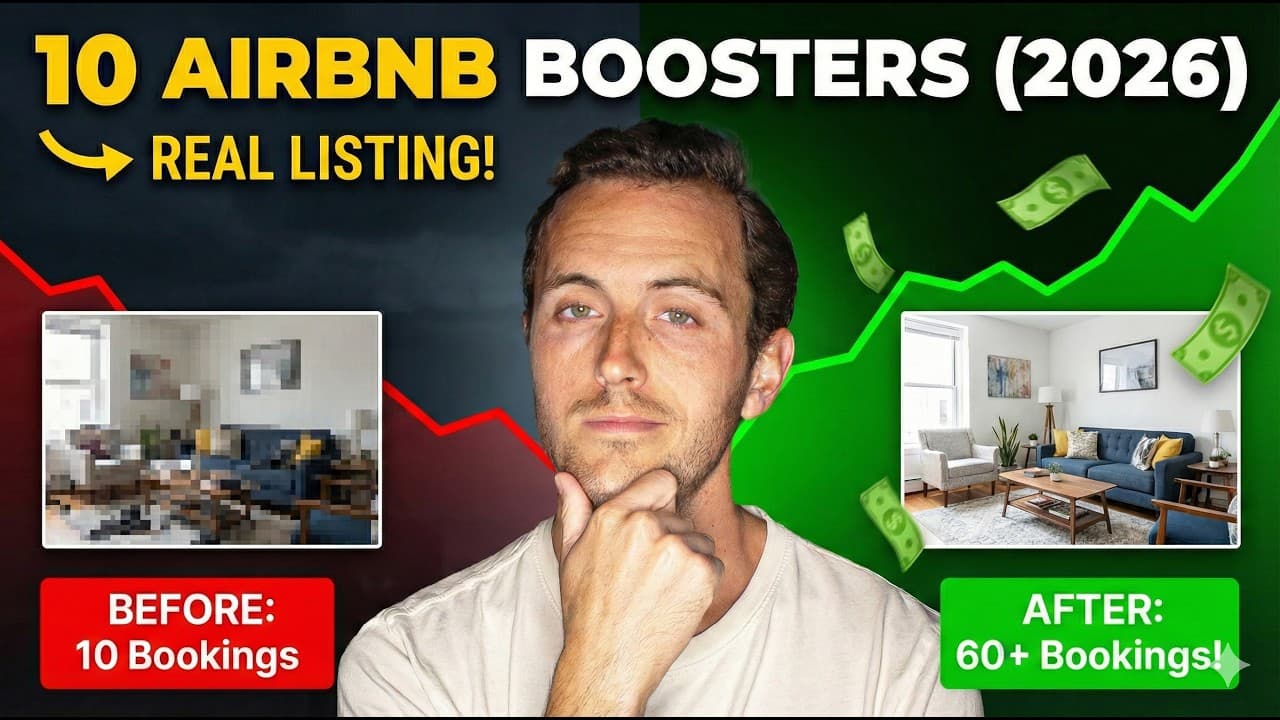
10 ESSENTIAL Steps to Improve Your Airbnb in 2026 (Real Listing Example!)
Most Airbnb listings lose bookings to the same fixable mistakes: bad photos, weak headlines, incomplete amenities, and missed seasonal opportunities. Here are 10 proven strategies to turn any underperforming listing into a consistent booking machine in 2026.
January 1, 2026 · 11 min read

10 Game-Changing Hacks to Improve Your Airbnb
What does it really mean to run a successful Airbnb in 2026? These 10 practical hacks — including a $15 sensor that prevented $44,000 in property damage — show exactly what separates top hosts from average ones.
January 16, 2025 · 9 min read

10 Tips to Get More Views on Airbnb
More views mean more bookings, and more bookings mean more revenue. This guide breaks down 10 actionable Airbnb listing optimization strategies that help hosts climb the search rankings and fill their calendars in 2026.
March 26, 2024 · 14 min read