Why People Are Flocking to Airbnbs in 2026
By James Svetec · May 27, 2021 · 9 min read
Part of our Airbnb Hosting 101 guide →
Key Takeaways
- Rural and nature-adjacent markets are seeing 20–50% revenue increases as travelers shift away from major cities toward outdoor destinations.
- The surge in STR investing is creating massive demand for professional Airbnb property managers, even in markets that were already strong before recent travel shifts.
- Hotels can't compete in cottage country, national parks, or secluded rural areas — giving Airbnb hosts a near-monopoly on accommodation supply in those markets.
- Properties that were solid investments in 2018–2019 are now producing outstanding returns when evaluated against current occupancy and rate trends.
- The best time to enter high-demand rural STR markets is before property prices fully catch up to revenue performance — which is happening fast in 2026.
Understanding why people are flocking to Airbnbs — both as guests and as investors — is one of the most important things any aspiring short-term rental host or property investor can do right now. The STR market in 2026 is not slowing down.
It is accelerating, and it's doing so in markets that most traditional real estate investors haven't even looked at yet.
Watch the full video above or keep reading for the complete breakdown.
The Big Picture: Why the STR Market Is Exploding
A lot of people assume the Airbnb market must be struggling. They hear noise about market saturation, regulatory crackdowns, and oversupply — and they conclude that the golden era is over. That assumption is wrong, and it's costing them money.
The short-term rental market in 2026 is one of the strongest it has ever been, particularly in specific types of markets. The key phrase there is specific types of markets. Not every Airbnb in every city is printing money.
But hosts and investors who understand where demand is concentrated — and why — are generating returns that long-term rental investors can only dream about.
One major driver is the fundamental shift in how and where people travel. That shift didn't reverse. It evolved. And it's creating a structural advantage for Airbnb properties in exactly the markets where hotels have the least presence.
The Shift in Travel That Changed Everything
Before travel patterns changed dramatically in the early 2020s, the majority of tourism dollars flowed into major cities. International visitors, business travelers, and weekend trippers all converged on urban centers — and hotels dominated that market. Airbnb was growing fast, but hotels and short-term rentals each had their turf.
Then the dynamic flipped. Domestic travel surged while international travel contracted. More importantly, travelers stopped going to cities and started leaving them. People packed into dense urban centers suddenly wanted space — outdoor activities, fresh air, privacy, and room for the whole family.
That's not a pandemic-era quirk that went away. It became a permanent behavioral shift. Remote work normalized extended getaways. Families started booking longer stays in rural properties. The demand that used to flow into downtown hotel corridors started flowing into cottage country, national parks, lakefront communities, and mountain towns.
In 2026, that trend is still very much in play. The travel landscape has permanently diversified away from pure urban concentration — and that is excellent news for rural and nature-adjacent Airbnb hosts.
Why Rural and Nature Markets Are Winning
Here's the competitive dynamic that makes rural STR markets so compelling: hotels don't exist there.
When a traveler wants to stay near a national park, a lake, or a secluded mountain retreat, they're not choosing between an Airbnb and a Marriott. They're choosing between an Airbnb and nothing. The Hilton isn't building properties in random cottage country towns.
The major hotel chains need population density, consistent business travel, and economies of scale. Rural markets offer none of that — for hotels.
For Airbnb hosts, that's pure upside. No price competition from institutional hospitality. No loyalty program incentives pulling guests away. Just a traveler who wants a specific experience, and a host who can provide it.
This is why the most sophisticated STR investors have been targeting markets near:
- National parks and state parks
- Cottage country and lake regions
- Ski towns and mountain communities
- Coastal communities outside major metros
- Rural towns with strong seasonal draw (harvest festivals, wine regions, hiking trails)
These markets were already generating solid returns before the travel shift. Now they're generating exceptional ones. For hosts looking to understand which specific market characteristics predict strong performance, the post on 3 things you need to know about Airbnb investing lays out the core framework.
Supply, Demand, and the Revenue Spike
When demand spikes and supply stays constrained, prices go up. That's basic economics — and it's exactly what happened in rural STR markets, with numbers that are hard to ignore.
Markets around major urban centers and near national parks saw anywhere from a 20% to 50% increase in overall revenue compared to pre-shift baselines. Properties that were generating $3,000 a month suddenly cleared $4,000 or $4,500. Properties that were break-even started producing strong positive cash flow.
The supply side hasn't caught up because you can't just build new rural properties on demand. Land in desirable cottage country areas is finite. Zoning in many rural municipalities is restrictive. And unlike a hotel development, you can't fast-track a custom lakefront cabin in 18 months. Supply grows slowly in these markets.
Key insight: In markets where demand is surging and supply grows slowly, revenue per property stays elevated for longer. That's a structural advantage, not a temporary blip.
This matters enormously for investors running cash-on-cash return analysis. A property that pencils out at 8% return using conservative 2019-era revenue numbers might actually be delivering 12–15% once current occupancy and nightly rate data are applied. That's a meaningful difference in the quality of the investment.
For a deep look at how to run these numbers properly before buying, the guide on Airbnb investment analysis using proper data walks through the methodology step by step.
The Investing Opportunity Right Now
So why are people flocking to Airbnbs as investments in 2026? Because the math is compelling, the demand is real, and the entry window — while narrowing — is still open in many markets.
The smart play is to find properties that make strong financial sense using conservative, pre-surge revenue assumptions. If a property works at 2019 numbers, it's a solid investment. If it's currently generating 30% more than that, it's an outstanding one. That's the framework BNB Mastery recommends for evaluating any STR property in today's market.
Here's what that looks like in practice:
- Identify a market with proven rural demand — national park proximity, lake access, ski region, or similar draw.
- Pull revenue data conservatively — use historical comps from 2018–2019 as your baseline, not peak years. If it works on those numbers, you have built-in upside.
- Analyze supply constraints — are there natural barriers to new supply entering the market? Zoning restrictions? Limited land?
- Stress test the numbers — model what happens if occupancy drops 20%. Are you still cash-flow positive?
- Buy before prices fully catch up to performance — property values in many of these markets are rising, but there's still a lag between revenue performance and purchase price in many areas.
Investors who want a structured framework for all of this can explore the BNB Investing Blueprint, which provides the exact analytical tools for evaluating STR deals with confidence.
One thing to watch: real estate prices in many rural markets have risen significantly. That doesn't mean the opportunity is gone — it means you need to be more selective. Deals that worked easily in 2020 require more diligence in 2026. But they're still there, and the revenue performance more than justifies the search.
For a comparison of different STR investment strategies and which one fits different investor profiles, the breakdown of Airbnb investing vs. long-term rental and multifamily investing is worth reading before you commit to a direction.
Free Tool
Grab the Airbnb Nightly Pricing Tool
Grab the exact spreadsheet James uses to set profitable nightly rates — plus a step-by-step setup cheatsheet.
Why Co-Hosting Demand Is Also Surging
Here's the other side of the equation that most people miss: the same wave of investors flooding into short-term rentals is creating a massive secondary opportunity — Airbnb property management, also called co-hosting.
Think about it. Thousands of people are buying vacation homes, cottages, and rural investment properties with the intention of listing them on Airbnb. Many of them have no idea how to optimize a listing, manage pricing dynamically, handle guest communication, or coordinate cleaning and maintenance efficiently. They own the property. They don't want to run the operation.
That's where co-hosts step in.
A co-host manages the day-to-day operations of an Airbnb on behalf of the property owner — handling bookings, guest messaging, reviews, cleaners, and pricing — typically in exchange for 20–30% of gross revenue. The property owner gets passive income. The co-host builds a scalable business without owning a single property.
In high-demand markets right now, that 20–30% of a well-performing rural property can translate to meaningful monthly income per property under management. Scale that to five or ten properties and the numbers become very attractive — without a mortgage, without a down payment, and without the risk of property ownership.
The demand for competent co-hosts is genuinely outpacing supply in many markets. Property owners are actively looking for managers. That's an unusual market condition — and it won't last indefinitely as more people discover the opportunity.
For hosts who want to build this kind of business, BNB Mastery's Co-Hosting Program provides a step-by-step system for landing clients, managing operations professionally, and scaling to full-time income without buying a single property.
How to Get Started in Short-Term Rentals
Whether the goal is to invest in STR properties or manage them for others, the starting point is the same: get educated before spending money or signing contracts.
The STR space rewards people who understand the fundamentals — market selection, revenue analysis, guest experience, pricing strategy — and punishes people who jump in with assumptions borrowed from long-term rental investing. The two asset classes behave very differently.
A few practical starting points for new hosts and investors in 2026:
- Start with market research. Before looking at a single property, understand the demand patterns in your target area. Look at occupancy rates, seasonal trends, and average daily rates using tools like AirDNA or Rabbu.
- Visit the market. Spend a weekend as a guest in your target area. Stay at a competitor property. Understand what guests are paying for and what they're getting.
- Run conservative numbers. Base your investment analysis on historical data, not peak performance. Properties that work on conservative assumptions have built-in resilience.
- Choose your business model deliberately. Co-hosting, direct ownership, and rental arbitrage are three very different approaches with different risk profiles. Understand all three before committing.
- Connect with other operators. The fastest way to avoid expensive mistakes is to learn from people who've already made them. A community of active STR operators is one of the most valuable resources you can access.
On that last point — the BNB Tribe community brings together hosts, investors, and co-hosts who are actively operating in markets across North America and beyond. When the market shifts (and it always does), having that network is invaluable.
For hosts who are brand new to the concept and want a foundational overview before diving into specifics, James Svetec's free copy of "Airbnb Unlocked" covers the core principles of building a profitable STR operation from scratch.
The Bottom Line
People are flocking to Airbnbs — as guests seeking space and nature, and as investors chasing returns that traditional real estate struggles to match. The structural reasons behind that trend are still intact in 2026: constrained rural supply, strong domestic travel demand, and a guest preference for whole-home privacy over hotel corridors.
The opportunity is real. But it's not passive, and it's not automatic. The investors and hosts who are winning right now are the ones who did their homework, chose the right markets, and modeled their numbers conservatively. The ones who bought based on hype alone are the cautionary tales.
There's still time to get into strong rural markets before prices fully close the gap on revenue performance. The window is narrower than it was two or three years ago — but it's not closed. The question is whether you move with information or without it.
Frequently Asked Questions
Why are people flocking to Airbnbs instead of hotels in 2026?
Travelers increasingly prefer Airbnbs for the privacy, space, and unique locations they offer — especially in rural areas where hotels simply don't exist. The shift toward domestic travel and nature-based getaways has made whole-home STR rentals the default choice for family trips, extended stays, and outdoor getaways.
Is investing in Airbnb properties still a good idea in 2026?
Yes — particularly in rural, nature-adjacent, and vacation markets where demand is strong and hotel competition is minimal. Properties near national parks, lakes, and ski towns are generating 20–50% more revenue than pre-2020 baselines in many markets, making them compelling investments when analyzed with proper data.
What markets are best for Airbnb investing right now?
Rural markets with strong natural attractions — national parks, lake regions, mountain towns, coastal communities outside major metros — consistently outperform urban STR properties in 2026. These markets have constrained supply, no hotel competition, and loyal repeat guest demand.
How much can an Airbnb property manager earn by co-hosting?
Co-hosts typically earn 20–30% of gross revenue per property under management. In high-performing rural markets, that can translate to $800–$1,500 or more per property per month. Managing five to ten properties can generate full-time income without owning any real estate.
What is the biggest risk of investing in Airbnb properties?
The biggest risk is overpaying based on peak revenue numbers rather than conservative historical data. Investors who model returns using inflated short-term performance can end up with properties that don't cash flow if occupancy or nightly rates normalize. Always stress-test your numbers using conservative assumptions before buying.
The math behind short-term rental investing works — but only if you understand which markets to target and how to analyze a deal properly. The BNB Investing Blueprint gives you the exact framework for evaluating properties before you commit, so you're buying based on data rather than optimism. And if you'd rather build income without buying property at all, BNB Mastery's Co-Hosting Program shows you how to build a full co-hosting business — step by step — starting with your first client.
Free Tool
Grab the Airbnb Nightly Pricing Tool
Grab the exact spreadsheet James uses to set profitable nightly rates — plus a step-by-step setup cheatsheet.
Ready to get started with Airbnb?
Join 240+ members in BNB Tribe — the community James built for hosts and investors who want real results.
Join BNB TribeMore Articles
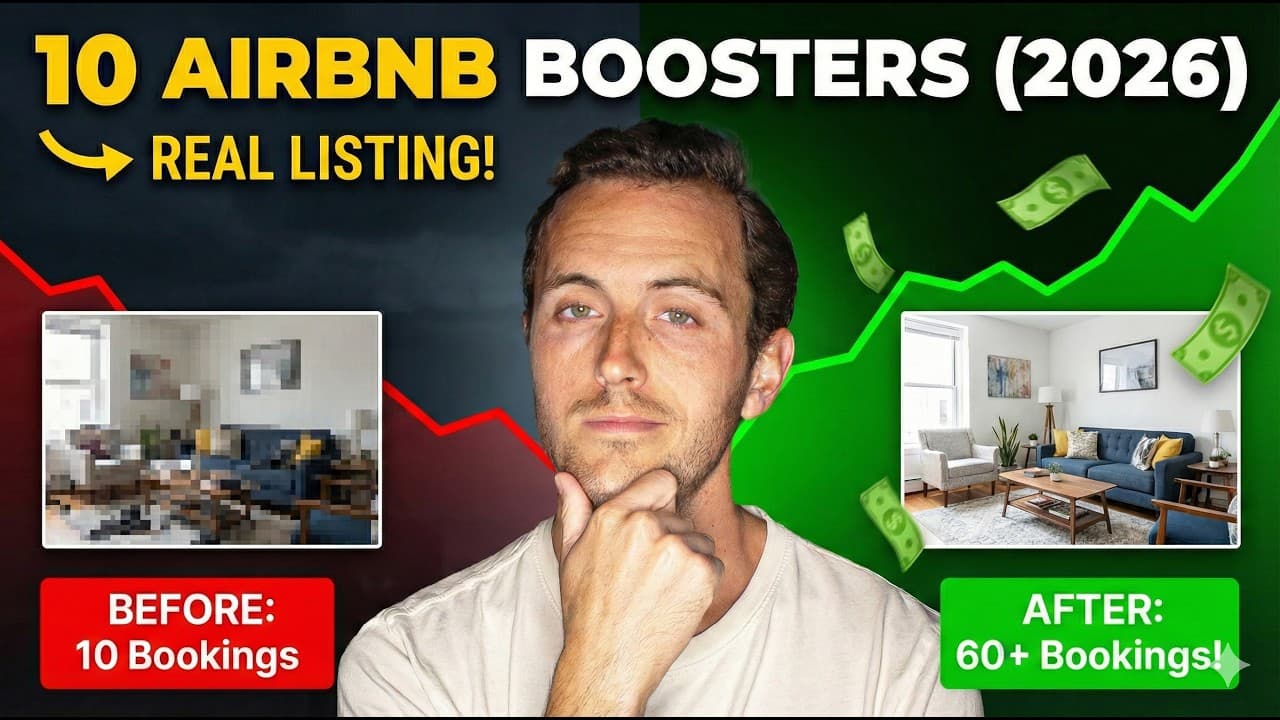
10 ESSENTIAL Steps to Improve Your Airbnb in 2026 (Real Listing Example!)
Most Airbnb listings lose bookings to the same fixable mistakes: bad photos, weak headlines, incomplete amenities, and missed seasonal opportunities. Here are 10 proven strategies to turn any underperforming listing into a consistent booking machine in 2026.
January 1, 2026 · 11 min read

10 Game-Changing Hacks to Improve Your Airbnb
What does it really mean to run a successful Airbnb in 2026? These 10 practical hacks — including a $15 sensor that prevented $44,000 in property damage — show exactly what separates top hosts from average ones.
January 16, 2025 · 9 min read

10 Tips to Get More Views on Airbnb
More views mean more bookings, and more bookings mean more revenue. This guide breaks down 10 actionable Airbnb listing optimization strategies that help hosts climb the search rankings and fill their calendars in 2026.
March 26, 2024 · 14 min read