Airbnb Millionaires: 3 Ways to Make Money in 2026
By James Svetec · April 29, 2020 · 9 min read
Part of our Airbnb Hosting 101 guide →
Key Takeaways
- Hosting your own space on Airbnb — even a spare bedroom or pullout couch — can fully offset your rent each month
- Rental arbitrage requires $5,000–$7,000 upfront but can generate $500–$1,000+ monthly profit on top of your rent costs
- Co-hosting (managing other people's Airbnbs for 20–30%) is the lowest-risk model and the most scalable for beginners
- A well-optimized property earning $5,000/month at a 20% management fee puts $1,000/month in the co-host's pocket
- Co-hosting can be done remotely, meaning you're not limited to properties in your local market
The Airbnb millionaire is not a myth — but the path to getting there looks different depending on which business model you choose. This blog video breaks down three of the most accessible, proven ways that everyday people are generating serious income on Airbnb in 2026, with no prior experience or technical background required.
Watch the full video above or keep reading for the complete breakdown.
Why Airbnb Still Creates Real Wealth in 2026
Airbnb has now been scaling for over a decade. The platform currently lists more rooms than the five largest hotel chains in the world — combined. That kind of market penetration has spawned an entire economy: cleaning companies, laundry services, key management, dynamic pricing software, and dozens of adjacent businesses.
For the average person, though, the opportunity isn't in building software or launching a cleaning franchise. It's in working directly with properties — your own or someone else's — and monetizing them more effectively than traditional long-term rental ever could.
Three models dominate how real people are building income on Airbnb right now. Each has different capital requirements, risk profiles, and earning ceilings. Understanding the differences is the first step toward picking the right one.
Method 1: Hosting Your Own Space on Airbnb
This is the simplest entry point. If you have any spare space — a pullout couch, a spare bedroom, or an entire property — you can list it on Airbnb and start earning income almost immediately.
Many people assume this only works in major tourist destinations like New York City or Miami. That's not accurate. Markets like Boise, Idaho have lower long-term rent costs and lower mortgage costs, which means the relative return on short-term rental can actually be higher than in expensive cities.
The gap between what a property costs to own or rent and what it earns on Airbnb — that spread — is often most favorable in mid-sized markets.
What Does Managing Your Own Listing Actually Involve?
Less than most people think. James Svetec, co-author of Airbnb for Dummies, describes his own experience hosting in Toronto: adjusting pricing about once a week, handling guest communication, and turning over the unit between guests. Total time commitment? A few hours per week.
That's a meaningful trade-off when the income generated can run into the thousands per month. For hosts looking to optimize their listing from day one, the tips in this Airbnb listing breakdown covering must-do hosting tips are a practical starting point.
If you already own a vacation property or investment property, this model is especially compelling. Short-term rental consistently outperforms long-term rental on a per-night basis — often by a significant margin. For a structured look at the numbers, the 258% ROI vacation rental case study shows what's possible when a property is optimized properly.
Rental Hacking: Living Rent-Free with Airbnb
One of the most underrated applications of hosting your own space is what's known as rental hacking — using Airbnb income from spare bedrooms to fully offset your monthly rent.
Svetec did this for years in downtown Toronto, one of Canada's most expensive rental markets. Starting with just a pullout couch, then moving to a two-bedroom apartment and listing the spare room, he was able to cover his entire rent. Later, in a three-bedroom property, he covered rent and pocketed an extra few hundred dollars per month on top.
In Toronto, where a one-bedroom apartment runs $1,800–$2,000/month, that's a substantial financial advantage. In lower-cost markets, the math often works even more favorably.
The main obstacle: getting landlord approval. Not every landlord will say yes — but in Svetec's experience, roughly one in three will. The best approach is to factor this in during your property search, rather than asking an existing landlord to change the terms after you've already signed.
Method 2: Rental Arbitrage
Rental arbitrage takes the rental hacking concept further. Instead of living in the property, you lease it specifically to operate as an Airbnb — without the owner doing any of the hosting work.
Here's how it works in practice:
- Find a property owner willing to allow short-term subletting (requires a lease addendum — not a standard lease)
- Pay first and last month's rent plus a security deposit
- Furnish the property (budget $3,000–$5,000 for furniture and setup)
- List it on Airbnb and price it to exceed your monthly rent costs
- Pocket the difference after rent, utilities, and operating expenses
Total upfront investment: typically $5,000–$7,000. Monthly profit potential: $500–$1,000+ per property in a well-chosen market.
The Arbitrage Risk You Need to Understand
Unlike co-hosting (covered below), rental arbitrage puts you on the hook for a fixed monthly rent payment regardless of how much the property earns. In peak season, this is rarely a problem. In slow months, you may break even or take a small loss.
Svetec notes that in Toronto, summer months could generate $1,000+ in profit easily — but January and February required careful cash-flow planning. Selecting the right market and property is critical before committing.
There's also a regulatory angle. Most standard leases prohibit subletting, so hosts need to negotiate an explicit addendum allowing Airbnb use. Skipping this step creates legal and financial risk. For a full breakdown of what can go wrong, the rental arbitrage risk breakdown is required reading before signing any lease.
Why Would a Landlord Say Yes?
More often than you'd expect. Here's what makes the pitch work:
- Long-term stability: A business tenant is less likely to move out after 12 months than a residential tenant with changing life circumstances
- Higher rent potential: Arbitrage operators can often offer $50–$100/month above market rate, since they expect to profit above that
- Visible property care: The landlord can literally see the Airbnb listing, read guest reviews, and confirm the unit is being professionally cleaned every few days
- Predictable cash flow: Operators have financial motivation to maintain the property and pay rent consistently
For anyone comparing arbitrage against buying properties outright, the full comparison of Airbnb investing vs. arbitrage covers the trade-offs in detail.
Free Tool
Grab the Airbnb Nightly Pricing Tool
Grab the exact spreadsheet James uses to set profitable nightly rates — plus a step-by-step setup cheatsheet.
Method 3: Co-Hosting (The Management Fee Model)
Co-hosting is the model BNB Mastery recommends most strongly for people just starting out — and for good reason. It requires zero upfront investment, carries no financial risk, and scales faster than either of the other two models.
Here's the premise: property owners who list on Airbnb often find it more time-consuming than expected. Responding to guest messages at all hours, coordinating cleaners, optimizing pricing, managing check-ins — it adds up quickly. A co-host steps in to handle all of that in exchange for a percentage of the monthly revenue.
The typical management fee runs 20–30%. On a property earning $3,500/month, that's $700/month for the co-host. On a property earning $5,000/month, that's $1,000/month — from a single property.
Why the Math Works for Property Owners Too
This is the part people often miss. A property owner managing their own Airbnb might earn $4,000/month. An experienced co-host who knows how to optimize pricing, improve the listing photos, and increase the review score might push that same property to $5,000/month.
The owner walks away with $4,000 after the 20% fee — the same as before — but now does zero work. The co-host earns $1,000/month for the difference they created.
That's not a hard sell. That's a straightforward value exchange.
Why Co-Hosting Scales So Much Faster
With rental arbitrage, every new property requires another $5,000–$7,000 investment. Growth is capital-constrained. With co-hosting, adding a new property costs nothing — and some co-hosts even charge an onboarding fee to cover initial setup work.
Co-hosting is also location-independent. Properties don't have to be in your city. A co-host based in a small town can manage properties in Miami, Nashville, or any high-demand market entirely remotely. This dramatically expands the available opportunity.
Risk is also structurally different. If a co-hosted property earns nothing in a given month, the co-host earns nothing — but loses nothing. There's no rent payment to cover, no lease obligation, no furniture investment on the line.
For anyone building a co-hosting business from scratch, BNB Mastery's Co-Hosting Program walks through the complete process of landing clients and managing properties at scale.
Connecting with other co-hosts who are already running this model is one of the fastest ways to accelerate results. The BNB Tribe community brings together experienced hosts and co-hosts who share strategies, answer questions, and hold each other accountable.
Comparing All Three Airbnb Business Models
| Model | Upfront Cost | Monthly Risk | Earning Potential | Scalability |
|---|---|---|---|---|
| Hosting Your Own Space | Minimal (furniture only) | Low | $500–$3,000/month | Limited to available space |
| Rental Arbitrage | $5,000–$7,000 per property | Medium (fixed rent) | $500–$1,500/month per property | Capital-constrained |
| Co-Hosting | $0 | None | $700–$1,200/month per property | High — fully remote |
Each model has a legitimate place. Hosting your own space is ideal if you already have a spare room or property. Arbitrage makes sense if you have capital to deploy and a strong local market. Co-hosting is the best starting point for anyone with limited funds, limited risk tolerance, or an interest in building a scalable management business.
Which Airbnb Model Is Right for You?
The honest answer: it depends on your situation. Here are three quick filters:
- You have a spare room or property: Start with hosting your own space. It's low effort, generates real income fast, and teaches you how Airbnb works from the inside.
- You have $5,000–$7,000 to invest and a strong local market: Rental arbitrage can produce solid returns, but requires careful property selection and cash-flow planning for slow months.
- You're starting from zero (no property, limited capital): Co-hosting is the clearest path. No investment required, no risk, and the scaling ceiling is genuinely high once you have 3–5 properties under management.
Many hosts start with one model and expand into others as their experience and capital grow. Hosting your own space teaches the fundamentals. Arbitrage teaches market analysis. Co-hosting teaches operations and client management — skills that translate directly to building a full property management business.
For investors thinking about buying properties specifically for short-term rental, the BNB Investing Blueprint provides a framework for analyzing markets, running ROI projections, and building a rental portfolio with confidence. And for a side-by-side comparison of all three models with deeper context, the Airbnb hosting vs. co-hosting vs. investing breakdown covers each in more detail.
Final Thoughts
Airbnb income isn't reserved for people who already own property or have significant capital. The three models covered in this blog video — hosting your own space, rental arbitrage, and co-hosting — represent a genuine spectrum of entry points, from zero investment to a few thousand dollars upfront.
The co-hosting model stands out as the most accessible and scalable for most people in 2026. Managing even two or three properties at a 20% fee can generate income equivalent to a part-time or full-time salary, with no lease obligations or capital tied up in furniture.
The real question isn't whether the opportunity exists — it's which model fits your current situation well enough to actually get started.
Pick the model that matches your resources and risk tolerance, take the first concrete step this week, and build from there. Waiting for the perfect conditions is how most people miss the window.
Frequently Asked Questions
How much money can you realistically make co-hosting on Airbnb in 2026?
Most co-hosts earn $700–$1,200 per property per month at a 20–30% management fee. Managing 3–5 properties can generate a full-time income without any upfront investment or property ownership.
What is rental arbitrage and is it still profitable in 2026?
Rental arbitrage involves renting a property, furnishing it, and relisting it on Airbnb at a higher nightly rate. It typically requires $5,000–$7,000 upfront and can generate $500–$1,500/month in profit per property, but success depends heavily on market selection and landlord approval.
Do you need to own property to make money on Airbnb?
No. Co-hosting allows you to manage other people's Airbnb properties for a 20–30% management fee with zero investment. Rental arbitrage is another option where you lease and sublet properties without owning them.
How do you get a landlord to allow Airbnb subletting?
About one in three landlords will agree if approached correctly. Key arguments include long-term tenant stability, potential for above-market rent, and the fact that the property will be professionally cleaned every few days with visible public reviews proving its condition.
What is the easiest way to start making money on Airbnb with no experience?
Hosting a spare room or spare space in your existing home is the easiest starting point. Co-hosting is the best option for building a scalable income stream without property ownership or significant upfront costs.
If co-hosting sounds like the right fit, the hardest part for most people is landing that first client and knowing exactly what to charge. BNB Mastery's Co-Hosting Program walks through the complete process — from finding property owners to managing 10+ listings remotely. For those who want ongoing support and a community of hosts to learn from, the BNB Tribe is the place to connect with people already running these models successfully.
Free Tool
Grab the Airbnb Nightly Pricing Tool
Grab the exact spreadsheet James uses to set profitable nightly rates — plus a step-by-step setup cheatsheet.
Ready to get started with Airbnb?
Join 240+ members in BNB Tribe — the community James built for hosts and investors who want real results.
Join BNB TribeMore Articles
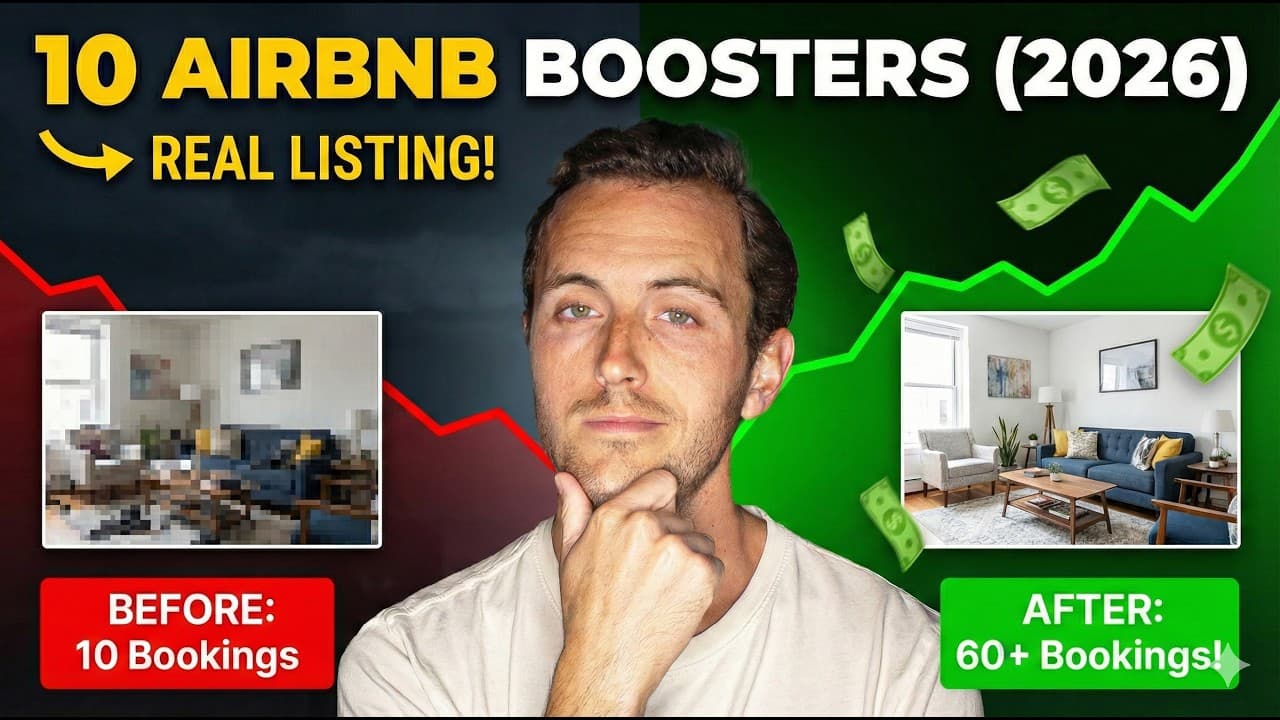
10 ESSENTIAL Steps to Improve Your Airbnb in 2026 (Real Listing Example!)
Most Airbnb listings lose bookings to the same fixable mistakes: bad photos, weak headlines, incomplete amenities, and missed seasonal opportunities. Here are 10 proven strategies to turn any underperforming listing into a consistent booking machine in 2026.
January 1, 2026 · 11 min read

10 Game-Changing Hacks to Improve Your Airbnb
What does it really mean to run a successful Airbnb in 2026? These 10 practical hacks — including a $15 sensor that prevented $44,000 in property damage — show exactly what separates top hosts from average ones.
January 16, 2025 · 9 min read

10 Tips to Get More Views on Airbnb
More views mean more bookings, and more bookings mean more revenue. This guide breaks down 10 actionable Airbnb listing optimization strategies that help hosts climb the search rankings and fill their calendars in 2026.
March 26, 2024 · 14 min read