How to Earn $100K/Year on Airbnb in 1-2 Hours a Month
By James Svetec · January 20, 2022 · 8 min read
Part of our Airbnb Hosting 101 guide →
Key Takeaways
- James Svetec's STR property generated $99,000 in its first six months and is on track for $150,000 in annual revenue.
- After expenses, the property nets an estimated $50,000–$70,000 per year in profit.
- Total management time: just 1–2 hours per month, primarily reviewing monthly financials.
- Three core buckets of time — cleaning, guest communication, and pricing — can all be systemized or outsourced.
- A single virtual assistant (VA) can handle guest messaging, cleaner coordination, and maintenance routing at low cost.
If you've ever wondered whether a short-term rental can generate serious income without consuming your life, this blog video from BNB Mastery founder James Svetec answers that question directly. In it, James breaks down exactly how much time he spends managing an Airbnb property that brings in over $100,000 per year — and the number is almost hard to believe.
Watch the full video above or keep reading for the complete breakdown.
The Property Numbers: $150K Revenue, $70K Net
James's property pulled in $99,000 in its first six months on Airbnb — and with forward bookings already confirmed, the property is tracking toward $150,000 in total annual revenue.
That's gross revenue, not take-home. Like any real estate investment, there are real expenses: cleaning fees, a mortgage, property taxes, insurance, utilities, and income taxes all come out of that top-line number. When everything is accounted for, James estimates a net profit of $50,000 to $70,000 per year on this single property.
For context, that's a significant income replacement for most people. And as you'll see, it's being achieved with a fraction of the time most hosts assume is required. If you want a deeper look at how to find and analyze properties capable of this kind of return, the BNB Investing Blueprint walks through the full investment analysis framework James uses.
You can also see a more detailed numbers breakdown in a related post on achieving a 258% ROI on a vacation rental, which covers how compounding smart systems and strong market selection can dramatically improve returns.
How Much Time Does Managing an Airbnb Actually Take?
Here's the number that stops most people in their tracks: one to two hours per month.
Not per week. Not per day. Per month. And James says even that figure is generous — most months, he's in and out in 30 to 45 minutes reviewing the property's financial statements.
Until recently, he was also spending about 30 minutes per week on pricing optimization. That's been offloaded entirely. So the actual ongoing time commitment is almost nothing.
This is possible because of systems. Not magic, not luck — systems. James spent years building and refining these workflows while managing properties for other people through co-hosting, and he's now deploying those same frameworks on his own portfolio.
The key insight: Most Airbnb hosts spend far too much time on tasks that could be automated or delegated for very little cost. Getting your time down to 1–2 hours per month is a systems problem, not a talent problem.
There are four main categories where STR host time typically gets consumed. James has systematically eliminated or offloaded all of them. Here's exactly how.
Cleaning: The Biggest Time Sink — And How to Fix It
Cleaning is where most property owners either hemorrhage time or accept mediocre results. The absolute worst-case scenario? Doing the cleaning yourself. Beyond the obvious time cost, it keeps you personally tied to a task that should be fully handled by someone else.
But even hosts who hire cleaners often find themselves constantly managing them — scheduling turnovers, chasing invoices, ordering supplies, and answering questions. That middle-management layer is where time disappears.
James's solution has three components:
- Find the right cleaning team from the start. He uses a structured screening process and step-by-step onboarding to identify cleaners who are reliable, thorough, and professional — not just whoever is cheapest.
- Train them with a clear checklist and workflow. Proper onboarding means fewer mistakes, fewer check-in calls, and fewer emergency fixes after guests arrive.
- Integrate them with self-scheduling tools. There are property management software platforms that allow cleaners to see the booking calendar and schedule themselves for each turnover automatically — no manual coordination needed.
Supply replenishment is also automated. When cleaning supplies run low, a team member places an Amazon order that ships directly to the cleaner's address. The property owner is never in the loop.
The result: a cleaning operation that runs itself. Even if you don't have an existing team, a single virtual assistant (VA) can handle all cleaner coordination — scheduling follow-ups, processing invoices, and facilitating supply orders — without requiring any specialized skills or high hourly rates.
For hosts who want to build a full property management operation along these lines, BNB Mastery's Co-Hosting Program covers the complete framework for setting up cleaning teams, onboarding VAs, and systematizing operations across multiple properties.
Guest Communication: Automate First, Delegate Second
Guest messaging is the other major time drain for most Airbnb hosts. Guests ask questions constantly — about check-in, WiFi, parking, early check-out, local recommendations. Without a system, this becomes a second job.
James's approach combines two strategies: automation for the predictable stuff, and VA delegation for everything else.
What Can Be Automated
Most guest questions are completely predictable. The same five to ten questions come up over and over across every booking. Pre-written message templates — triggered automatically at check-in, mid-stay, and checkout — can answer nearly all of them before the guest even thinks to ask.
- Automated check-in message with door code, WiFi password, parking instructions
- Mid-stay check-in message asking if everything is going well
- Pre-checkout reminder with instructions and checkout time
- Quick-reply templates for the most common one-off questions
For first-time hosts with a single property, James actually recommends handling messaging yourself initially. It builds intuition for what guests need and helps you write better templates. But once you're ready to step back, this task is easy to hand off.
Free Tool
Grab the Airbnb Nightly Pricing Tool
Grab the exact spreadsheet James uses to set profitable nightly rates — plus a step-by-step setup cheatsheet.
Delegating to a VA
A VA handling guest communication doesn't need to be an experienced hospitality professional. They need clear templates, a defined tone of voice, and the authority to escalate unusual situations. That's it. This is an entry-level role that can be filled at very reasonable cost — often offshore — without compromising the guest experience.
James emphasizes that guest communication and cleaner coordination can be handled by the same VA. The workload for each task individually is small enough that one person can manage both, keeping overhead minimal.
Pricing Optimization: The Difference Between Good and Great Revenue
This is the area most hosts either ignore entirely or handle poorly. Dynamic pricing — adjusting nightly rates based on demand, seasonality, local events, and competitive availability — can meaningfully increase annual revenue on any STR property.
Without it, you're almost certainly leaving money on the table during peak periods and underperforming during slow seasons.
The challenge is that manual pricing optimization is genuinely complex. Done right, it requires reviewing market data, occupancy trends, and competitor rates on a regular basis. That's not something you want to hand to a random VA without a clear process.
James's solution is to use specialized pricing tools that reduce the complexity down to a repeatable, teachable workflow. Once the process is simplified and documented, a VA can execute it without needing deep expertise in revenue management.
James was spending about 30 minutes per week on this before offloading it entirely — a small time investment that produces outsized revenue results.
This concept connects to a broader truth about STR investing: the systems matter more than the hustle. A property with good pricing discipline will consistently outperform a comparable one that just sets-and-forgets its rates.
Connecting with other hosts who are actively optimizing their listings is one of the fastest ways to sharpen your pricing instincts. The BNB Tribe community is a good resource for exactly that — comparing notes on what's working in different markets in 2026.
Maintenance: Let Your VA Be the Middleman
Maintenance issues are inevitable in any rental property. A guest reports a broken appliance, a leaky faucet, or a faulty lock. In a traditional landlord setup, you'd field that call yourself, find a contractor, schedule the repair, and follow up to make sure it's done.
In a well-systemized STR, that entire chain runs through your VA.
The VA is already handling guest communication, so they're the first to know when a maintenance issue arises. From there, they can contact the appropriate contractor directly, schedule the fix, and confirm resolution — all without the property owner being involved.
The key is having a pre-vetted list of local contractors for common issues: plumbing, electrical, HVAC, general handyman work. Build that list once, and your VA can act on it indefinitely.
This setup doesn't require a large team or complex software. A good VA, a clear contractor list, and the right communication tools are sufficient for most single-property owners.
Building the Full System: What You Actually Need
To recap the full operational picture James describes, here's what the lean, systemized STR setup looks like:
- A great cleaning team — screened, trained, and integrated with self-scheduling tools
- One virtual assistant — handling guest messaging, cleaner coordination, supply ordering, and maintenance routing
- Automated guest message templates — covering the 80% of guest questions that repeat every booking
- A pricing tool and documented process — so pricing optimization is executable by the VA without expert-level skill
- A contractor shortlist — pre-vetted for common maintenance categories
The owner's remaining job? Reviewing monthly financials. Thirty to forty-five minutes, once a month.
This isn't theoretical. James built this system over years of managing properties for other people as a co-host, and now applies it to his own portfolio. The advantage of starting with proven systems is that you skip the trial-and-error phase entirely.
For a related breakdown of what it actually looks like to earn income managing other people's properties before buying your own, see this post on earning $1,000 managing a single Airbnb.
And if you're still deciding which STR business model makes the most sense for your situation, this comparison of Airbnb hosting vs. co-hosting vs. investing lays out the pros and cons of each path clearly.
The Bottom Line on Passive Airbnb Income
A blog video like this one exists because most people dramatically overestimate how much time a well-run Airbnb requires. One to two hours per month for a property generating $50,000–$70,000 in net profit isn't a fluke — it's the result of building the right systems once and letting them run.
The hard part isn't managing the property. The hard part is building the systems correctly in the first place. Tools, team structure, onboarding processes, pricing workflows — getting all of that right from day one compresses years of trial-and-error into a clean, repeatable setup.
For investors serious about reaching this kind of outcome with their own STR property, the BNB Investing Blueprint covers everything from market selection and deal analysis to property setup and operational systems. Starting with the right framework makes the difference between a truly passive asset and a second job.
Frequently Asked Questions
How much time does it take to manage an Airbnb property per month?
With the right systems in place, managing a single Airbnb can take as little as 1–2 hours per month. This typically involves reviewing monthly financials, while a virtual assistant and automated tools handle guest communication, cleaning coordination, pricing, and maintenance.
Can an Airbnb property really earn $100,000 per year?
Yes, in the right market with strong pricing and operational systems, a single STR property can generate $100,000 or more in gross annual revenue. James Svetec's property hit $99,000 in its first six months alone, tracking toward $150,000 for the full year.
Is Airbnb still a good investment in 2026?
Airbnb investing remains a strong strategy in 2026 for investors who choose the right markets, analyze deals carefully, and implement proper systems. Properties with dynamic pricing and lean operations can generate significantly better cash flow than comparable long-term rentals.
What is the best way to minimize time spent managing an Airbnb?
The most effective approach is combining automation (message templates, self-scheduling cleaning software) with low-cost delegation (a virtual assistant for guest communication and cleaner coordination). Pricing can also be offloaded with the right tools and a documented process.
Do I need a property manager or can I self-manage an Airbnb passively?
Self-management is very achievable with the right systems. A virtual assistant, automated messaging, and a well-trained cleaning team allow most property owners to step back from day-to-day operations entirely, without paying the 20–30% fee a traditional property manager charges.
Earning $50,000–$70,000 net from a single property while spending under two hours per month managing it is a systems problem — and systems can be learned. The BNB Investing Blueprint gives you the exact framework for finding the right property, running the numbers, and setting up the operational systems that make this level of passive income realistic from day one.
Free Tool
Grab the Airbnb Nightly Pricing Tool
Grab the exact spreadsheet James uses to set profitable nightly rates — plus a step-by-step setup cheatsheet.
Ready to get started with Airbnb?
Join 240+ members in BNB Tribe — the community James built for hosts and investors who want real results.
Join BNB TribeMore Articles
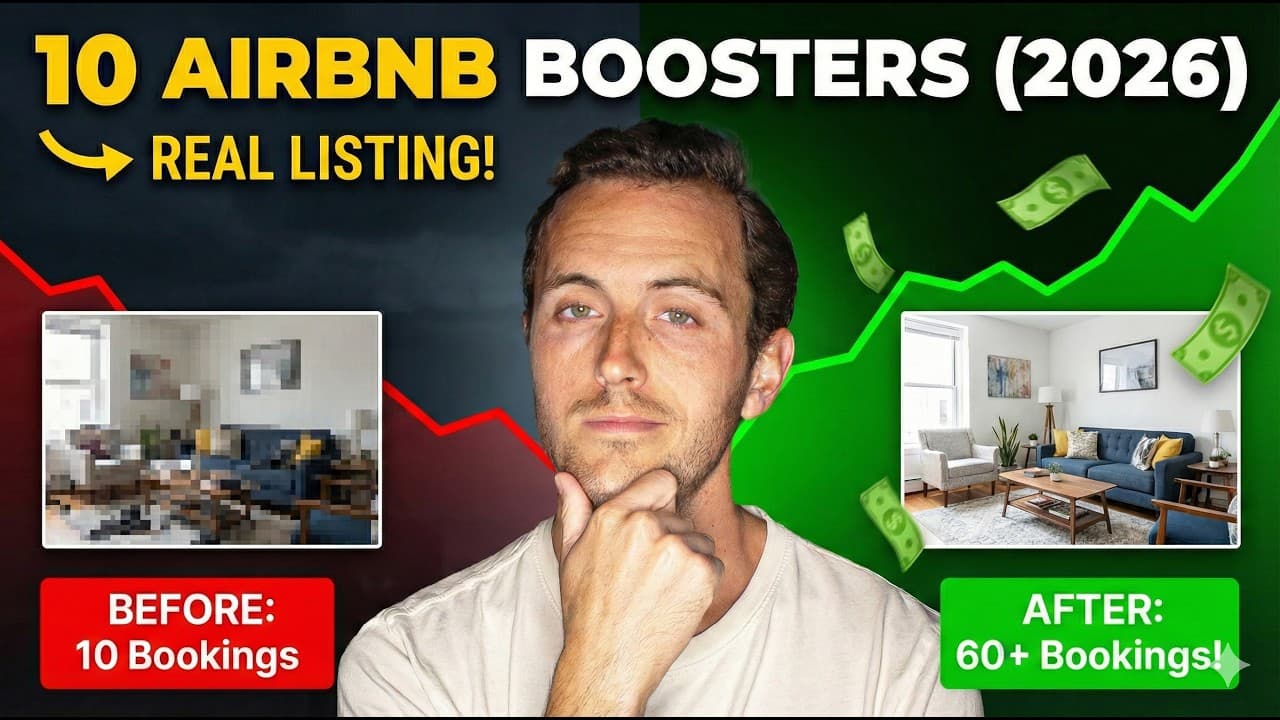
10 ESSENTIAL Steps to Improve Your Airbnb in 2026 (Real Listing Example!)
Most Airbnb listings lose bookings to the same fixable mistakes: bad photos, weak headlines, incomplete amenities, and missed seasonal opportunities. Here are 10 proven strategies to turn any underperforming listing into a consistent booking machine in 2026.
January 1, 2026 · 11 min read

10 Game-Changing Hacks to Improve Your Airbnb
What does it really mean to run a successful Airbnb in 2026? These 10 practical hacks — including a $15 sensor that prevented $44,000 in property damage — show exactly what separates top hosts from average ones.
January 16, 2025 · 9 min read

10 Tips to Get More Views on Airbnb
More views mean more bookings, and more bookings mean more revenue. This guide breaks down 10 actionable Airbnb listing optimization strategies that help hosts climb the search rankings and fill their calendars in 2026.
March 26, 2024 · 14 min read