How to Buy a Short Term Rental Property: 2026 Guide
By James Svetec · February 24, 2022 · 9 min read
Part of our Airbnb Hosting 101 guide →
Key Takeaways
- Set clear investment criteria before you start browsing listings — location, property size, and target revenue benchmarks should all be defined upfront.
- Use the 1/10 rule as a quick filter: annual gross revenue should equal at least 10% of the purchase price in a worst-case scenario.
- A 20% cash-on-cash return is a reasonable minimum threshold for STR investments — many well-chosen properties exceed this significantly.
- Pull revenue comps from AirDNA at the 50th, 75th, and 90th percentile to model worst-case, moderate, and best-case scenarios.
- Larger properties (8–10 guests) often generate more than double the revenue of smaller ones without costing twice as much to buy.
Figuring out how to buy a short term rental property can feel overwhelming — there are dozens of variables to track, and one bad decision early in the process can sink an otherwise promising deal.
The good news is that the process breaks down into a repeatable system that any investor can follow, whether they're buying their first Airbnb or their tenth.
Watch the full video above or keep reading for the complete breakdown.
Step 1: Set Your Investment Criteria
Before opening a single listing on Zillow or Realtor.ca, successful STR investors define exactly what they're looking for. Without clear criteria, it's easy to fall in love with a property that looks great but performs terribly as a rental.
Here's an example of what a well-structured criteria list looks like in practice. BNB Mastery co-founder James Svetec and his investing partner Riley use criteria like these for their Ontario-based portfolio:
- Location: Within a three-hour drive of a major urban center (in their case, Toronto) so the guest market is large and accessible
- Cluster geography: Within 30–60 minutes of existing properties to keep cleaning teams and operations efficient
- Privacy: Private residential or rural setting — not on a main street, with neighbors far enough away that groups of 8–10 guests won't cause friction
- Capacity: Can accommodate 8 or more people after renovations, ideally 4+ bedrooms and 2+ bathrooms
- Desirable amenities: Near a lake, has acreage, or both — these drive bookings in leisure markets
- Revenue benchmark: Annual gross revenue of at least 1/10th of the purchase price based on AirDNA comps
That last point — the 1/10 rule — is worth unpacking. If a property is listed at $500,000, the bare minimum target is $50,000 in annual gross revenue. That's not a detailed underwriting number; it's a quick filter to eliminate properties that can't possibly cash flow before running deeper analysis.
Your criteria will differ depending on your market, budget, and goals. The point is to have them written down before you start shopping. It saves enormous time and keeps emotions from driving decisions.
Why Larger Properties Win on ROI
One of the most counterintuitive insights in STR investing is that larger properties tend to produce disproportionately higher revenue without costing proportionately more to buy.
Consider a two-bedroom versus a four-bedroom property in the same vacation market. The four-bedroom won't cost twice as much to purchase — you still have one roof, one HVAC system, one set of fixed costs. But the revenue? In many leisure markets, a four-bedroom can generate more than double what a two-bedroom earns.
Why? Because groups of 6–10 people can split a higher nightly rate among themselves, making it feel affordable per person. Those larger groups are also willing to pay a premium because they want to vacation together in one space rather than booking two separate units.
And in shoulder seasons, a larger property can still host smaller groups — 8 is a max, not a floor.
For investors focused on maximizing cash-on-cash return, targeting the 8–10 guest sweet spot is one of the highest-leverage decisions in the buying process. It's also why properly analyzing STR cash-on-cash returns matters so much — the numbers tell a very different story than what surface-level comparisons suggest.
Step 2: Find and Evaluate Properties
Once your criteria are set, the search begins. At this stage, you're not running full financial models — you're filtering. The goal is to quickly identify properties worth deeper analysis and discard the rest.
When a property looks promising on paper, call the listing agent directly (or have your buyer's agent do it). You're trying to gather details that don't show up in the MLS listing:
- Realistic purchase price: Is there competing interest? What's the actual number you'll need to offer to win the deal?
- Renovation scope: What does the property need? Get a rough budget estimate.
- Post-renovation capacity: Can you add bedrooms or bathrooms? Is the layout flexible?
- Furnished or unfurnished: Furnishing a property costs real money — factor it in from day one.
- Seasonal limitations: In some markets, properties are only set up for three-season use. Insulation, heated water lines, and winterization all affect operating costs.
- ARV comps: If you're renovating, what's the after-repair value? Will the renovation actually build equity, or just break even?
- Operating expenses: Hydro, propane, property taxes, insurance — get real numbers, not estimates.
This call takes 20–30 minutes and saves hours of wasted analysis on properties that don't qualify. It's a simple step that many first-time investors skip entirely.
For hosts who want a community to share deal-finding strategies and get feedback on properties before making offers, the BNB Tribe community is a valuable sounding board — particularly for less experienced investors who benefit from peer review on their early deals.
Step 3: Analyze the Deal with Real Numbers
Once a property passes the initial filter, it's time for a full financial analysis. This is where most investors either get it right or get burned.
A proper STR analysis accounts for every dollar in and every dollar out. Here's what a complete cost model looks like:
Total Cash to Deploy
- Down payment (percentage of purchase price)
- Closing costs and land transfer taxes
- Home inspection fee
- Renovation / rehab budget
- Furnishing and interior package
- Professional photography and staging
- Capital expense reserve (approximately 2% of purchase price held in reserve for repairs)
On a $595,000 property with a 5% down payment, furnishing, a hot tub and sauna install, and renovation work, total cash to close and launch can run around $130,000 in Canadian markets. That number surprises a lot of first-time buyers who only budget for the down payment.
Projected Revenue
Annual gross revenue projections come from AirDNA. Pull comps that match your target property's bedroom count and guest capacity. Model three scenarios:
- Worst case: 50th percentile revenue
- Moderate: 75th percentile revenue
- Best case: 90th percentile revenue
For a four-to-five bedroom property accommodating 8–10 guests in a strong Ontario vacation market, 75th percentile revenue can come in around $107,000 CAD annually. The 90th percentile pushes closer to $148,000. These aren't guarantees — they're benchmarks from comparable active listings.
Operating Expenses
Annual expenses to model include:
- Cleaning fees (estimate by multiplying your per-turnover cleaning cost by projected annual turnovers)
- Property management or software fees
- Utilities: hydro/electricity, propane, water, internet
- Property taxes and homeowners insurance
- Yard maintenance and snow removal
- Repairs and maintenance
Call a local cleaning company before finalizing numbers. Make sure you specify it's an Airbnb cleaning — that means linens, restocking supplies, and full property reset, not just a basic clean.
Free Tool
Grab the Airbnb Nightly Pricing Tool
Grab the exact spreadsheet James uses to set profitable nightly rates — plus a step-by-step setup cheatsheet.
The Cash-on-Cash Return Target
After running all the numbers, the key output is cash-on-cash return — annual net cash flow divided by total cash invested. BNB Mastery's recommended minimum is 20% cash-on-cash. Many strong STR markets deliver 25–35%+ on well-chosen properties.
A property that pencils out at 24.93% cash-on-cash with $29,000 in projected annual cash flow on a $595,000 purchase is decent — but not compelling enough to pull the trigger if better deals are available.
Running the analysis is what gives you the confidence to either move forward or walk away. The full cash-on-cash analysis framework is worth studying before you make your first offer.
Investors who want a structured system for running these numbers can explore the BNB Investing Blueprint, which provides a step-by-step framework for analyzing STR deals and building a rental portfolio.
Pulling Revenue Comps from AirDNA
AirDNA is the industry standard for STR revenue data, but pulling comps manually is tedious. Clicking through individual listings on their map view and adding up monthly revenue numbers by hand eats up time fast.
One workaround is a Chrome extension called Air Export, which pulls AirDNA data directly into a downloadable spreadsheet. Filter by bedroom count, guest capacity, and date range — then download the whole dataset. Instead of manually calculating that 75th percentile properties in a specific market earned $107,000 last year, you get that number with one click.
The extension also lets you pull historical data back to 2018 or earlier in some markets, which is useful for spotting long-term revenue trends rather than reacting to a single year's numbers. It's a free tool worth adding to any STR investor's toolkit.
When reviewing AirDNA comps, also look at the quality of competing listings. Are they professionally photographed? Are their descriptions optimized? If most comparable properties have mediocre listings, a well-optimized listing can outperform the 75th percentile benchmark — sometimes significantly. That's an upside most standard analysis tools don't capture.
For more context on this, the 3 things every Airbnb investor needs to know covers market analysis in more depth.
Step 4: Making an Offer and Closing
If the numbers work, it's time to make an offer. The structure of that offer depends heavily on market conditions.
In a competitive market where multiple offers are common, you may need to go in firm — no conditions — to win the deal. In a slower market, a conditional offer gives you protection.
The most valuable condition is inspection contingency, which lets you bring in a professional home inspector, uncover hidden issues, and potentially renegotiate the price based on what they find.
A failed inspection doesn't have to kill a deal. If the inspector uncovers $20,000 in deferred maintenance on a property you offered $600,000 for, that's a negotiating lever. Either the seller reduces the price, or you walk away knowing you avoided a money pit.
After closing, the real work begins: renovation (if applicable), furnishing, and listing setup.
Step 5: Furnish, Photograph, and List
How you set up and present a property has a direct impact on revenue. Two identical properties in the same market can generate dramatically different income based on listing quality alone.
Furnishing the Right Way
The goal isn't to furnish cheaply — it's to furnish strategically. Some amenities generate outsized returns: a hot tub, for example, dramatically increases booking rates and allows for higher nightly pricing in most leisure markets. Other upgrades — like expensive kitchen appliances guests will never use — add cost without adding bookings.
Budget thoughtfully. For an 8–10 guest property, a full furnishing package including a hot tub and sauna can run around $42,000 in Canadian markets. Know what you're spending before you start buying furniture.
Photography and Listing Optimization
Professional photography is non-negotiable. Have the property deep-cleaned and staged before the photographer arrives. First impressions happen in the first three photos — if those don't grab attention, guests scroll past.
Inside the listing itself, every detail matters:
- Caption every photo to answer common guest questions (Do you have Wi-Fi? What streaming services are available?)
- Fill out every amenity field completely — Airbnb's algorithm rewards completeness
- Write a description that answers objections and paints a picture of the guest experience
- Set house rules clearly to filter out guests who aren't a fit for the property
The more complete and compelling a listing is, the higher Airbnb surfaces it in search results — which means more eyeballs, more bookings, and higher occupancy. For tips on getting those first bookings and building momentum, these three Airbnb listing tips are a solid starting point.
Pricing and Operations
After launch, consistent revenue requires active pricing management. Flat nightly rates leave money on the table during peak periods and kill occupancy in slower months. Dynamic pricing tools — or manual rate adjustments tied to local demand signals — are essential for maximizing annual income.
You'll also need a reliable cleaning team, a guest communication system, and a process for handling maintenance issues. None of this is complicated, but all of it needs to be set up before the first guest checks in, not after.
Final Thoughts on Buying a Short Term Rental
The process of buying a short term rental property is systematic, not guesswork. Set clear criteria, filter properties quickly, run rigorous financial analysis, and only make offers on deals that meet your return thresholds. That discipline is what separates investors who build profitable portfolios from those who end up with expensive underperforming properties.
In 2026, the STR market rewards operators who combine smart acquisition with excellent execution. The property is the foundation — but the listing quality, pricing strategy, and guest experience are what drive the actual returns. Get both sides right, and a well-chosen short term rental can generate $29,000 to $48,000+ in annual net cash flow on a single property.
Start with the numbers. Let the numbers tell you where to invest your energy — and your capital.
Frequently Asked Questions
How much money do I need to buy a short term rental property in 2026?
The total cash required depends on your down payment, renovation budget, furnishing costs, and a capital expense reserve. On a $500,000–$600,000 property with a 5% down payment and full setup costs, expect to deploy $100,000–$130,000 in total cash before your first booking.
What is a good cash-on-cash return for a short term rental?
A minimum of 20% cash-on-cash return is a reasonable threshold for STR investments. Many well-selected properties in strong vacation markets deliver 25–35% or higher, especially when purchased with lower down payments.
How do I estimate Airbnb revenue before buying a property?
Use AirDNA to pull revenue data on comparable listings in your target market. Filter by bedroom count and guest capacity, then model three scenarios using the 50th, 75th, and 90th percentile data as worst-case, moderate, and best-case revenue projections.
Is it better to buy a smaller or larger Airbnb property?
Larger properties (8–10 guest capacity) typically generate disproportionately higher revenue without costing proportionately more to buy. A four-bedroom STR can often earn more than twice what a two-bedroom earns in the same market, making the economics significantly stronger.
Should I buy a turnkey Airbnb or renovate a property?
Both approaches work, but renovating a distressed property allows you to build equity and customize the space for STR performance. The key is ensuring the after-repair value exceeds your purchase price plus renovation costs — otherwise, you're spending money that doesn't translate into equity or returns.
If you want a structured framework for running deal analysis, modeling returns, and building a short term rental portfolio with confidence, the BNB Investing Blueprint covers exactly that — from finding properties to closing and launching. And if you want to stress-test your deals with other experienced investors before you make a move, the BNB Tribe community is where those conversations happen every day.
Free Tool
Grab the Airbnb Nightly Pricing Tool
Grab the exact spreadsheet James uses to set profitable nightly rates — plus a step-by-step setup cheatsheet.
Ready to get started with Airbnb?
Join 240+ members in BNB Tribe — the community James built for hosts and investors who want real results.
Join BNB TribeMore Articles
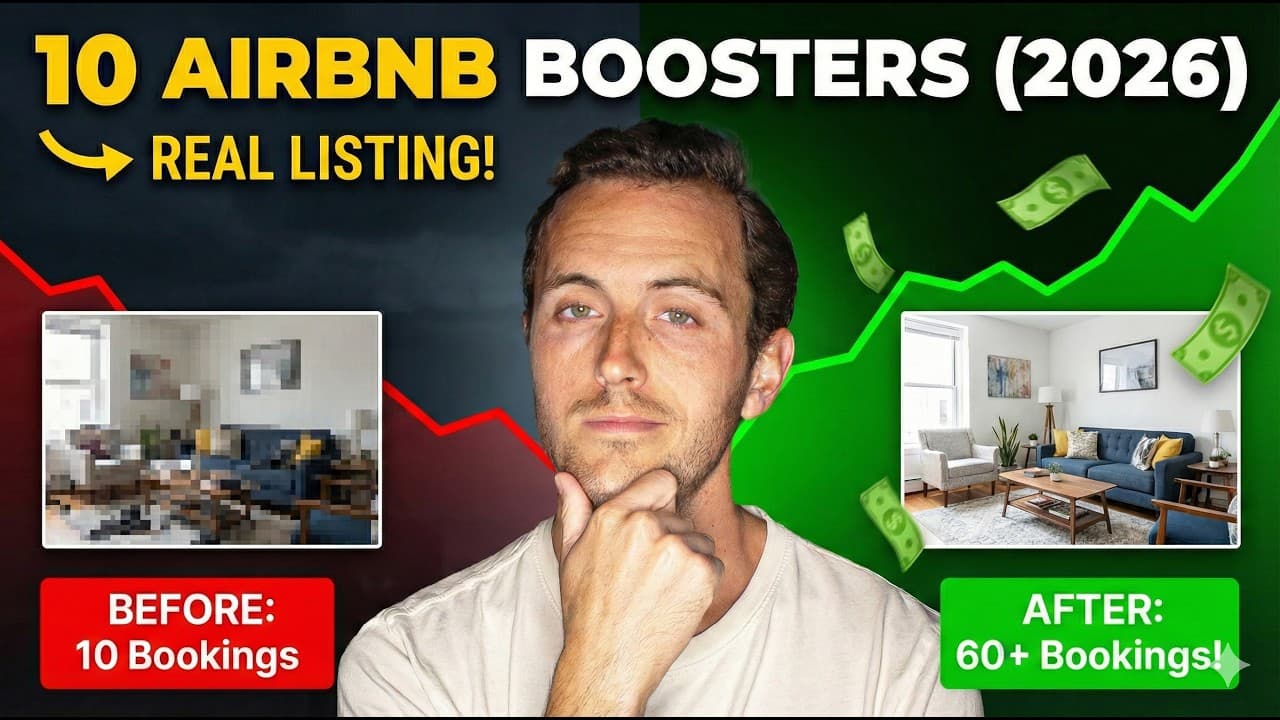
10 ESSENTIAL Steps to Improve Your Airbnb in 2026 (Real Listing Example!)
Most Airbnb listings lose bookings to the same fixable mistakes: bad photos, weak headlines, incomplete amenities, and missed seasonal opportunities. Here are 10 proven strategies to turn any underperforming listing into a consistent booking machine in 2026.
January 1, 2026 · 11 min read

10 Game-Changing Hacks to Improve Your Airbnb
What does it really mean to run a successful Airbnb in 2026? These 10 practical hacks — including a $15 sensor that prevented $44,000 in property damage — show exactly what separates top hosts from average ones.
January 16, 2025 · 9 min read

10 Tips to Get More Views on Airbnb
More views mean more bookings, and more bookings mean more revenue. This guide breaks down 10 actionable Airbnb listing optimization strategies that help hosts climb the search rankings and fill their calendars in 2026.
March 26, 2024 · 14 min read