Top 5 Things to Consider When Buying an Airbnb [2026]
By James Svetec · March 1, 2022 · 8 min read
Part of our Airbnb Hosting 101 guide →
Key Takeaways
- Always analyze STR properties in both best-case and worst-case scenarios — not just peak projections.
- Seasonality affects monthly cash flow but not annual profitability — don't let slow months scare you off a great market.
- Short-term rental revenue is predictable, not volatile — tools like AirDNA let you forecast income with real data.
- Operating an STR is more like running a hotel than a long-term rental — plan for it or hire a property manager.
- Dynamic pricing optimization can add $10,000–$40,000 per year in revenue for roughly one hour of work per month.
This blog video covers one of the most important topics for anyone considering an Airbnb investment: the five things that separate successful short-term rental investors from those who lose money. Whether you're buying your first vacation rental or expanding a portfolio, getting these fundamentals right in 2026 makes the difference between strong returns and a costly mistake.
Watch the full video above or keep reading for the complete breakdown.
1. Most Investors Don't Analyze Properties the Right Way
The single biggest mistake new short-term rental investors make is analyzing properties incorrectly. Specifically, they only look at the best-case scenario — peak season occupancy, top-dollar nightly rates, no vacancies — and project that forward as if it's guaranteed income.
That's not analysis. That's wishful thinking.
A proper STR analysis always models both a best-case and a worst-case scenario. What happens if occupancy drops 30%? What if local regulations tighten and you need to switch to mid-term rentals? What if a major employer leaves the area and travel demand softens?
The goal isn't to be pessimistic — it's to make sure you're never forced to sell a property at a loss because it can't cover its own carrying costs. Many investors found themselves in exactly that position when market conditions shifted. Don't be one of them.
Pro tip: Run your numbers at 60%, 75%, and 90% occupancy. If the property still cash-flows at 60%, you've got a solid deal. If it only works at 90%, walk away.
For a step-by-step walkthrough of how to run this analysis, the how to analyze a short-term rental property guide breaks down the full cash-on-cash return method with real numbers.
Investors who want a structured framework for deal analysis can also explore the BNB Investing Blueprint, which includes tools and templates specifically designed for STR property evaluation.
2. Seasonality Affects Cash Flow, Not Profitability
Here's something that trips up a lot of first-time STR investors: they look at a beach market or a ski town, see a clear high season and low season, and immediately assume the property won't pencil out.
The logic sounds reasonable. But it's usually wrong.
In most seasonal markets, the high season generates enough revenue to carry the entire year — including the slow months. A lake house that generates $18,000 in July and August alone might only need $4,000/month to cover its expenses. Even if November through March brings in very little, the annual math still works out strongly.
The real skill here isn't avoiding seasonal markets. It's understanding cash flow timing so you don't get caught short. Squirrel away your high-season revenue to cover operating expenses in the slow months. Treat it like a business with a fiscal year, not a paycheck that has to hit every month.
Example: A mountain cabin that earns $90,000 in six peak months and $20,000 in the remaining six still generates $110,000 annually. That's a very different picture than a long-term rental pulling in $2,000/month flat.
For a broader look at how STR investing stacks up against other real estate strategies, the Airbnb hosting vs. co-hosting vs. investing comparison is worth reading before you commit to a strategy.
3. STR Revenue Is Predictable — Not a Mystery
One of the most persistent myths about short-term rentals is that they're unpredictable and volatile. The revenue goes up and down. You never know what you're going to make. It's a gamble.
This is simply not accurate — and it's one of the reasons many investors still haven't entered the STR space despite strong returns being available.
Unlike a long-term rental that pays exactly the same amount every month or nothing (if the tenant leaves), STR revenue fluctuates in a highly predictable, seasonal pattern. With the right tools and data, you can forecast annual income with reasonable accuracy before you ever close on a property.
Tools like AirDNA let you pull real historical booking data for comparable properties in any market. You can see what similar listings earned month-by-month over the past three to four years, how demand has trended, and what nightly rates look like across different seasons. That's not a mystery — that's market research.
Pro tip: Always look at 3-4 years of historical data, not just the most recent 12 months. This helps you see whether demand is growing, flattening, or declining — and accounts for any anomalies in a given year.
The three things you need to know about Airbnb investing post goes deeper on how to read market data and set realistic income expectations.
4. Operating an STR Is Different — But Doesn't Have to Be Overwhelming
Short-term rentals are fundamentally more like running a hotel than managing a long-term rental. That statement surprises some people. But think about what's involved: furnishing the property, guest communication, check-in coordination, pricing adjustments, cleaning turnovers, and ongoing maintenance. It's active hospitality — not passive ownership.
There are two camps of investors who get this wrong in opposite directions.
Camp 1: The Underestimators
These are investors who assume an STR will run itself. They skip the systems, cut corners on communication, and then wonder why their reviews are mediocre and their occupancy lags the market. Operating an STR without a plan leads to burnout, bad guest experiences, and lost revenue.
Free Tool
Grab the Airbnb Nightly Pricing Tool
Grab the exact spreadsheet James uses to set profitable nightly rates — plus a step-by-step setup cheatsheet.
Camp 2: The Overestimators
These investors have heard that Airbnb is a full-time job and they want nothing to do with it. But this perception is outdated for anyone who sets up the right systems — or simply hires a professional property manager.
Here's the reality: good STR property managers are easier to find than good long-term rental managers, because the upside is higher for them. A property manager on a short-term rental might earn $800–$1,000/month on a single unit, versus $50–$100 on a long-term rental. That difference in compensation attracts more capable operators.
If you'd rather self-manage, that's very achievable too. With the right systems in place — automated messaging, dynamic pricing tools, vetted cleaning teams — many hosts spend as little as 20–30 minutes per month on a single property once everything is running smoothly.
Investors who want to take the management side seriously — or even build a co-hosting business managing other people's properties — can find a complete framework in BNB Mastery's Co-Hosting Program.
It's also worth connecting with other active investors and hosts. The BNB Tribe community is a solid resource for getting real answers from people currently operating in various markets — which is often more valuable than any single piece of content.
5. Never Set-and-Forget Your Pricing
If there's one operational lever that moves the needle more than anything else in short-term rental investing, it's dynamic pricing optimization. And it's the one thing most hosts do poorly — or don't do at all.
Setting your rates once and leaving them is the equivalent of a hotel charging the same price on a Saturday in July and a Tuesday in January. No serious hospitality operator does that. Your pricing should respond to demand signals: local events, booking lead times, competitor availability, and seasonal patterns.
The returns on pricing time investment are extraordinary. Spending roughly one hour per month actively monitoring and adjusting pricing can generate $10,000 to $40,000 in additional annual revenue per property — depending on the market and property size.
Here's a real example from the video: one property that was projected to earn $100,000–$120,000 in a year ended up trending toward $150,000 — a $30,000 increase — entirely because of active pricing management. That's 12 hours of work generating $30,000 in incremental revenue. Very few activities in any business offer that kind of return on time.
What does active pricing look like in practice?
- Check your forward occupancy every week and adjust rates if you're booking too fast (rates too low) or too slowly (rates potentially too high for that window)
- Monitor local events that drive demand spikes — festivals, conferences, graduations — and raise rates accordingly
- Use a dynamic pricing tool like PriceLabs, Wheelhouse, or DPGO as a baseline, but review its recommendations rather than blindly accepting them
- Track competitor listings to understand your market position
For more tactical pricing strategies, the three Airbnb pricing hacks every investor and host should know covers specific techniques that work in 2026's market.
And if you want to see a real deal analyzed with pricing built into the projections, check out the five big mistakes to avoid with Airbnb investing — pricing errors are among the most expensive on that list.
Final Thoughts on Buying an Airbnb Investment Property
The five things this blog video covers — proper deal analysis, seasonality, revenue predictability, operational planning, and pricing optimization — aren't complicated. But they're consistently where investors go wrong, often because they learned from generic real estate advice that doesn't account for the unique dynamics of short-term rentals.
The good news is that none of these are hard to get right once you understand them. Run conservative numbers. Study seasonal patterns in your target market. Use real data to forecast income. Plan your operations before you close. And treat pricing as an ongoing activity, not a one-time decision.
In 2026, the short-term rental market rewards investors who do their homework. The properties that underperform are almost always ones where the fundamentals were ignored — not because the market doesn't work, but because the investor didn't prepare. Get the fundamentals right, and the numbers tend to follow.
Frequently Asked Questions
What is the most important thing to consider before buying an Airbnb investment property?
Proper financial analysis is the most critical step. You should model both best-case and worst-case revenue scenarios before purchasing. If the property can't cover its carrying costs at 60–70% occupancy, it's too risky to buy.
Is short-term rental investing still profitable in 2026?
Yes, STR investing remains profitable in 2026 for investors who choose markets carefully and manage their properties well. The key is thorough market research, conservative income projections, and active pricing management to maximize revenue.
How do I handle slow seasons with an Airbnb investment property?
Seasonality affects monthly cash flow but not annual profitability in most markets. The strategy is to set aside revenue during high-demand months to cover operating expenses in slow periods. Think of it like managing a business with seasonal income cycles.
Can an Airbnb investment property be truly passive income?
It can be close to passive if you hire a professional property manager or set up strong self-management systems. With the right tools — automated messaging, dynamic pricing software, and vetted cleaners — many hosts spend fewer than 30 minutes per month per property.
How much extra revenue can dynamic pricing add to an Airbnb property?
Active pricing optimization can add $10,000 to $40,000 or more in annual revenue per property. One example from BNB Mastery showed a property that outperformed its $120,000 projection by $30,000 — purely from consistent pricing adjustments taking about one hour per month.
Getting the fundamentals right before you buy is what separates profitable STR investors from those who struggle. If you want to go deeper on deal analysis, market selection, and building a real portfolio — the BNB Investing Blueprint gives you a structured, data-driven approach to evaluating properties before you commit a dollar. And for ongoing strategy, market updates, and support from active investors, the BNB Tribe community is where serious STR investors are connecting right now.
Free Tool
Grab the Airbnb Nightly Pricing Tool
Grab the exact spreadsheet James uses to set profitable nightly rates — plus a step-by-step setup cheatsheet.
Ready to get started with Airbnb?
Join 240+ members in BNB Tribe — the community James built for hosts and investors who want real results.
Join BNB TribeMore Articles
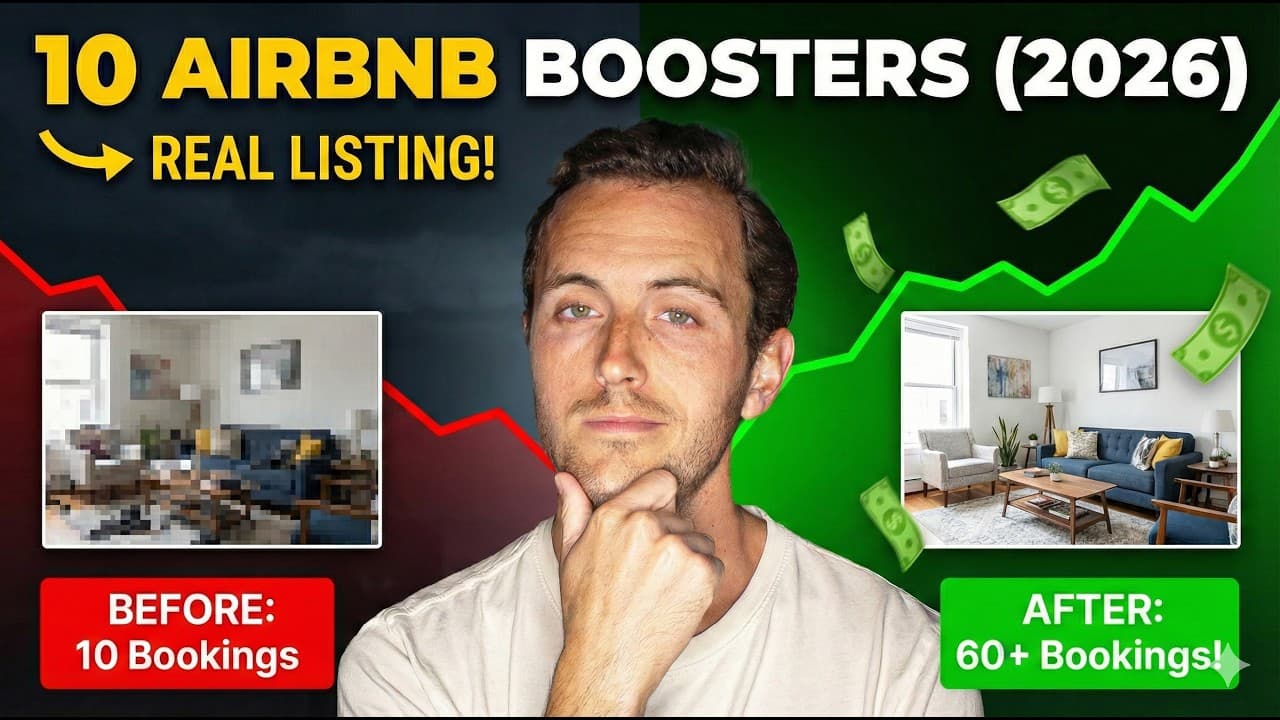
10 ESSENTIAL Steps to Improve Your Airbnb in 2026 (Real Listing Example!)
Most Airbnb listings lose bookings to the same fixable mistakes: bad photos, weak headlines, incomplete amenities, and missed seasonal opportunities. Here are 10 proven strategies to turn any underperforming listing into a consistent booking machine in 2026.
January 1, 2026 · 11 min read

10 Game-Changing Hacks to Improve Your Airbnb
What does it really mean to run a successful Airbnb in 2026? These 10 practical hacks — including a $15 sensor that prevented $44,000 in property damage — show exactly what separates top hosts from average ones.
January 16, 2025 · 9 min read

10 Tips to Get More Views on Airbnb
More views mean more bookings, and more bookings mean more revenue. This guide breaks down 10 actionable Airbnb listing optimization strategies that help hosts climb the search rankings and fill their calendars in 2026.
March 26, 2024 · 14 min read