Biggest Airbnb Opportunities in 2026: Blog Video Breakdown
By James Svetec · August 25, 2020 · 8 min read
Part of our Airbnb Hosting 101 guide →
Key Takeaways
- Airbnb Online Experiences lets anyone earn income by hosting virtual events for a global audience with minimal competition
- Remote co-hosting is a high-demand business model where you manage listings online and earn 10–20% management fees
- Surges in new hosts create a built-in client pipeline for co-hosting businesses — most new hosts don't know how to optimize their listings
- A property grossing $5,000/month at a 10% management fee earns you $500 — strong passive income per client
- The best time to start a co-hosting business is when demand is highest — and 2026 still represents a strong opportunity window
This blog video covers two of the biggest Airbnb opportunities available to hosts and entrepreneurs in 2026 — Airbnb Online Experiences and remote property co-hosting. Both models allow you to generate real income without owning a single property, and both are significantly underestimated by the majority of people in the short-term rental space.
Watch the full video above or keep reading for the complete breakdown.
Why the Airbnb Opportunity Is Misunderstood
Most people look at Airbnb and see disruption, uncertainty, and risk. They're not entirely wrong — the short-term rental market has faced regulatory pressure, platform changes, and shifting traveler behavior over the years. But that surface-level reading misses what's actually happening underneath.
When markets go through turbulence, two things happen simultaneously: weak players exit and strong opportunities emerge. Airbnb is no exception. During periods when new hosts flood the platform — often driven by financial necessity — and travel patterns shift domestically, demand for professional hosting support spikes.
That's the hidden story most people aren't paying attention to. While others are watching headlines, the hosts and entrepreneurs who understand how the platform actually works are quietly building income streams that didn't exist five years ago.
Understanding the Airbnb business landscape means looking past the noise and spotting what's actually creating value. Right now, in 2026, two specific models stand out: Airbnb Online Experiences and remote co-hosting.
Airbnb Online Experiences: A Low-Competition Revenue Stream
Airbnb's Experiences platform originally allowed hosts to offer in-person activities to travelers — think cooking classes, guided hikes, photography tours, or yoga sessions. It was a clever extension of the core Airbnb brand, but it was limited by geography.
The online version of that platform removed the geography problem entirely. Now, anyone with a skill or knowledge set can offer a virtual experience to participants anywhere in the world. Burlesque dancing, cocktail-making, language lessons, wellness retreats — if people are willing to pay for it, it can live on the platform.
What makes this particularly compelling is distribution. Airbnb already has millions of active users. When you list an experience, you're not starting from zero on marketing — you're plugging into an existing audience. That's a massive advantage for anyone just getting started.
According to the video breakdown, there were already hosts earning six figures per month on Airbnb Experiences at the time of filming. Competition has grown since then, but the platform still has far less saturation than traditional STR listings in most categories.
What Makes a Good Airbnb Online Experience?
- Unique skill or knowledge — something you can genuinely teach or demonstrate
- Clear value proposition — participants should know exactly what they're getting
- Strong visuals — your listing photos and preview matter enormously
- Engaging delivery — online formats reward energy and interactivity
- Scalability — virtual experiences can run for groups of 2 or 200
For a deeper look at the Experiences model, the full Airbnb Online Experiences breakdown covers the platform mechanics and monetization strategies in detail.
Remote Co-Hosting: Manage Properties Without Owning Them
The second major opportunity is remote co-hosting — and it's arguably the bigger one for people looking to build a real, scalable business. The concept is straightforward: you manage other people's Airbnb listings and take a percentage of the revenue as your fee.
What makes the remote management model unique is that you don't need to be physically present at the property. You handle the digital side of hosting — listing optimization, pricing, messaging, and performance analysis — while the property owner manages the physical aspects like check-ins and cleaning coordination.
This is a genuinely powerful business model. It has low startup costs, no need for capital to purchase real estate, and scales well once systems are in place. One person managing five properties at a 10% fee on properties grossing $3,000–$5,000/month can generate $1,500–$2,500/month. Managing ten properties doubles that.
For hosts already thinking about the differences between Airbnb hosting, co-hosting, and investing, the remote co-hosting path is often the lowest barrier to entry with the fastest path to consistent income.
Hosts looking to build a full co-hosting business from scratch should explore BNB Mastery's Co-Hosting Program, which provides a structured framework for landing clients, optimizing listings, and scaling operations without owning a single property.
Why New Hosts Need Your Help (And Will Pay for It)
Here's one of the most important dynamics in the STR market right now: new hosts are continuously entering the platform, and the vast majority of them have no idea what they're doing.
When economic pressure increases — job losses, reduced income, the need for supplemental cash — people turn to Airbnb. They list their spare bedroom, their vacation home, or their investment property. They set up a basic listing and hope for the best. The results are almost always underwhelming without professional optimization.
This pattern has played out before. During the 2008 financial crisis, Airbnb saw a surge in new hosts for exactly the same reason. The hosts who knew how to optimize listings, price strategically, and manage guest communication had a significant advantage — and a ready market of new hosts who needed their expertise.
The same dynamic creates opportunity today. Every new host who joins the platform and struggles to get bookings is a potential co-hosting client. They're motivated to get help. They don't want to learn the nuances of dynamic pricing and SEO optimization — they want results.
That's where a skilled co-host comes in. The value exchange is clear: you improve their performance, they pay you a percentage. Everyone wins.
If you want to see how other hosts have approached building this kind of business, the strategies for scaling an Airbnb management business post covers key growth tactics in detail.
Free Tool
Grab the Airbnb Nightly Pricing Tool
Grab the exact spreadsheet James uses to set profitable nightly rates — plus a step-by-step setup cheatsheet.
How Remote Airbnb Management Actually Works
There are two main service models within remote co-hosting. Understanding the difference helps you position your services and set expectations with clients.
Full-Service Co-Hosting (typically 20% fee)
You handle everything from end to end: listing creation and optimization, pricing management, guest communication, review strategy, and performance reporting. The property owner manages physical operations — cleaning, maintenance, check-ins — but you own the digital and strategic layer completely.
Remote Optimization Only (typically 10% fee)
This lighter model focuses specifically on the online performance side. Your core responsibilities include:
- Listing headline and description optimization — writing copy that converts browsers into bookers
- Photo curation and ordering — ensuring the visual presentation is compelling
- Dynamic pricing setup — using tools and data to maximize revenue per available night
- Guest messaging — responding quickly and professionally to inquiries and booking requests
- Ongoing performance monitoring — tracking metrics and adjusting strategy
The property owner handles everything physical. You handle everything digital. It's a clean division of labor that works well for hosts who are capable of managing their own property but lack the technical expertise to compete on the platform.
For hosts curious about what listing optimization actually looks like in practice, the essential Airbnb listing tips post covers the core elements every high-performing listing needs.
Connecting with other co-hosts and experienced operators in a community like BNB Tribe can accelerate the learning curve dramatically — especially when you're trying to land your first few clients and build systems that scale.
Income Potential: What Co-Hosting Can Actually Earn You
Let's put some concrete numbers on this. The income from co-hosting depends on three variables: the number of properties you manage, the gross revenue of each property, and your management fee percentage.
| Properties Managed | Avg. Monthly Revenue/Property | Fee % | Monthly Income |
|---|---|---|---|
| 3 | $3,000 | 10% | $900 |
| 5 | $4,000 | 10% | $2,000 |
| 10 | $4,500 | 10% | $4,500 |
| 5 | $4,000 | 20% | $4,000 |
| 10 | $5,000 | 20% | $10,000 |
These are conservative estimates. In high-demand markets, properties can gross significantly more — pushing your take well above these figures even at a lower percentage. A property grossing $5,000/month at a 10% fee puts $500/month in your pocket per client. Land ten clients at that level and you're at $5,000/month.
Pro tip: Start with full-service co-hosting at 20% while you're building your client base. Once you have systems in place and a track record to show, you'll have more flexibility to offer tiered pricing based on what each property owner actually needs.
For a broader look at what managing a single Airbnb property can generate, the breakdown of earning $1K managing one Airbnb gives a realistic baseline for new co-hosts.
When to Start: Timing Your Entry Into the Market
One of the most common questions aspiring co-hosts ask is whether the timing is right to start. The answer in 2026 is the same as it was when this video was originally recorded: the best time to start is when demand for the service is high and competition is manageable.
Both of those conditions still apply. New hosts continue to enter the Airbnb platform regularly. The gap between what new hosts know and what it takes to compete effectively on the platform has not narrowed significantly. Experienced co-hosts with strong track records continue to earn well.
The other timing argument is simply this: the sooner you start, the sooner you build a track record. Co-hosting is a business where social proof compounds. Your first successful client leads to a testimonial. That testimonial helps you land the second client. The second and third build credibility that makes every subsequent pitch easier.
Starting in a market with high demand is always better than starting in a saturated one. The window of relatively low competition in any given market does close over time. Waiting rarely makes the path easier.
Final Thoughts on These Airbnb Opportunities
The two opportunities covered in this blog video — Airbnb Online Experiences and remote co-hosting — represent different paths to generating income through the Airbnb platform without necessarily owning property. One leverages your skills and knowledge. The other leverages your operational expertise and systems.
Both are real businesses that require real effort. Neither is a passive income scheme or a get-rich-quick shortcut. But for people willing to learn the model and put in the work, the income potential in 2026 remains significant.
The remote co-hosting model in particular is one of the most accessible ways to build a meaningful income in the short-term rental space. Low startup costs, scalable systems, and a growing supply of new hosts who need help — the fundamentals are strong.
Frequently Asked Questions
What is Airbnb remote co-hosting and how does it work?
Remote co-hosting means managing another person's Airbnb listing — handling pricing, messaging, and listing optimization — in exchange for a percentage of the revenue, typically 10–20%. You don't need to visit the property or own any real estate to do it.
How much can you earn from Airbnb co-hosting in 2026?
Earnings depend on the number of properties managed and their gross revenue. At a 10% fee on properties generating $4,000–$5,000/month, managing 10 clients can produce $4,000–$5,000/month in management income. Full-service co-hosting at 20% can double that.
What are Airbnb Online Experiences and are they worth pursuing?
Airbnb Online Experiences let you offer virtual events — cooking classes, yoga sessions, workshops — to a global audience through the Airbnb platform. Competition is lower than traditional STR hosting, and the built-in Airbnb audience provides significant distribution advantages.
Is Airbnb co-hosting still a viable business model in 2026?
Yes. New hosts continue to enter the Airbnb platform without the expertise to optimize performance, creating consistent demand for professional co-hosting services. The business model remains viable for anyone willing to learn listing optimization, pricing strategy, and guest communication.
Do I need to own property to start an Airbnb co-hosting business?
No. Co-hosting is specifically designed for people who want to generate income through Airbnb without purchasing real estate. You manage other people's properties in exchange for a management fee, making it one of the lowest-barrier entry points into the STR industry.
If remote co-hosting sounds like the right path, the hardest part is always landing that first client. BNB Mastery's Co-Hosting Program walks you through the exact process — from building your pitch to managing a full roster of properties efficiently. And if you want ongoing support and a community of hosts who are actively building the same type of business, the BNB Tribe community is where experienced co-hosts share what's actually working right now.
Free Tool
Grab the Airbnb Nightly Pricing Tool
Grab the exact spreadsheet James uses to set profitable nightly rates — plus a step-by-step setup cheatsheet.
Ready to get started with Airbnb?
Join 240+ members in BNB Tribe — the community James built for hosts and investors who want real results.
Join BNB TribeMore Articles
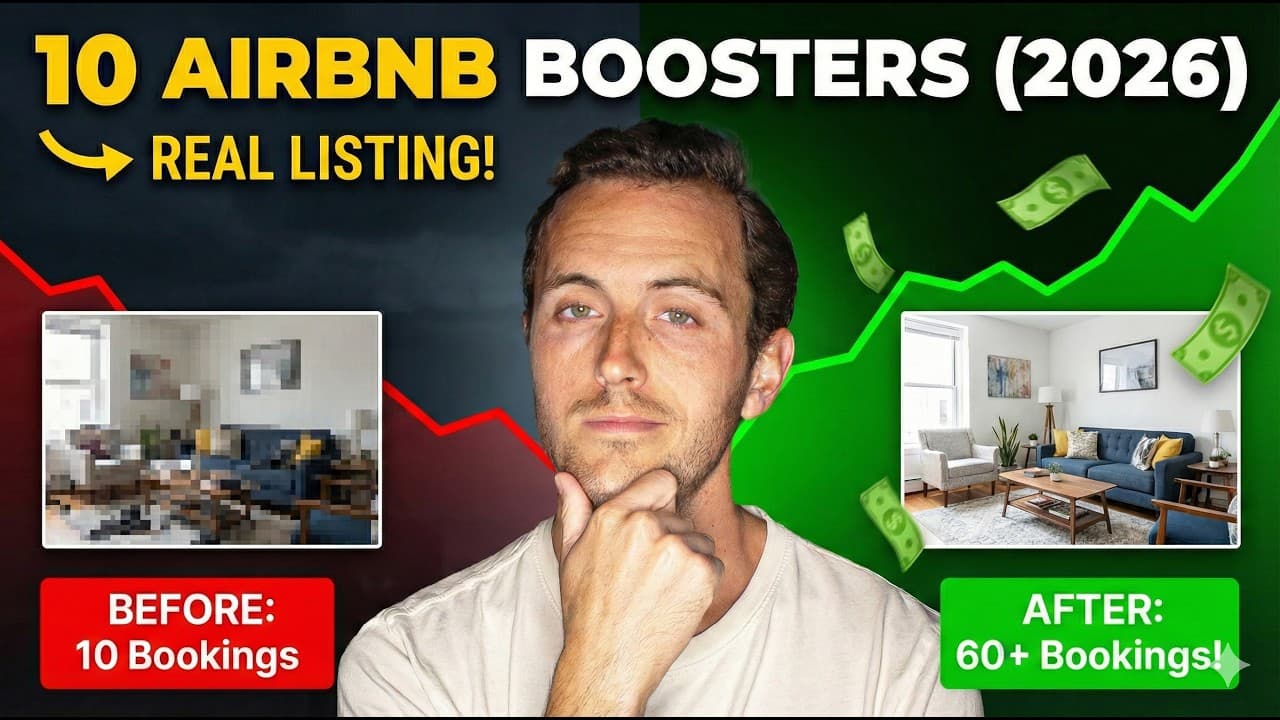
10 ESSENTIAL Steps to Improve Your Airbnb in 2026 (Real Listing Example!)
Most Airbnb listings lose bookings to the same fixable mistakes: bad photos, weak headlines, incomplete amenities, and missed seasonal opportunities. Here are 10 proven strategies to turn any underperforming listing into a consistent booking machine in 2026.
January 1, 2026 · 11 min read

10 Game-Changing Hacks to Improve Your Airbnb
What does it really mean to run a successful Airbnb in 2026? These 10 practical hacks — including a $15 sensor that prevented $44,000 in property damage — show exactly what separates top hosts from average ones.
January 16, 2025 · 9 min read

10 Tips to Get More Views on Airbnb
More views mean more bookings, and more bookings mean more revenue. This guide breaks down 10 actionable Airbnb listing optimization strategies that help hosts climb the search rankings and fill their calendars in 2026.
March 26, 2024 · 14 min read