Reacting to Graham Stephan – Why I’ll Never Rent On Airbnb
By James Svetec · June 7, 2023 · 10 min read
Part of our Airbnb Hosting 101 guide →
Key Takeaways
- Top-performing Airbnb hosts aren't affected much by increased supply — well-optimized properties capture the lion's share of bookings regardless of competition.
- Proper due diligence means running numbers based on historical averages, not pandemic-era peaks — a property should cash flow even in a down scenario.
- Pricing strategy is one of the most overlooked skills for any host of Airbnb — holding out for peak-weekend prices too long is a common and costly mistake.
- Short-term rental arbitrage is a high-risk model — owning or co-hosting properties is a far more sustainable path to income.
- Building a management team or partnering with a co-host turns an active business into a largely passive income stream over time.
Becoming a successful host of Airbnb in 2026 requires more than just listing a property and hoping for bookings. The market has matured, regulations have tightened in major cities, and guests have higher expectations than ever.
The hosts who are thriving right now are the ones who treat this like an actual business — with systems, smart pricing, and real due diligence behind every decision.
Watch the full video above or keep reading for the complete breakdown.
What the 'Airbnb Bust' Actually Means for Hosts
Over the past few years, headlines have screamed about an "Airbnb bust" — falling bookings, empty properties, panicked hosts slashing prices. But what actually happened? The answer is more nuanced than the media lets on.
During the pandemic, international travel ground to a halt. Millions of people redirected their vacation budgets toward local short-term rentals — a beach house two hours away instead of a European trip. That created an artificial demand spike that inflated bookings and revenue to levels that were never going to be sustainable long-term.
Opportunistic investors flooded in at the peak, buying properties at inflated prices and projecting those pandemic-era numbers into the future. When demand normalized, they were left holding properties that couldn't cash flow at the prices they paid. That's not an Airbnb bust — that's what happens when people skip due diligence and try to time the market.
For hosts who bought well and manage well, 2026 looks quite different. As James Svetec of BNB Mastery has noted, one of his properties dropped from $150,000 in bookings to $120,000 — still an exceptional return on a property originally underwritten at $80,000–$100,000 in annual revenue.
The people who got hurt bought the same property a year later at a much higher price and projected the peak numbers forward. That's a planning failure, not a platform failure.
For a deeper look at how experienced investors have reacted to the "Airbnb crash" narrative, check out this Airbnb investor's reaction to the crash headlines — the data tells a very different story than the doom-and-gloom coverage.
Due Diligence: The #1 Thing Every Host Gets Wrong
Whether you're becoming an Airbnb host for the first time or adding a property to an existing portfolio, due diligence is non-negotiable. Most hosts who struggle financially weren't undone by bad luck — they were undone by bad math.
Use Historical Data, Not Peak Data
Projecting revenue based on the best 12 months in Airbnb history is like buying a restaurant because it had a record Valentine's Day. Run your numbers on normalized, historical averages — what did similar properties earn in 2019, in 2021, and in 2023? Find the middle ground, then stress-test it.
A property that cash flows at $80,000 per year in conservative projections and hits $120,000 in reality is a home run. A property that only pencils out at $150,000 and earns $100,000 is a financial disaster.
Always Have a Backup Plan
Smart hosts and investors don't buy a property that only works as a short-term rental. In markets where regulations are tightening — or where political pressure makes future restrictions likely — the property should also cash flow as a long-term or mid-term rental.
This isn't pessimism. It's basic risk management. If you can clear your expenses and generate positive cash flow on a 12-month lease, then Airbnb revenue becomes upside — "icing on the cake," as Graham Stephan put it when discussing why he'd consider the platform in limited circumstances.
Investors who want a structured framework for running these numbers can explore the BNB Investing Blueprint, which walks through market analysis, deal evaluation, and how to stress-test a property before you buy.
Don't Confuse Arbitrage with Investing
Rental arbitrage — renting a property from a landlord and then subletting it on Airbnb — sounds appealing in theory. In practice, it's one of the riskiest models in the short-term rental space. You carry all the cost risk with none of the equity upside.
When bookings drop below rent, you're losing money with nothing to show for it. For a closer look at why this model fails so often, read why Airbnb arbitrage with no money is a trap.
Pricing Strategy: The Skill That Separates Winners from Losers
Pricing is where a huge number of hosts leave money on the table — or actively sabotage themselves. Getting this right is one of the most important things any host of Airbnb can do to protect their revenue.
Don't Hold Out for Imaginary Peak Prices
One of the most common mistakes hosts make is overpricing around high-demand events. A host expecting massive Super Bowl weekend revenue who holds firm on premium rates until the last minute may end up slashing prices by 60% just to get anyone through the door — or sitting with empty units entirely.
The fix? Monitor your market constantly. Watch occupancy rates for comparable listings in real time. If similar properties are booking up two weeks out and yours isn't, your price is probably wrong.
Dynamic Pricing Isn't Optional Anymore
In 2026, static pricing is essentially leaving revenue on the table. Tools like PriceLabs, Wheelhouse, and Beyond allow hosts to automate pricing adjustments based on demand, seasonality, and local events. Using these tools correctly can increase annual revenue by 10–25% compared to manual pricing.
Pro tip: Don't just turn on a dynamic pricing tool and walk away. Review its recommendations weekly, especially around major local events. Algorithms sometimes miss hyper-local demand signals that you'd catch manually.
For a practical breakdown of what works, see these Airbnb pricing hacks every host should know.
Regulations and Market Selection Matter More Than Ever
Regulatory risk is real — but it's also largely predictable if you know where to look. The cities making headlines for cracking down on short-term rentals (Los Angeles, New York, Las Vegas, Atlanta) share something in common: dense urban housing markets where politicians can score easy points by targeting Airbnb.
In those markets, a 1% increase in Airbnb listings correlates with just a 0.018% increase in rents — a negligible figure. But political incentives don't follow economic logic. If a mayor can say "I took on Airbnb to protect renters," they will.
How to Choose a Safer Market
Markets that are more regulation-resistant tend to share these characteristics:
- Tourism-dependent local economies — governments are less likely to kill an industry that supports local jobs and tax revenue.
- No major housing shortage narrative — cities without a high-profile affordability crisis face less political pressure to restrict STRs.
- Established STR history — markets where vacation rentals have existed for decades are less likely to face sudden crackdowns.
The due diligence process shouldn't just look at current regulations. It should include a forward-looking hypothesis: given the local political climate, economic dependence on tourism, and housing market dynamics, where are regulations likely to be in five years?
Always check local zoning rules, HOA restrictions, and licensing requirements before committing to a property. The biggest mistakes Airbnb investors make almost always include ignoring this step.
Free Tool
Grab the Airbnb Nightly Pricing Tool
Grab the exact spreadsheet James uses to set profitable nightly rates — plus a step-by-step setup cheatsheet.
Why Top Performers Don't Feel the Squeeze
Here's the counterintuitive truth about increased competition on Airbnb: it barely affects great properties.
When supply increases in a market, the demand doesn't spread evenly across all listings. It concentrates. The top 10–15% of properties — the ones with professional photos, compelling descriptions, competitive pricing, and strong review profiles — continue to capture the majority of bookings. The mediocre middle and the poorly-optimized bottom suffer disproportionately.
This is not a race to the bottom. A luxury lakefront property isn't competing with a basic studio apartment, any more than a high-end restaurant competes with a fast-food drive-through. They serve different needs at different price points, and guests self-select accordingly.
The practical implication: stop worrying about how many listings are in your market. Start worrying about whether your listing is in the top tier of its specific niche. Are your photos professional? Does your description actually sell the experience? Are your amenities what your target guest actually wants?
Example: In Phoenix, AirDNA data showed listings quadrupled from 5,000 to 21,000 between 2017 and 2023. The hosts who panicked were the ones running average properties. The ones running exceptional properties saw little change in their booking rates — they just absorbed demand from the listings that couldn't compete.
For actionable tips on standing out, see 10 tips to get more views on Airbnb.
The Airbnb Co-Host Model: Working Smarter, Not Harder
One of the most common objections to becoming a host of Airbnb is the workload. And it's a fair concern — managing guest communications, coordinating cleaners, handling maintenance, and staying on top of pricing is genuinely demanding if you try to do it all yourself.
The solution is building systems — or partnering with an Airbnb co-host who already has them.
What Is Airbnb Co-Hosting?
An Airbnb co host is someone who manages a property on behalf of the owner — handling everything from the Airbnb host login and listing management to guest communication, pricing, and cleaning coordination. Owners get the revenue upside of short-term rental without the day-to-day operational grind. Co-hosts get paid a percentage of revenue (typically 15–25%) for managing the property.
This model has grown significantly because it solves a real problem on both sides. Property owners with existing long-term rental portfolios can convert their best-performing units to short-term rentals without learning an entirely new business. Co-hosts can build a full-time income by managing other people's properties without buying a single piece of real estate.
Building Your Own Management System
If you own multiple properties, building an internal team makes more economic sense than paying a third-party Airbnb hosting service 20–30% of your revenue indefinitely. The components of a solid management system include:
- A dedicated guest communications manager (can be virtual)
- Reliable cleaning teams with clear protocols and checklists
- A handyperson or maintenance contact for quick fixes
- A portfolio manager to tie it all together and ensure quality
It takes real work to build this — but once it's in place, the business runs with minimal owner involvement. That's what genuinely passive income from short-term rentals actually looks like.
For hosts looking to build a co-hosting business from scratch — landing clients, managing operations, and scaling — BNB Mastery's Co-Hosting Program provides a step-by-step framework for doing exactly that.
Connecting with other hosts who've already built these systems is also invaluable. The BNB Tribe community is a good place to ask questions, share what's working, and avoid expensive trial-and-error on things other hosts have already figured out.
And if you're evaluating whether to hire an outside management company rather than building internally, this guide to picking an Airbnb management company covers the five things you need to vet before signing a contract.
Long-Term Rentals vs. Airbnb: Getting the Backup Plan Right
The debate between long-term and short-term rentals misses the point. The real question is: which strategy makes sense for a specific property in a specific market, and what's the fallback if circumstances change?
Long-term rental investors are increasingly converting their strongest properties to short-term rentals as interest rate pressure squeezes traditional cash flow. A property earning $2,000 per month as a long-term rental might generate $4,500–$6,000 per month as a well-managed Airbnb — without buying anything new, just furnishing and optimizing what already exists.
That said, the reverse also matters. If you're buying a property primarily for Airbnb, it should be able to support itself as a long-term or mid-term rental if needed. Regulations change. Platforms evolve. Markets shift. A property that only works as an STR is a single-point-of-failure investment.
The smart move: model both scenarios before you buy. If the long-term rental numbers work and the STR numbers are great, you have a genuinely resilient investment. If only the STR numbers work, you're speculating — and the market will eventually remind you of that.
What It Actually Takes to Win as an Airbnb Host in 2026
Being a successful host of Airbnb in 2026 comes down to a few non-negotiable fundamentals: buying or listing the right property, running accurate numbers, pricing dynamically, optimizing your listing to compete at the top of your niche, and building systems so the business doesn't depend on you being available 24/7.
The hosts who are struggling right now largely made the same mistakes — they over-projected revenue, ignored regulatory risk, and skipped the optimization work. The hosts who are thriving bought conservatively, managed actively, and kept improving their listings even when things were going well.
The opportunity hasn't disappeared. If anything, the exit of undisciplined operators has made it easier for serious hosts to stand out. Stop trying to time the market. Get in, do the work, and build something that lasts.
Frequently Asked Questions
Is being a host of Airbnb still profitable in 2026?
Yes — but only if you do it right. Well-optimized, professionally managed Airbnb properties continue to outperform long-term rentals significantly on cash flow. The hosts who struggle are typically those who overpaid for properties or haven't optimized their listings and pricing strategies.
What does an Airbnb co-host actually do?
An Airbnb co-host manages a property on behalf of the owner — handling guest communication, pricing, cleaning coordination, and overall listing management. They typically earn 15–25% of revenue and allow property owners to benefit from short-term rental income without doing the day-to-day work.
How do I protect myself from Airbnb regulations as a host?
Choose markets carefully. Avoid dense urban areas with high-profile housing affordability debates, where politicians have strong incentives to restrict STRs. Focus on tourism-dependent markets where short-term rentals support the local economy. Always have a backup plan — ensure the property can also cash flow as a long-term or mid-term rental.
How many Airbnb bookings will have issues or problems?
Statistically, the rate is extremely low. With 2 million bookings per day on Airbnb, even a 0.1% issue rate would produce hundreds of thousands of incidents per year — enough to fill headlines. But for any individual host, the probability of a serious issue on any given booking is well under 1 in 1,000.
Should I use dynamic pricing tools as an Airbnb host in 2026?
Absolutely. Tools like PriceLabs, Wheelhouse, and Beyond are now standard practice for competitive hosts. Static pricing leaves revenue on the table and leads to preventable vacancies. Review tool recommendations weekly, especially around local events, to catch signals the algorithm might miss.
If you're serious about building income as a host — whether that means owning properties, managing them for others, or converting an existing rental — the frameworks and community support you need already exist. The BNB Tribe community connects you with experienced hosts and investors who are navigating the same decisions right now. And if the co-hosting model appeals to you, BNB Mastery's Co-Hosting Program gives you the exact playbook for building that business from your first client to a full management operation.
Free Tool
Grab the Airbnb Nightly Pricing Tool
Grab the exact spreadsheet James uses to set profitable nightly rates — plus a step-by-step setup cheatsheet.
Ready to get started with Airbnb?
Join 240+ members in BNB Tribe — the community James built for hosts and investors who want real results.
Join BNB TribeMore Articles
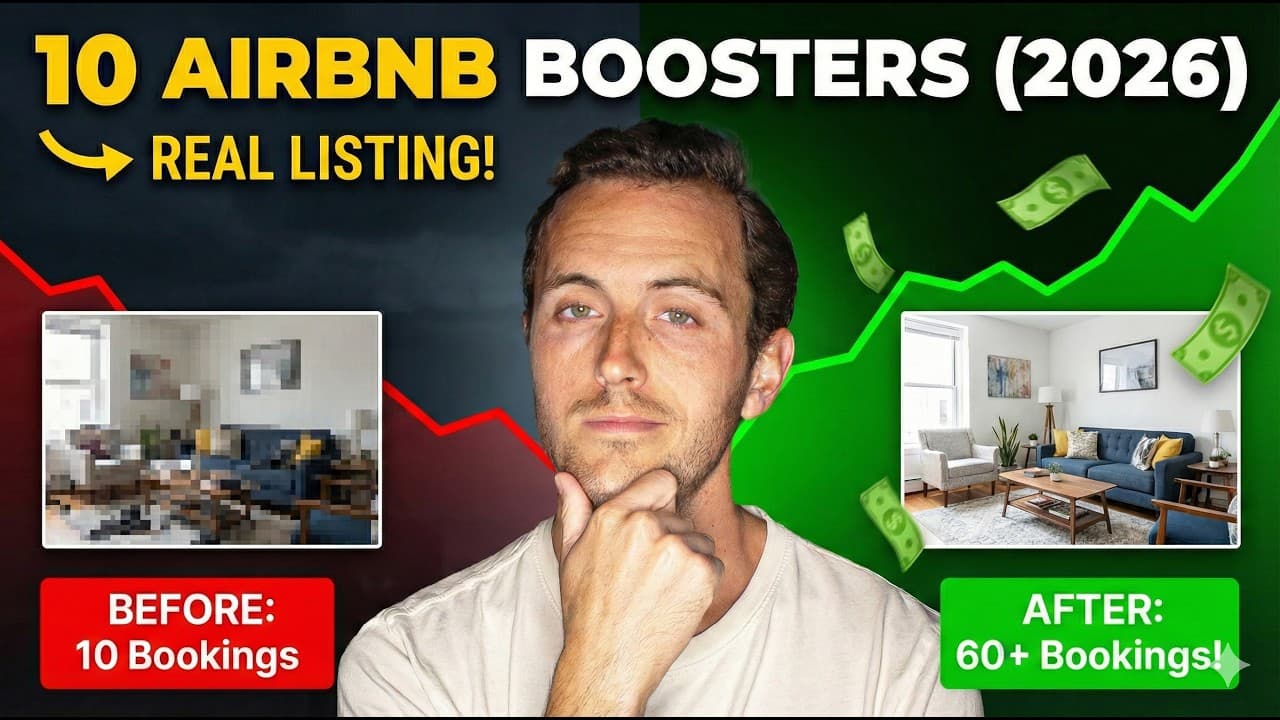
10 ESSENTIAL Steps to Improve Your Airbnb in 2026 (Real Listing Example!)
Most Airbnb listings lose bookings to the same fixable mistakes: bad photos, weak headlines, incomplete amenities, and missed seasonal opportunities. Here are 10 proven strategies to turn any underperforming listing into a consistent booking machine in 2026.
January 1, 2026 · 11 min read

10 Game-Changing Hacks to Improve Your Airbnb
What does it really mean to run a successful Airbnb in 2026? These 10 practical hacks — including a $15 sensor that prevented $44,000 in property damage — show exactly what separates top hosts from average ones.
January 16, 2025 · 9 min read

10 Tips to Get More Views on Airbnb
More views mean more bookings, and more bookings mean more revenue. This guide breaks down 10 actionable Airbnb listing optimization strategies that help hosts climb the search rankings and fill their calendars in 2026.
March 26, 2024 · 14 min read