Real Airbnb Pros and Cons – Is It Too Late Get Started on Airbnb?
By James Svetec · April 4, 2024 · 9 min read
Part of our Airbnb Hosting 101 guide →
Key Takeaways
- Co-hosting is the lowest-risk way to start on Airbnb — no property purchase or rental required
- Rental arbitrage funded by maxed-out credit cards is a dangerous strategy that can leave hosts deeply in debt
- STR investing builds long-term equity, cash flow, and wealth — but it requires real work to set up properly
- There is no 'set it and forget it' in Airbnb — a learning curve exists regardless of which model you choose
- Once systems and a team are in place, an STR portfolio can be managed in as little as 30–60 minutes per week
Understanding the pros and cons of owning an Airbnb is the most important homework any aspiring host or investor can do before jumping in. There's a growing wave of influencers promising overnight riches with zero effort — and that narrative is doing real damage to people who take it seriously.
This article cuts through the noise and gives you an honest look at what Airbnb actually involves in 2026.
Watch the full video above or keep reading for the complete breakdown.
The Myth vs. Reality of Airbnb Income
Spend 20 minutes on social media and you'll find someone claiming they made $50,000 last month managing Airbnbs from a beach in Bali. What they don't show you is their expense sheet, the three properties that flopped, or the $15,000 in credit card debt they're carrying.
BNB Mastery has been operating in the short-term rental space for nearly a decade — through hosting, co-hosting, investing, and education. That experience makes one thing clear: Airbnb is a legitimate, highly profitable opportunity, but it is not a shortcut. The people who thrive are the ones who go in with accurate expectations.
The goal here isn't to discourage anyone. It's to give you the kind of honest Airbnb pros and cons for hosts and investors that actually helps you make a smart decision.
The Real Pros of Owning an Airbnb
Let's start with the good news — because there genuinely is a lot of it.
Strong Income Potential
A well-run short-term rental in the right market can generate meaningful cash flow. In many markets, a property rented long-term for $2,000/month might generate $4,000–$6,000/month as a short-term rental. That spread is real, and it's why so many investors are drawn to this model.
The key phrase is well-run, right market. STR income is highly dependent on location, property type, pricing strategy, and listing quality. Get those right, and the numbers can be impressive. Get them wrong, and the income evaporates fast.
Multiple Entry Points — Including Low-Cost Ones
One of the most underrated advantages of Airbnb is that you don't need to own property to participate. The co-hosting model lets you manage other people's properties in exchange for a percentage of revenue — often 10–25% depending on the market and scope of services.
For someone starting out, this means building real income and real experience without taking on the financial risk of a property purchase or a rental lease. You can get started with relatively modest investment — some business tools, education, and time.
Long-Term Wealth Building Through STR Investing
For those who do buy properties, short-term rental investing stacks multiple wealth-building mechanisms at once:
- Cash flow — monthly income after expenses
- Principal paydown — your mortgage balance decreases with every payment
- Appreciation — property values tend to rise over time
- Tax advantages — depreciation and expense deductions can reduce taxable income significantly
That combination is hard to beat. It's why STR investing remains one of the most compelling wealth-building strategies available to regular people in 2026 — not just institutional investors. For a deeper look at how equity and appreciation work in your favor, check out this breakdown on making money through equity and appreciation.
More Control Than Long-Term Rentals
STR investors also have more flexibility than traditional landlords. You can block off dates for personal use, adjust pricing in real time, and respond to market conditions much faster. If a tenant stops paying rent in a long-term rental, eviction can take months. With short-term rentals, the guest relationship is transactional and time-limited by design.
The Cons: Why Rental Arbitrage Is Riskier Than You Think
Here's where the honest conversation gets uncomfortable. Rental arbitrage — renting a property from a landlord and then subletting it on Airbnb at a higher rate — is aggressively promoted online as a zero-capital path to Airbnb income. The reality is more complicated.
The Credit Card Arbitrage Trap
A common pitch goes like this: get a business line of credit, max out your credit cards, use that money to cover first month's rent, last month's rent, security deposit, and furniture — then pay it all back with Airbnb revenue. It sounds clever. It's actually a financial landmine.
Here's why the math doesn't work in your favor:
- First month + last month + security deposit on a $3,000/month property = $9,000 upfront
- Furnishing that property conservatively = $8,000–$10,000
- Total debt entering the business: $17,000–$19,000+
- Realistic monthly profit after all expenses on a $3,000/month rental: around $1,000
- Time to break even (ignoring interest): 17–19 months
- With 20–25% annual interest on credit card debt, you're in a hole that keeps getting deeper
And that math only works if the property performs well. There's no guarantee it will. If you've done insufficient research and the property doesn't generate the bookings you projected, that debt doesn't pause — it keeps compounding while your revenue stalls.
For a more thorough take on why this strategy backfires, read why starting Airbnb arbitrage with no money is a trap.
What Rental Arbitrage Actually Requires to Work
Rental arbitrage isn't inherently evil — but it requires disciplined due diligence and, ideally, capital you can afford to lose. That means researching comparable STR revenue in the specific submarket, stress-testing your numbers at lower occupancy rates, and only moving forward if the numbers hold up even in a bad month.
If you're going to pursue arbitrage, use your own money — not borrowed money, and certainly not high-interest revolving debt. Comparing all three Airbnb business models side by side can help clarify whether arbitrage is actually the right fit for your situation.
Co-Hosting: The Lower-Risk Way to Get Started
Co-hosting doesn't get enough credit as a serious business model. The premise is simple: property owners who list on Airbnb often don't want to handle the day-to-day management — guest communication, pricing, cleaning coordination, maintenance issues. You step in and handle all of that in exchange for a percentage of revenue.
The financial risk profile is completely different from arbitrage or investing. You're not on the hook for rent, you're not furnishing anything, and you're not carrying debt. Your main investment is time and education.
What Co-Hosting Actually Looks Like in Practice
A co-host managing five properties at a 15–20% management fee, each generating $3,000/month in revenue, is looking at $2,250–$3,000/month in management income. Scale to ten properties and that becomes $4,500–$6,000/month — without owning a single piece of real estate.
The work involved is real: you need to respond to guests, coordinate cleaners, handle pricing optimization, and occasionally deal with property issues. But with the right systems and tools, this can run efficiently. For hosts looking to build a full co-hosting business, BNB Mastery's Co-Hosting Program provides a step-by-step framework for landing clients and scaling operations.
Free Tool
Grab the Airbnb Nightly Pricing Tool
Grab the exact spreadsheet James uses to set profitable nightly rates — plus a step-by-step setup cheatsheet.
The Learning Curve Still Exists
Co-hosting isn't a passive income stream on day one. There's a learning curve — pricing strategy, guest communication, listing optimization, handling complaints professionally. The first few clients are a training ground whether you like it or not. The way to compress that learning curve is through education, not trial and error at your clients' expense.
STR Investing: Big Upside, Real Responsibilities
Buying properties specifically to operate as short-term rentals is the highest-potential and highest-commitment path. Done correctly, it builds real wealth. Done carelessly, it becomes an expensive lesson.
The Upside Is Legitimate
STR investors consistently outperform long-term rental investors on cash flow per property. The same property generating $1,200/month net as a long-term rental might generate $2,500–$4,000/month net as a well-managed STR. That gap lets investors reach financial independence with fewer properties — meaning less total debt, less leverage, and proportionally less risk.
Investors who want a structured approach to analyzing deals and building a portfolio can explore the BNB Investing Blueprint — a resource built specifically for evaluating STR opportunities with real rigor.
The Workload Is Real, Especially Early On
Running an STR is more demanding than dropping a tenant in and collecting rent for 12 months. You'll deal with guest turnover, cleaning logistics, pricing decisions, platform management, and occasional issues — a damaged item, a noise complaint, a late check-out.
None of these problems are catastrophic. But they require systems. The hosts who complain that STR is too much work typically tried to wing it without building proper infrastructure first.
Those who set up the right tools — a property management system, a reliable cleaning team, automated guest messaging, a dynamic pricing tool — often report spending 30–60 minutes per week per property once everything is running smoothly.
To understand what that hands-off setup actually looks like in practice, this breakdown on building a passive Airbnb system is worth reading.
Picking the Right Property Matters More Than Anything
The biggest mistake STR investors make is buying the wrong property. A mediocre property in a strong STR market will underperform. A great property in the wrong location will underperform.
The property selection and market analysis phase is where most returns are won or lost — before a single guest books a night. See the five biggest mistakes to avoid with Airbnb investing for a detailed look at what goes wrong most often.
How Hard Is It to Run an Airbnb, Really?
This is one of the most common questions from people considering the platform. How hard is it to run an Airbnb? The honest answer is: harder than the gurus say, and easier than the skeptics claim. It depends almost entirely on preparation.
Without Education and Systems: Very Hard
Walking into Airbnb hosting without any preparation is a recipe for avoidable mistakes — underpriced nights, poor guest communication, bad reviews, operational chaos. Those mistakes cost real money and real reputation on the platform.
Hosts who skip the learning phase don't just struggle personally. If they're co-hosting, they're delivering subpar service to property owners who trusted them with a significant asset. That's a problem that compounds quickly.
With the Right Preparation: Very Manageable
The flip side is equally true. Hosts who invest in education — whether through content, courses, or community — compress the learning curve dramatically. They avoid the costly beginner mistakes and build better systems from the start.
Connecting with experienced hosts in a community like the BNB Tribe accelerates that process significantly. Having access to proven playbooks, direct feedback, and a network of operators who've already solved the problems you're facing is a genuine competitive advantage.
Ongoing Management: The Real Picture
For an investor who has built out their infrastructure properly, ongoing Airbnb management is not overwhelming. Automated messaging handles most guest communication. Dynamic pricing tools like PriceLabs or Wheelhouse adjust rates automatically. A reliable cleaning team handles turnovers. The active management time drops to a fraction of what people assume.
The front-loaded effort — setting up systems, vetting cleaners, optimizing the listing, dialing in pricing — is real. But it's a one-time investment that pays dividends across every property you add to your portfolio.
The Bottom Line on Airbnb Pros and Cons
The pros and cons of owning an Airbnb aren't mysterious — they're just often misrepresented. The pros are real: strong cash flow, long-term wealth building, multiple entry points, and more control than traditional real estate.
The cons are equally real: a genuine learning curve, upfront setup work, operational demands, and serious financial risk if you fund your start with high-interest debt.
The hosts and investors who succeed in 2026 aren't the ones who found a magic shortcut. They're the ones who went in with clear eyes, got educated, started with a model that matched their risk tolerance, and built real systems.
Whether that means co-hosting your way to your first $5,000/month, or analyzing STR markets to find your first investment property, the path forward is clear — it just requires actual effort.
Skip the overnight-millionaire content. Focus on fundamentals, pick the right entry point for your situation, and build something that lasts.
Frequently Asked Questions
Is owning an Airbnb profitable in 2026?
Yes, owning an Airbnb can be highly profitable in 2026, but results depend heavily on market selection, property type, pricing strategy, and operational quality. Well-managed properties in strong STR markets regularly generate $2,000–$5,000+ per month in net income, but poorly chosen or mismanaged properties can lose money.
What are the biggest risks of starting an Airbnb?
The biggest risks include choosing the wrong property or market, underestimating operating expenses, and taking on excessive debt to get started. Rental arbitrage funded by credit cards is particularly dangerous — the interest costs can outpace revenue if the property underperforms even slightly.
How hard is it to run an Airbnb as a side business?
It depends on your preparation. Hosts with good systems — automated messaging, dynamic pricing tools, and a reliable cleaning team — often spend 30–60 minutes per week per property in ongoing management. The first few months require significantly more effort to set everything up correctly.
Is Airbnb co-hosting a legitimate business model?
Yes. Co-hosting — managing other people's Airbnb properties for a percentage of revenue — is a well-established model with low startup costs and no requirement to own or rent property. Experienced co-hosts managing 5–10 properties can earn $3,000–$6,000+ per month in management fees.
What is the difference between Airbnb arbitrage and Airbnb investing?
Airbnb arbitrage means renting a property from a landlord and subletting it on Airbnb at a higher rate — you control the property without owning it, but you carry lease obligations. Airbnb investing means purchasing the property outright, which builds equity and appreciation but requires more capital upfront.
Getting started on the right foot matters more than getting started fast. If you want to build an Airbnb business — whether through co-hosting, investing, or hosting your own space — connecting with a community of experienced operators can save you months of trial and error. The BNB Tribe community offers training, proven playbooks, and direct access to hosts who've already solved the problems you're about to face. It's one of the most practical first steps you can take.
Free Tool
Grab the Airbnb Nightly Pricing Tool
Grab the exact spreadsheet James uses to set profitable nightly rates — plus a step-by-step setup cheatsheet.
Ready to get started with Airbnb?
Join 240+ members in BNB Tribe — the community James built for hosts and investors who want real results.
Join BNB TribeMore Articles
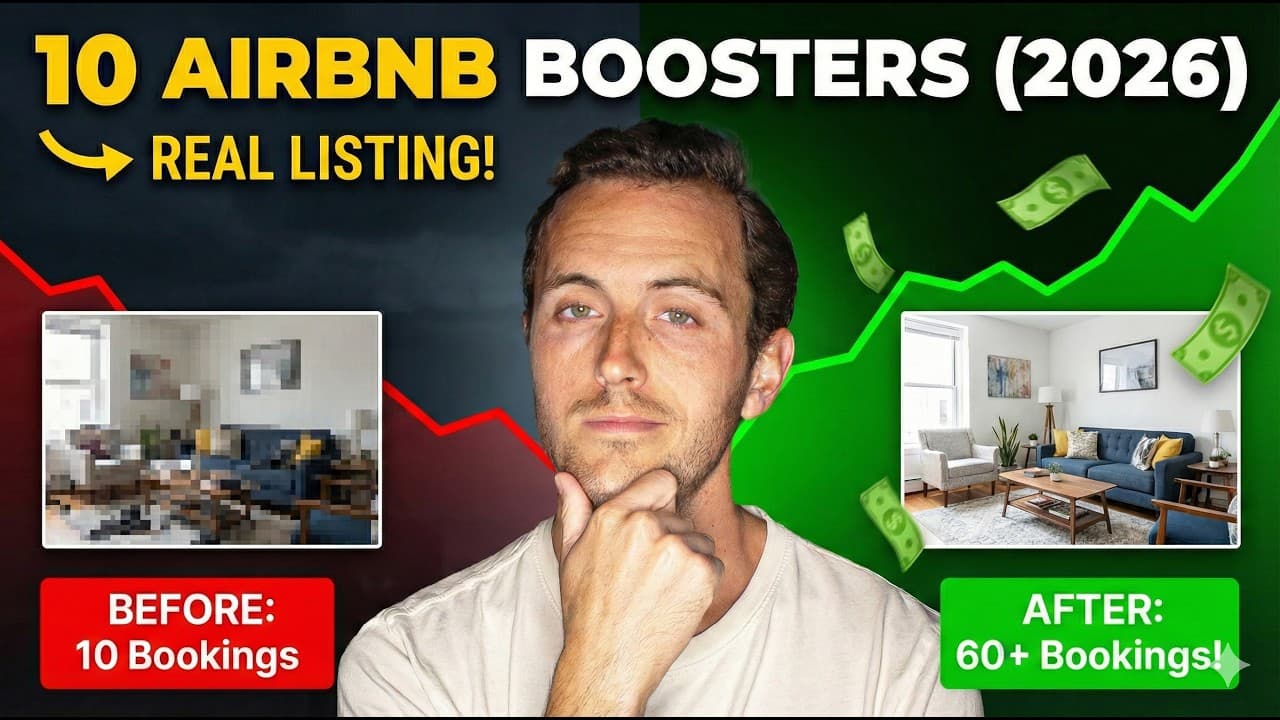
10 ESSENTIAL Steps to Improve Your Airbnb in 2026 (Real Listing Example!)
Most Airbnb listings lose bookings to the same fixable mistakes: bad photos, weak headlines, incomplete amenities, and missed seasonal opportunities. Here are 10 proven strategies to turn any underperforming listing into a consistent booking machine in 2026.
January 1, 2026 · 11 min read

10 Game-Changing Hacks to Improve Your Airbnb
What does it really mean to run a successful Airbnb in 2026? These 10 practical hacks — including a $15 sensor that prevented $44,000 in property damage — show exactly what separates top hosts from average ones.
January 16, 2025 · 9 min read

10 Tips to Get More Views on Airbnb
More views mean more bookings, and more bookings mean more revenue. This guide breaks down 10 actionable Airbnb listing optimization strategies that help hosts climb the search rankings and fill their calendars in 2026.
March 26, 2024 · 14 min read