11 Airbnb Algorithm Tips to 3X Bookings
By James Svetec · December 22, 2025 · 10 min read
Part of our Airbnb Hosting 101 guide →
Key Takeaways
- Your first photo drives 90% of clicks — lead with your best amenity (hot tub, view, pool), not the living room
- Enabling Instant Book with the 'good track record' filter gives your listing a major algorithm boost without compromising guest quality
- Booking velocity matters more than total bookings — 3 bookings in 14 days outranks 10 bookings in 60 days
- Price within 20% of comparable listings — pricing too low signals low quality to both guests and the algorithm
- Regularly refreshing your listing (photos every 3-4 months, description every 60 days) signals active management and earns algorithm preference
If your Airbnb listing isn't getting the traction it deserves, the problem might not be your property — it could be that you're unknowingly triggering the wrong signals in Airbnb's ranking system.
Understanding Airbnb algorithm tips to 3x bookings is one of the highest-leverage things any host can do in 2026, and most of the fixes take less than an hour to implement.
Watch the full video above or keep reading for the complete breakdown.
Photo Strategy: Why Your First Five Photos Are Everything
Most hosts agonize over having 20 stunning photos. The algorithm doesn't care about photo 12. It cares about photos 1 through 5 — and photo one above all others.
Airbnb tracks click-through rates on your cover photo more than almost any other signal. If guests scroll past your listing without clicking, the algorithm interprets that as a lack of demand and pushes you further down the results. The fix is straightforward but counterintuitive: don't lead with your living room. Lead with your best amenity.
- Have a hot tub? That's photo one.
- Stunning mountain view? Photo one.
- Private pool? Photo one.
Photos two through five should tell a sequential story that walks guests through the property. Think of it as a visual tour that builds desire with every swipe. Every image should be bright, high-contrast, and professionally edited. The ROI on professional photography consistently outperforms almost any other listing investment — don't skip it.
Pro tip: Refresh your cover photo every 3-4 months. Stale listings get deprioritized. More on that in the active management section below.
For more tactics on getting more eyes on your listing, see these 10 tips for getting more views on Airbnb.
The Hidden Custom Promotion Feature That Boosts Visibility
Here's a feature that most hosts have never touched: Airbnb's custom promotion tool. This is different from the standard weekly or monthly discount settings. It lives inside your calendar and lets you create targeted promotions for specific dates.
When you use it, the algorithm interprets your action as proactive calendar management and gives promoted listings preference in search results. It's one of the clearest ways to signal to Airbnb that you're an engaged, responsive host.
The best strategy: identify dates that are 30-60 days out and still open. Create a custom promotion for those dates — even a 5-10% discount is often enough to trigger the algorithm boost. The increased visibility leads to more clicks, more bookings, and what becomes a self-reinforcing flywheel of momentum.
This is a classic example of working with the algorithm rather than waiting for it to notice you. Combined with the pricing framework covered later in this article, it's one of the fastest ways to increase Airbnb bookings on underperforming dates.
Instant Book: The Workaround Most Hosts Miss
Many hosts disable Instant Book out of fear — bad guests, no control, property damage. That fear is understandable but largely misplaced, because there's a setting that changes everything.
When you enable Instant Book, you can also enable the "good track record" requirement. With this filter active, only guests who have stayed on Airbnb before without incidents or negative reviews can book instantly. Everyone else still has to send a request that you manually approve.
The result: you get the algorithm boost that comes with Instant Book (Airbnb favors listings that convert browsers into bookers faster), while still filtering out unverified or risky guests. Your Airbnb search ranking can jump noticeably within days of enabling this combination.
This is one of the most underused settings on the entire platform. If you're currently running without Instant Book, this one change alone could move the needle meaningfully on your Airbnb occupancy rate.
Response Rate and Response Time: Don't Get Buried
If your response rate drops below 90%, the algorithm starts deprioritizing your listing. That's well-documented. What surprises most hosts is how much response time matters on top of that.
Hosts who respond to inquiries within one hour get priority placement in search results. Hosts who take more than 24 hours get buried. The algorithm is essentially rewarding hosts who make guests feel attended to, quickly.
The practical solution isn't to be glued to your phone every hour of every day. It's automated message templates that handle common guest questions instantly. A well-built automation can respond to the majority of inquiries within seconds, keeping your response metrics pristine without adding any real workload.
Connecting with other hosts in a community like BNB Tribe gives you access to pre-built, tested messaging templates that handle this automatically — so your response rate stays high even when you're traveling or managing multiple listings.
Pricing Strategy: Why Cheap Listings Lose
Pricing too low is one of the most common and most damaging mistakes in STR management. It doesn't just hurt your revenue — it actively signals to both guests and the algorithm that something is wrong with your property.
High-quality guests — the ones who treat your property well, leave great reviews, and come back — often interpret rock-bottom pricing as a red flag. Meanwhile, the guests most likely to cause problems are exactly the ones drawn to the cheapest option available.
The framework that works: price within 20% of comparable listings in your area. If similar properties are averaging $100/night, your target range is $80-$120. This positions you as a quality option without pricing yourself out of the market.
For a deeper look at how pricing affects your ranking and revenue, this breakdown of Airbnb pricing hacks covers the mechanics in detail. You can also explore 3 Airbnb pricing hacks every host should know for additional strategies.
Calendar Availability and Airbnb Search Ranking
Here's a counterintuitive one: closing your calendar beyond 90 days hurts your Airbnb search ranking. Most hosts do this because they're uncertain about their schedule. The algorithm interprets a closed or short calendar window as limited availability — and gives you less visibility as a result.
The fix is simple: keep your calendar open 12 months in advance and adjust as needed. Set your booking window to accept reservations up to a full year out.
This does more than just boost your ranking. Guests who book 6-12 months in advance tend to be higher quality — they're planners, often traveling for specific events or vacations, and they typically stay longer. These are exactly the guests most hosts want.
Pro tip: If you're worried about long-term scheduling conflicts, use minimum stay requirements or blocked dates strategically rather than shortening your entire booking window. You get the algorithm benefit without locking yourself into anything.
Free Tool
Grab the Airbnb Nightly Pricing Tool
Grab the exact spreadsheet James uses to set profitable nightly rates — plus a step-by-step setup cheatsheet.
Guest Avatar Alignment and Review Signals
Most hosts think the algorithm only cares about your review score. That's only part of the picture. The algorithm also pays attention to who is reviewing you.
If business travelers consistently book your property and leave strong reviews, the algorithm starts showing your listing to more business travelers. If families do the same, you get more family traffic. The review data becomes a matching signal — Airbnb uses it to connect your property with the guests most likely to love it.
This is why guest avatar alignment matters so much at the listing level. If you want business travelers, highlight your fast Wi-Fi, dedicated workspace, and proximity to business districts. If you want families, feature your kid-friendly amenities, safety features, and outdoor space.
Your listing and your marketing should speak directly to one primary guest type. The reviews will follow — and so will the algorithm's matching. For hosts focused specifically on the business travel segment, these 9 steps to maximize bookings with business travelers lay out the full playbook.
Booking Velocity: The Momentum Window
This one surprises most hosts: 3 bookings in 14 days beats 10 bookings in 60 days for algorithm ranking purposes. Airbnb's algorithm heavily weights something called booking velocity — how frequently bookings are coming in during a recent rolling window.
Consistent booking activity signals that your property is in demand right now. If you go more than 1-2 weeks without a booking, you start losing that momentum and the algorithm begins pushing you down in search results.
This is why strategic pricing matters beyond just revenue optimization. Sometimes it's smarter to book a 3-night stay at a slightly reduced rate than to hold out for a full-week booking that might not materialize. The short booking keeps your velocity up, which drives more visibility, which leads to more bookings — a compounding effect.
If your calendar has gone quiet, this guide on what to do when Airbnb bookings slow down covers how to restart your momentum quickly.
Review Frequency: Why Timing Your Review Request Matters
Review scores matter. But review frequency and recency matter almost as much. The algorithm treats a steady stream of recent reviews as proof of consistent guest satisfaction. A property with 200 reviews, the last of which was 8 months ago, ranks lower than a property with 50 reviews earned in the last 90 days.
The single most effective tactic: send your review request within 6 hours of checkout. Not the next day. Not two days later. Within 6 hours, while the experience is still vivid in the guest's mind.
Guests who receive a prompt, personal follow-up message are reportedly three times more likely to leave a review than those who get the standard Airbnb reminder days later.
Your message doesn't need to be long. A genuine, warm note thanking them for their stay and letting them know reviews help your small hosting business is enough. Keep it human, not transactional.
Active Listing Management Signals
The algorithm rewards hosts who show they're engaged. Regular, meaningful updates to your listing tell Airbnb's system that this is an actively managed property worth showing to guests — not a set-it-and-forget-it listing collecting dust.
Here's a practical refresh calendar to follow:
- Every 3-4 months: Update at least one or two photos (especially the cover photo)
- Every 60 days: Refresh your listing description — even minor edits count
- Ongoing: Add new amenities when you install them, update local recommendations, adjust your house manual seasonally
Even small changes — updating your welcome message or adding a new local restaurant recommendation — register as activity signals. This is one of the most underrated Airbnb algorithm tips to 3x bookings because it costs nothing and takes minutes.
For a structured approach to improving your listing from the ground up, these 10 essential steps for improving your Airbnb in 2026 walk through a real listing example with specific fixes.
Conversion Rate: Views Mean Nothing Without Bookings
Here's a fundamental shift in thinking that separates top-performing hosts from average ones: if you're getting views but not bookings, you don't have a visibility problem — you have a conversion problem.
Airbnb tracks your view-to-booking ratio. Listings that convert browsers into bookers at a high rate get rewarded with better placement, which creates more views, which creates more opportunities to convert. A listing converting 5% of views at a lower search position will consistently outperform one converting 1% from a higher position.
The most common conversion killers:
- Pricing too high relative to perceived value
- Photos that don't match the listing description (or vice versa)
- Vague or confusing listing copy that leaves guests with unanswered questions
- Missing amenities that comparable listings offer
This is exactly the approach that helped one host in New Zealand hit 80% occupancy from day one on a new listing.
By optimizing for conversion first — nailing the photos, pricing, and description before launch — the algorithm detected the strong booking rate early and rewarded it with better placement. Visibility came as a result of performance, not the other way around.
Applying Airbnb algorithm tips to 3x bookings in 2026 ultimately comes down to this principle: give the algorithm proof that guests love your property, and it will send you more guests.
For hosts who want a structured way to apply all these strategies — including automated messaging templates, a pricing optimization spreadsheet, and step-by-step implementation guides — the BNB Tribe community provides all of these tools alongside hundreds of fellow hosts actively testing and refining what works right now.
Putting It All Together
Working with Airbnb's algorithm isn't about gaming the system — it's about demonstrating, consistently and repeatedly, that your listing delivers for guests. When your photos convert clicks, your response time is fast, your bookings come in regularly, and your reviews are recent and positive, the algorithm does what it's designed to do: show your listing to more people.
Start with the highest-leverage fixes first. Swap your cover photo to your best amenity. Enable Instant Book with the good track record filter. Send your next review request within 6 hours of checkout. Each of these changes is free and implementable today. The airbnb algorithm tips to 3x bookings that matter most aren't complicated — they're just consistently overlooked.
If your bookings have gone quiet and you're not sure where to start diagnosing the problem, this guide on why your Airbnb listing suddenly stopped getting booked is a good next step.
Frequently Asked Questions
How does the Airbnb algorithm decide which listings to show first?
Airbnb's algorithm weighs multiple factors including click-through rate on your cover photo, response time, booking velocity, review frequency, Instant Book status, and conversion rate. Listings that consistently turn views into bookings get rewarded with higher placement in search results.
Does enabling Instant Book really help your Airbnb ranking in 2026?
Yes — Instant Book remains one of the clearest ranking signals in 2026. Airbnb favors listings that convert browsers into bookers faster. You can enable it safely by turning on the 'good track record' requirement, which filters out guests who lack a clean hosting history.
How often should you update your Airbnb listing to stay visible?
BNB Mastery recommends refreshing your cover photo every 3-4 months, updating your listing description every 60 days, and adding new amenities whenever you install them. Regular updates signal to the algorithm that your property is actively managed and worth prioritizing.
What is booking velocity and why does it matter for Airbnb hosts?
Booking velocity refers to how frequently bookings come in during a short rolling window. Three bookings in 14 days signals stronger demand than 10 bookings spread over 60 days. Maintaining consistent booking momentum keeps your listing ranked higher in Airbnb search results.
What is the best way to increase your Airbnb occupancy rate in 2026?
The most effective combination is optimizing your cover photo, enabling Instant Book with guest filters, pricing within 20% of comparable listings, keeping your calendar open 12 months out, and sending review requests within 6 hours of checkout. These changes work together to boost both visibility and conversion.
Knowing the tactics is one thing — having the tools and community to execute them consistently is another. The BNB Tribe community gives hosts access to automated messaging templates, pricing optimization spreadsheets, and a network of experienced hosts actively using these strategies every day. If you want to apply these algorithm tips with proven systems already built out for you, it's worth exploring what's inside.
Free Tool
Grab the Airbnb Nightly Pricing Tool
Grab the exact spreadsheet James uses to set profitable nightly rates — plus a step-by-step setup cheatsheet.
Ready to get started with Airbnb?
Join 240+ members in BNB Tribe — the community James built for hosts and investors who want real results.
Join BNB TribeMore Articles
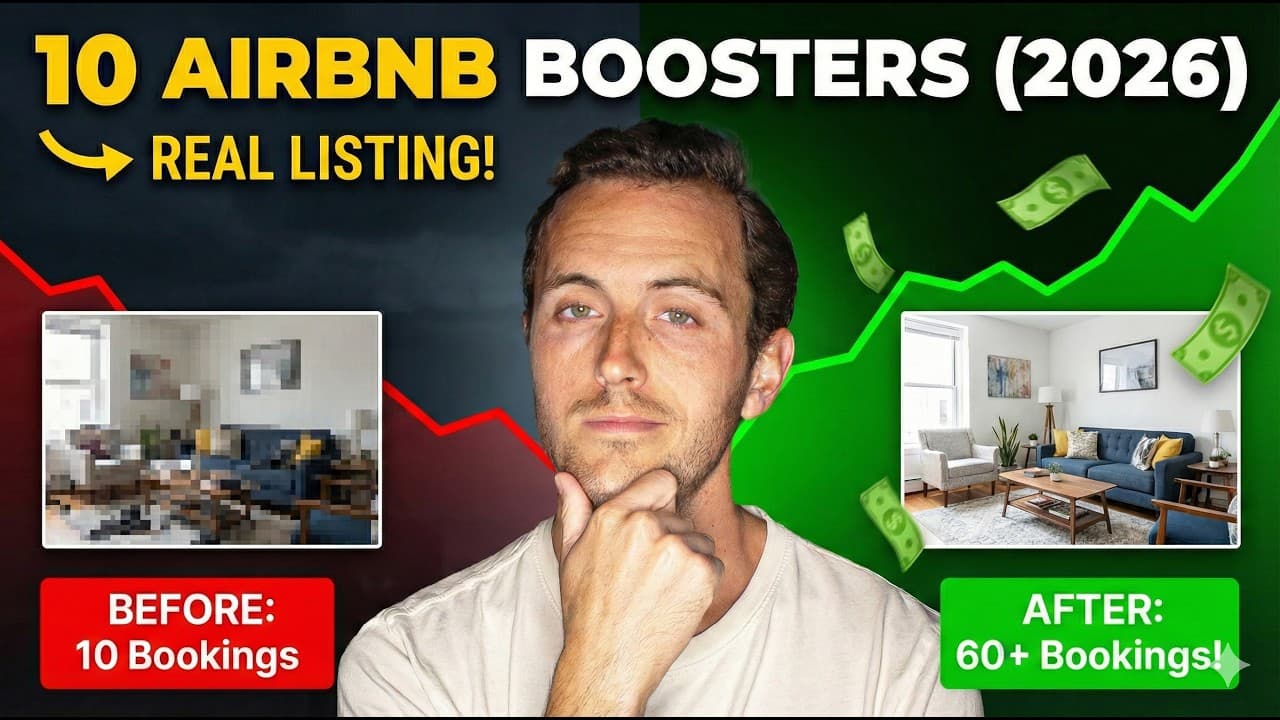
10 ESSENTIAL Steps to Improve Your Airbnb in 2026 (Real Listing Example!)
Most Airbnb listings lose bookings to the same fixable mistakes: bad photos, weak headlines, incomplete amenities, and missed seasonal opportunities. Here are 10 proven strategies to turn any underperforming listing into a consistent booking machine in 2026.
January 1, 2026 · 11 min read
10 Game-Changing Hacks to Improve Your Airbnb
What does it really mean to run a successful Airbnb in 2026? These 10 practical hacks — including a $15 sensor that prevented $44,000 in property damage — show exactly what separates top hosts from average ones.
January 16, 2025 · 9 min read
10 Tips to Get More Views on Airbnb
More views mean more bookings, and more bookings mean more revenue. This guide breaks down 10 actionable Airbnb listing optimization strategies that help hosts climb the search rankings and fill their calendars in 2026.
March 26, 2024 · 14 min read