Airbnb Properties That Make the MOST Money (Hidden Opportunities)
By James Svetec · June 26, 2025 · 10 min read
Part of our Airbnb Hosting 101 guide →
Key Takeaways
- Urban studios offer 15–20% cash-on-cash returns and double as profitable mid-term rentals for traveling nurses, corporate relocations, and digital nomads.
- Experience-based properties can outperform competitors with under $2,000 in upgrades — think stargazing decks, not just treehouses.
- ADU properties (main house + accessory dwelling unit) can generate 40% more revenue than comparable single-unit listings by offering flexible rental configurations.
- Niche market properties near hospitals or corporate HQs can hit 95% occupancy with near-zero marketing spend.
- Luxury properties in secondary markets cost roughly one-third of major-city equivalents while commanding similar peak-season rates due to scarce competition.
Choosing the right property type is the single biggest factor determining how much money an Airbnb investment actually makes — and most hosts get it wrong. Understanding which Airbnb properties make the most money in 2026 is not about chasing trends; it is about identifying structural advantages that produce strong returns across market cycles.
Watch the full video above or keep reading for the complete breakdown.
Urban Studios: Small Units, Outsized Returns
The knee-jerk reaction to urban studios is predictable: they are too small, nightly rates are capped, and the ROI math never works out. That reaction is wrong — and it is costing investors real money.
Well-positioned studios in central business districts are generating 15 to 20% cash-on-cash returns for hosts who understand how to use them. The lower purchase price is the first lever. Less capital deployed means the same gross revenue translates into a meaningfully higher percentage return compared to a larger, pricier unit.
The Mid-Term Rental Backup Strategy
The more powerful advantage is flexibility. Studios are ideal candidates for mid-term rentals — stays of 30 to 180 days — which sidestep many of the operational headaches that come with nightly bookings. The mid-term guest profile includes:
- Traveling nurses on 3-to-6-month hospital contracts
- Corporate relocations lasting one to six months
- Digital nomads who want to base themselves in a city for a season
Fewer turnovers mean lower cleaning costs, less wear on furnishings, and dramatically reduced management time. During slow seasons in competitive STR markets, a mid-term pivot can actually produce higher monthly revenue than short-term bookings — with less effort.
What Makes a Studio Actually Work
Setup matters enormously. A studio set up for overnight stays will underperform one designed for a two-month stay. The essentials:
- A real desk and ergonomic chair — not a side table with a barstool
- Fast, reliable Wi-Fi — non-negotiable for any professional guest
- A well-equipped kitchenette stocked for actual cooking, not just reheating
- Minimal, functional furniture — do not cram a dining set into 400 square feet
Location anchors everything. Proximity to a central business district, major hospitals, or an entertainment district gives the property appeal across multiple guest segments simultaneously. For hosts evaluating studio opportunities, the optimal Airbnb property size analysis provides a useful framework for thinking through unit configurations.
Connecting with other hosts navigating the mid-term versus short-term decision inside the BNB Tribe community can shortcut months of trial and error — members share live market data on what is actually working city by city.
Experience-Based Properties: Sell the Memory, Not the Bedroom
Travel has shifted. Guests are not booking a place to sleep — they are booking a story to tell. Experience-based properties capitalize on this shift, and the ROI on a well-executed experience addition is frequently absurd.
Consider a two-bedroom house about an hour outside Denver — nothing architecturally special, just a clean property in a low-light-pollution area. The host added a stargazing deck with netting, pillows, and blankets, had a photographer capture night-sky photos for the listing, and relisted the property around that central experience.
The total investment was under $2,000. The result: they outperformed every competitor in the area and earned Airbnb's Guest Favorite badge based on reviews alone.
You Do Not Need a Treehouse
Experience properties are not limited to quirky novelty builds. The principle applies broadly:
- A lakefront cabin that adds a kayak and paddleboard package
- A desert home with an outdoor hot tub and fire pit positioned around stargazing
- A mountain property with a sauna or cold plunge setup
- A beach house that provides surfboard rentals and a surf lesson hookup with a local instructor
The investment is low. The pricing power is high. Guests who are buying an experience are far less price-sensitive than guests shopping for the cheapest available bedroom in a market.
Pro tip: Build the experience into your listing title and photos first. A great experience that is invisible in the listing generates zero premium. For tactical advice on how amenity upgrades translate into booking revenue, the breakdown of affordable ways to make more money on Airbnb covers several high-ROI additions hosts frequently overlook.
ADU Properties: The Multi-Unit Strategy Most Investors Overlook
Multi-unit properties are not a new idea. But most investors think in terms of duplexes, triplexes, or apartment buildings — all of which come with their own regulatory and operational complications. The smarter version of the multi-unit strategy in 2026 is the ADU (accessory dwelling unit) model.
An ADU is a separate, self-contained unit on the same property as a primary residence — a detached guest house, a converted garage apartment, or a standalone studio on a larger lot. The separation is the point. Unlike a duplex, guests in the two units do not share walls, entrances, or hallways. Noise complaints disappear. Privacy is genuinely delivered.
Three Ways to Operate an ADU Property
- Rent the ADU only, keep the main house for personal use or family
- Rent both units separately to two different guest groups, maximizing revenue per night
- Rent both units combined to a single large group at a premium rate — ideal for weddings, family reunions, and corporate retreats
One BNB Tribe member purchased a three-bedroom house with a separate two-bedroom wing. During most of the year, they rent both units independently. The main house attracts families; the smaller wing draws couples and business travelers.
During peak season and major local events, they bundle both units as a single booking and charge a combined rate that reflects the added value of private, adjacent space. The result: 40% more revenue than comparable single-unit properties in the same area.
The common mistake with ADU properties is failing to differentiate the two units. Making the ADU too similar to the main house undercuts its standalone appeal. Making it too sparse means it will underperform as its own listing.
Each unit needs its own identity, its own amenity set, and its own listing photos. For hosts thinking about how to scale from a single property to multiple income streams, the guide on the best type of property for Airbnb investing offers a broader framework worth reviewing.
Niche Market Properties: Own a Category, Not Just a Listing
The most overlooked insight in STR investing is that tourist areas are not the only source of reliable demand. Niche market properties target steady, recurring guest segments that most hosts completely ignore — and that predictability is worth more than seasonal spikes in many cases.
The clearest example: a property positioned next to a major hospital. The typical investor skips this location because it is not a tourist corridor. That is the opportunity. A hospital generates a constant flow of guests with urgent accommodation needs:
- Patients' families who need to stay close for weeks at a time
- Physicians and nurses on temporary rotations
- Medical equipment representatives in town for training
- Clinical trial participants requiring extended local stays
One host who recognized this dynamic added blackout curtains for night-shift workers, a dedicated workspace for medical professionals, and — critically — partnered with the hospital directly to be listed as a recommended accommodation. The outcome: 95% occupancy with virtually no marketing spend. The hospital sends guests directly.
Free Tool
Grab the Airbnb Nightly Pricing Tool
Grab the exact spreadsheet James uses to set profitable nightly rates — plus a step-by-step setup cheatsheet.
Other Niche Markets Worth Targeting
- Properties near corporate headquarters or regional office campuses
- Properties adjacent to specialty training facilities (military bases, aviation schools, trade academies)
- Properties that cater specifically to traveling sports teams — groups that book multiple rooms and return seasonally
- Properties near universities during graduation, parents' weekends, and athletic events
Niche positioning also creates a natural moat. Once a host has the only STR in a hospital corridor with a partnership referral agreement, replication is difficult. That is a durable competitive advantage most vacation rental investors never build.
For a deeper look at how this plays out in practice, the most profitable niche on Airbnb is worth reading alongside this section.
Airbnb Properties That Make the Most Money: Luxury in Secondary Markets
This is the category generating the most excitement inside the BNB Tribe community right now — and the one most investors reflexively dismiss before they understand the math. Luxury properties in secondary markets represent one of the clearest supply-demand inefficiencies in short-term rentals today.
The conventional logic sends everyone to the same markets: Miami, Los Angeles, Nashville, Scottsdale. Competition is fierce, purchase prices are sky-high, and luxury inventory is abundant. Secondary markets — mid-size cities without a dominant tourism brand — are a different story.
Wealthy travelers exist everywhere. They attend college graduations in mid-size Midwest cities. They visit regional corporate headquarters. They travel to weddings, family events, and private gatherings in markets that have almost no luxury rental inventory.
When a luxury hotel sells out during a major event, and the only alternative is a standard Airbnb, a truly high-end listing can charge rates that rival top-tier properties in coastal metros.
The Numbers That Make This Work
A BNB Tribe member purchased a luxury home in a mid-size Midwestern city — designer furniture, premium appliances, a home theater — and paid roughly one-third of what an equivalent property would cost in Chicago or Miami. During major local events, the property commands premium nightly rates with no competition.
During non-peak periods, it still attracts CEOs visiting local companies, high-net-worth individuals attending weddings, and families who expect a certain standard of accommodation regardless of geography.
One BNB Tribe member recently generated over $31,000 from a single booking using this exact strategy — an outcome that would be near-impossible in an oversupplied luxury market where the next competing listing is two blocks away.
The key variables to evaluate before committing to this strategy:
- Event calendar density — how many high-demand weekends per year does the market generate?
- Existing luxury inventory — how many comparable STR listings already exist?
- Corporate presence — are there Fortune 500 headquarters or regional offices driving year-round executive travel?
- Acquisition cost relative to revenue potential — the lower price point needs to justify the investment even in off-peak months
Investors who want a structured approach to evaluating deals like this — including how to model event-based revenue and identify undersupplied market segments — should explore the BNB Investing Blueprint, which provides the analytical framework for running these numbers before making an offer.
For a real-world look at what a top-performing luxury STR actually produces, the property tour of a $1.1M per year Airbnb breaks down exactly what high-earning properties are doing differently.
How to Choose the Right Property Type for Your Market
Knowing about Airbnb properties that make the most money in 2026 is only useful if you can match the right strategy to the right market. There is no universal answer — a stargazing deck is worthless in a dense urban core, and a hospital-adjacent studio is irrelevant in a remote mountain town.
The starting framework for any market analysis:
- Identify your demand drivers. What brings people to this market? Events, healthcare, corporate travel, tourism, nature access? Each demand type aligns with a different property category.
- Audit existing supply. Where are the gaps? A market saturated with standard vacation homes may have almost no luxury inventory and no niche-positioned properties.
- Model multiple rental strategies. Before purchasing, run projections for short-term, mid-term, and — if an ADU is involved — combined rental scenarios. The numbers should work in at least two configurations.
- Evaluate entry cost vs. revenue ceiling. A studio in a business district at $180,000 generating $2,800/month is a different risk profile than a luxury secondary-market home at $600,000 generating $8,000/month. Both can make sense — but only if you have done the math correctly.
Hosts who try to skip the analysis stage and buy on instinct are the ones who end up with the wrong property in the wrong market. For a look at the most common errors investors make at this stage, the biggest mistake Airbnb investors make is a useful counterpoint to the optimism that property research naturally generates.
Pricing strategy is the other lever most hosts underuse. Even the right property in the right market will underperform if it is priced incorrectly. The guide on how to price your Airbnb to make bank covers the mechanics of dynamic pricing in detail.
Final Thoughts
The hosts generating the strongest returns in 2026 are not necessarily the ones with the biggest budgets or the most famous markets. They are the ones who identified a structural mismatch between what guests need and what the market is supplying — then built a property around that gap.
Whether that means a studio with a mid-term rental backup, an experience-centered listing that charges double what the competition earns, an ADU that generates 40% more revenue through flexible configurations, a niche property running at 95% occupancy without advertising, or a luxury secondary-market home that books out entirely during events — the common thread is strategic thinking before the purchase decision.
Understanding how to find Airbnb properties that make the most money comes down to analysis, not intuition. Do the demand research. Map the supply gaps. Model multiple revenue scenarios. And once you have the property, optimize the setup, the experience, and the pricing relentlessly.
Frequently Asked Questions
What types of Airbnb properties make the most money in 2026?
The highest-earning Airbnb properties in 2026 include urban studios with mid-term rental flexibility, experience-based properties, ADU (accessory dwelling unit) setups, niche-market properties near hospitals or corporate campuses, and luxury homes in secondary markets where high-end supply is scarce.
How much can an urban studio Airbnb realistically earn?
Well-positioned urban studios are generating 15 to 20% cash-on-cash returns for hosts who combine short-term and mid-term rental strategies. Monthly revenue varies significantly by market, but the lower acquisition cost is the key driver of strong percentage returns.
What is an experience-based Airbnb property?
An experience-based property is one where the unique activity or atmosphere — stargazing, hot springs access, a private sauna — is the primary selling point, not just the accommodation itself. These properties command higher nightly rates because guests are paying for a memory, not just a bed.
Why are luxury Airbnbs in secondary markets so profitable?
Secondary markets have far less luxury short-term rental inventory than major cities, yet wealthy travelers visit them for events, corporate trips, and family occasions year-round. Lower property acquisition costs combined with premium pricing during high-demand events creates strong ROI that is difficult to replicate in oversupplied primary markets.
What is an ADU property and why is it good for Airbnb investing?
An ADU (accessory dwelling unit) is a separate living space on the same lot as a primary residence. For Airbnb hosts, it enables three rental configurations — the ADU alone, both units separately, or both combined for large groups — which can increase revenue by 40% or more compared to a standard single-unit listing.
Identifying the right property type is only half the equation — knowing how to analyze a deal before you buy is what separates profitable investors from expensive mistakes. The BNB Investing Blueprint gives you the exact framework for modeling returns across multiple rental strategies so you can make confident purchase decisions. And if you want to tap into real data from hosts already running these strategies in markets across the country, the BNB Tribe community is where those conversations are happening every day.
Free Tool
Grab the Airbnb Nightly Pricing Tool
Grab the exact spreadsheet James uses to set profitable nightly rates — plus a step-by-step setup cheatsheet.
Ready to get started with Airbnb?
Join 240+ members in BNB Tribe — the community James built for hosts and investors who want real results.
Join BNB TribeMore Articles
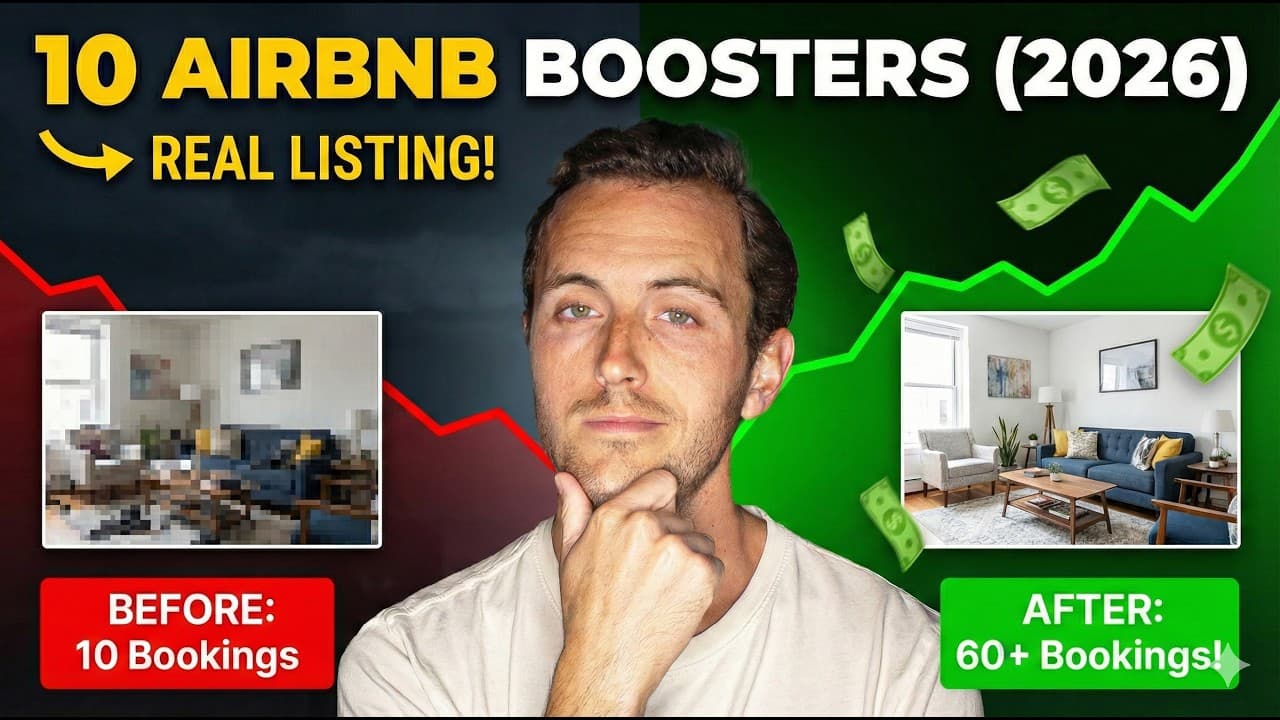
10 ESSENTIAL Steps to Improve Your Airbnb in 2026 (Real Listing Example!)
Most Airbnb listings lose bookings to the same fixable mistakes: bad photos, weak headlines, incomplete amenities, and missed seasonal opportunities. Here are 10 proven strategies to turn any underperforming listing into a consistent booking machine in 2026.
January 1, 2026 · 11 min read

10 Game-Changing Hacks to Improve Your Airbnb
What does it really mean to run a successful Airbnb in 2026? These 10 practical hacks — including a $15 sensor that prevented $44,000 in property damage — show exactly what separates top hosts from average ones.
January 16, 2025 · 9 min read

10 Tips to Get More Views on Airbnb
More views mean more bookings, and more bookings mean more revenue. This guide breaks down 10 actionable Airbnb listing optimization strategies that help hosts climb the search rankings and fill their calendars in 2026.
March 26, 2024 · 14 min read