Airbnb trends 2023 – My top 5 predictions
By James Svetec · February 16, 2023 · 9 min read
Part of our Airbnb Hosting 101 guide →
Key Takeaways
- Cottage and staycation markets remain strong but require smarter buying decisions — inflated pandemic-era prices are correcting, creating real buying opportunities.
- Urban markets are seeing a resurgence driven by international travel recovery and longer remote-work stays.
- Unique properties with standout amenities (hot tubs, game rooms, geodesic domes) consistently outperform plain listings.
- Pricing is no longer set-and-forget — a data-driven strategy is now essential to avoid leaving revenue on the table.
- Distressed sellers and motivated owners are creating some of the best STR buying opportunities in years.
Hosting on Airbnb has never been more dynamic — or more demanding. What worked automatically two years ago now requires deliberate strategy, sharper market awareness, and a clear-eyed view of what guests actually want.
Whether you're an established Airbnb host, an investor eyeing your first property, or someone exploring an Airbnb co host arrangement, understanding where the market is heading gives you a genuine edge.
Watch the full video above or keep reading for the complete breakdown.
Market Trends: Where the Opportunities Are
Not all Airbnb markets are equal right now — and understanding the distinction between cottage markets and urban markets could mean the difference between a profitable portfolio and a costly mistake.
Cottage and Staycation Markets
Cottage markets — think lakeside retreats, mountain cabins, beachfront escapes, and properties near national parks — saw explosive growth during the pandemic years. Demand surged because international travel was off the table. Revenues skyrocketed. Owners could price almost anything at any rate and still get booked.
That era is over. International travel has rebounded, and staycation demand has normalized. These markets are still solid performers by historical standards — revenues remain well above pre-pandemic baselines — but the easy money is gone. Anyone who purchased at peak 2021 or 2022 prices likely overpaid significantly.
The good news? Prices in many cottage markets have corrected. That creates real buying opportunities for disciplined investors who run the numbers properly. If you haven't looked at how to evaluate a deal in this environment, the guide on how to analyze a short-term rental property is worth reading before you make any offers.
Urban Markets Are Rebounding
Traditional urban markets — cities that attract business travelers, international tourists, and cultural visitors — are picking back up in a meaningful way. As international travel fully normalizes, city-based listings are seeing stronger occupancy and longer average stays.
For Airbnb hosts who own or manage urban properties, this is a welcome shift. It also opens the door for co-hosts and property managers looking to add urban units to their portfolio without the same level of competition that cottage markets attracted during the pandemic boom.
Connecting with other hosts navigating this shift can sharpen your perspective quickly. The BNB Tribe community is a good place to compare notes with hosts managing properties across different market types.
Stay Length: What Guests Actually Want
One of the most discussed trends in the short-term rental world is the shift toward longer stays. The reality is more nuanced than the headlines suggest.
Remote work has absolutely changed travel behavior. More people have the flexibility to combine work and travel — spending weeks or even months in a new location. But where they want to do that matters enormously.
Urban Areas Attract Longer Stays
When someone plans to work remotely for a month, they typically want to be somewhere with reliable internet, easy access to groceries, rideshare availability, and walkable amenities. Urban apartments check all those boxes. A remote cabin two hours from the nearest coffee shop does not.
This means hosts in cities should actively optimize their listings for longer stays — 14 to 30 nights or more. Offering weekly and monthly discounts, highlighting fast Wi-Fi, and setting up a dedicated workspace can significantly increase your average booking length and reduce turnover costs.
Rural and Cottage Markets Stay Short
In contrast, rural and staycation-style markets continue to see optimal stay lengths of three to seven nights. Guests visiting these areas are there for a break — a long weekend, a family reunion, a group getaway. They're not trying to hold a Zoom meeting from a lakeside dock.
Understanding this distinction helps you set smarter minimum night requirements and avoid the trap of chasing long stays in markets where they don't naturally occur.
Property Types That Win in 2026
If there's one shift that's reshaping how the best Airbnb hosts approach their listings, it's this: unique properties with exceptional amenities consistently outperform standard listings.
Think about what actually drives someone to book an Airbnb over a hotel. For solo travelers or couples, a hotel is often more convenient and comparably priced. The calculation changes completely when group size increases.
Six, eight, or ten people can't easily split across hotel rooms — but they can share a beautiful lakefront home with a private hot tub, a game room, and enough bedrooms for everyone.
Amenities That Move the Needle
The amenities that generate the strongest guest interest — and justify premium pricing — include:
- Hot tubs and saunas — consistently among the highest-ROI additions
- Private pools — particularly in warm-weather markets
- Game rooms and entertainment spaces — great for group bookings
- Home theaters — increasingly popular for family and group stays
- Outdoor kitchens and fire pits — extend usable seasons and add atmosphere
Even if you don't own the property, as an Airbnb co host or property manager, you can advise owners on exactly these upgrades. A hot tub that costs $8,000 to install can easily generate an additional $10,000 to $15,000 in annual revenue in the right market.
Unique Stays Occupy a Different Category
Geodesic domes, treehouses, converted barns, and other truly unique accommodations are essentially competition-proof. A couple deciding between a standard apartment listing and a geodesic dome with a stargazing skylight isn't really comparing similar options — they're in entirely different categories.
Airbnb has actively promoted unique stays on its platform, and that trend is accelerating. If you're evaluating which property to buy or which listings to pursue as a co-host, the best type of property for Airbnb investing comes down to differentiation, amenities, and group appeal.
For a deep look at adding something truly distinctive, check out this breakdown on adding a geodesic dome ADU to your Airbnb.
Pricing Strategy Is Now a Core Skill
This is where many hosts are getting caught flat-footed in 2026. During the pandemic boom, pricing almost didn't matter. Demand was so far ahead of supply in most markets that you could set rates manually, check in occasionally, and still fill your calendar.
That dynamic no longer exists. And hosts who are still treating pricing as a set-it-and-forget-it task are leaving significant money on the table — or worse, sitting on empty calendars.
Free Tool
Grab the Airbnb Nightly Pricing Tool
Grab the exact spreadsheet James uses to set profitable nightly rates — plus a step-by-step setup cheatsheet.
What a Data-Driven Pricing Approach Looks Like
Effective pricing today requires tracking local demand signals, competitor rates, and seasonal patterns in real time. Dynamic pricing tools — software platforms that automatically adjust your nightly rate based on demand — have gone from a nice-to-have to effectively a necessity for any serious host.
The core principles of a solid pricing strategy include:
- Set a competitive base rate — Research comparable listings in your market, not just nationally
- Use dynamic pricing software — Tools like PriceLabs adjust rates automatically based on real-time demand data
- Apply minimum price floors — Never drop below your break-even rate, regardless of software suggestions
- Adjust manually around local events — Algorithms don't always catch niche local demand spikes
- Review performance weekly — Look at your occupancy rate and revenue per available night (RevPAN) against comparable listings
For a practical walkthrough, the article on Airbnb pricing hacks every investor and host should know covers the fundamentals well. And if you want to go deeper on specific software, the guide to using PriceLabs for your Airbnb is a solid starting point.
Pro tip: An occupancy rate above 70-75% in most markets suggests you might be priced too low. If you're fully booked weeks out, test raising your rates — you're almost certainly leaving revenue behind.
Buying and Selling: Why Now Is a Real Opportunity
For investors thinking about entering the short-term rental space or expanding an existing portfolio, current market conditions are creating genuine opportunities that haven't existed in several years.
Two forces are pushing more motivated sellers into the market. First, higher interest rates have squeezed landlords who bought at low rates and are now facing refinancing or carrying costs they can't sustain.
Second, inexperienced hosts who got into the space during the excitement of 2020-2022 — and overpaid significantly — are now realizing the numbers don't work at the prices they paid.
What This Means for Buyers
More supply, more motivated sellers, and softening prices in many markets create a classic buyer's market. One example from within the BNB Mastery community: a member recently purchased a fully turnkey short-term rental — already operational, with active bookings — for $50,000 below asking price. That kind of deal was essentially impossible 18 months ago.
Warren Buffett's principle applies directly here: be greedy when others are fearful. Many sellers right now are fearful. They're watching interest costs rise, seeing their occupancy rates normalize, and questioning whether to hold or exit. That pressure creates negotiating room for disciplined buyers.
The key is knowing which deals actually pencil out. Emotions got a lot of people into trouble during the boom — paying whatever it took to get into a hot market. The right move is running an honest ROI analysis on every potential deal before making an offer.
Investors who want a structured framework for evaluating STR deals should explore the beginner's guide to Airbnb investing or consider the BNB Investing Blueprint, which provides the exact analytical tools needed to find properties that generate genuine returns.
For a realistic look at what can go wrong, the article on big mistakes to avoid with Airbnb investing is required reading before you put in any offers.
Co-Hosting and the Airbnb Hosting Service Model
Not everyone wants to own property. Co-hosting — managing Airbnb properties on behalf of other owners in exchange for a percentage of revenue — has become one of the most accessible and scalable ways to build income in the short-term rental space.
An experienced Airbnb co host typically earns 15-25% of gross booking revenue per property. Manage five properties averaging $3,000 per month each, and you're looking at roughly $2,250 to $3,750 in monthly management income — without owning a single piece of real estate.
Why the Co-Hosting Model Makes Sense Right Now
As more owners struggle with pricing, occupancy, and day-to-day operations, the demand for competent professional management is growing. Many property owners would rather hand over management to a skilled co-host than deal with the complexity themselves — especially as the market requires more active oversight.
The Airbnb hosting service model also provides a lower barrier to entry than direct ownership. You're not taking on mortgage risk, interest rate exposure, or large capital outlays. You're selling your operational expertise — and in 2026, operational expertise is worth a lot.
Hosts who use their Airbnb host login daily to manage guest communications, pricing, and calendar optimization are the ones building reputations that attract more client properties. Systematizing those operations is what separates a one-property manager from someone running 15 listings efficiently.
For hosts looking to build a full co-hosting business — from landing the first client to scaling a multi-property operation — BNB Mastery's Co-Hosting Program provides a step-by-step framework for making that happen.
Final Thoughts on Hosting on Airbnb in 2026
Hosting on Airbnb in 2026 rewards hosts who treat it like a real business — not a passive income tap. The fundamentals are strong. Unique properties with great amenities book well. Urban markets are gaining momentum. And for investors with cash and conviction, distressed sellers are creating some of the best acquisition opportunities in years.
The critical shift is that skill now matters more than timing. Pricing, property differentiation, market selection, and operational systems separate the hosts who thrive from those who plateau or exit. Understanding the current trends shaping the Airbnb market is step one — acting on them strategically is what actually builds wealth.
Whether you're optimizing an existing listing, evaluating a new market, or considering the co-hosting path, staying informed and connected to experienced operators is what keeps you ahead. Hosts who are serious about results tend to get there faster with the right guidance and community around them.
Frequently Asked Questions
Is hosting on Airbnb still profitable in 2026?
Yes, but profitability now depends more on strategy than market timing. Hosts who invest in unique amenities, use dynamic pricing tools, and choose markets carefully can generate strong returns. The easy-money era is over, but disciplined operators are still doing very well.
What types of properties perform best on Airbnb right now?
Unique properties with standout amenities — hot tubs, game rooms, private pools, and distinctive designs like geodesic domes — consistently outperform standard listings. Properties that cater to group bookings of 5 or more guests have the strongest competitive advantage over hotels.
What is an Airbnb co host and how do they get paid?
An Airbnb co host manages a property on behalf of the owner, handling guest communications, pricing, cleaning coordination, and operations. Co-hosts typically earn 15–25% of gross booking revenue per property, without needing to own any real estate themselves.
How important is pricing strategy for Airbnb hosts in 2026?
Pricing is now one of the most critical skills for any Airbnb host. With demand normalized post-pandemic, properties with static or poorly optimized pricing will sit vacant. Dynamic pricing software and regular rate reviews are essential for maintaining strong occupancy and revenue.
Are there good buying opportunities in short-term rental markets right now?
Yes. Rising interest rates and corrections in pandemic-inflated property prices are forcing some owners to sell. Buyers with solid ROI analysis and patience are finding deals that were essentially unavailable during the 2020–2022 boom, including turnkey properties well below previous asking prices.
The gap between a mediocre STR and a consistently high-performing one almost always comes down to systems — pricing, operations, and market knowledge. If you want to sharpen those skills alongside other serious hosts, the BNB Tribe community connects you with experienced operators who are actively managing properties and navigating the same market conditions you're facing. It's the fastest way to stop guessing and start making decisions with confidence.
Free Tool
Grab the Airbnb Nightly Pricing Tool
Grab the exact spreadsheet James uses to set profitable nightly rates — plus a step-by-step setup cheatsheet.
Ready to get started with Airbnb?
Join 240+ members in BNB Tribe — the community James built for hosts and investors who want real results.
Join BNB TribeMore Articles
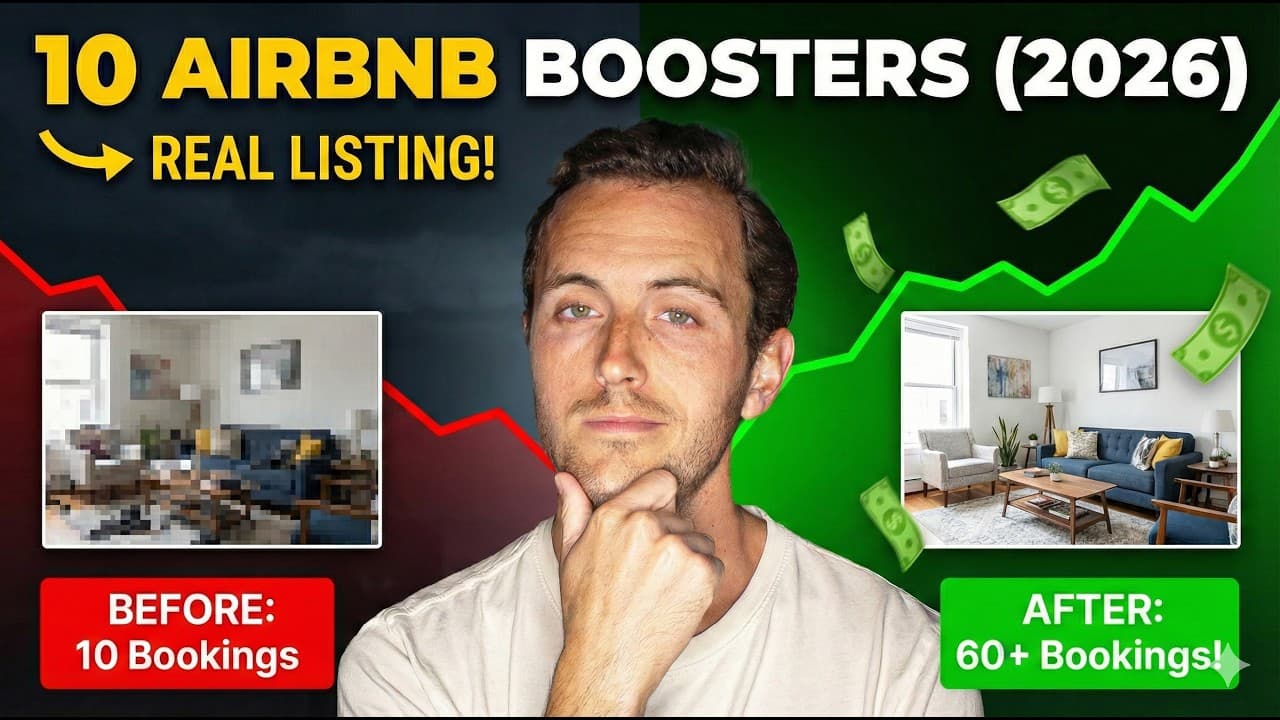
10 ESSENTIAL Steps to Improve Your Airbnb in 2026 (Real Listing Example!)
Most Airbnb listings lose bookings to the same fixable mistakes: bad photos, weak headlines, incomplete amenities, and missed seasonal opportunities. Here are 10 proven strategies to turn any underperforming listing into a consistent booking machine in 2026.
January 1, 2026 · 11 min read

10 Game-Changing Hacks to Improve Your Airbnb
What does it really mean to run a successful Airbnb in 2026? These 10 practical hacks — including a $15 sensor that prevented $44,000 in property damage — show exactly what separates top hosts from average ones.
January 16, 2025 · 9 min read

10 Tips to Get More Views on Airbnb
More views mean more bookings, and more bookings mean more revenue. This guide breaks down 10 actionable Airbnb listing optimization strategies that help hosts climb the search rankings and fill their calendars in 2026.
March 26, 2024 · 14 min read