How to Get More Bookings + Have More Fun on Airbnb in 2024 (EXCLUSIVE TRAINING: Part 3 of 3)
By James Svetec · March 1, 2024 · 13 min read
Part of our Airbnb Hosting 101 guide →
Key Takeaways
- The three core pillars every Airbnb host must optimize are property presentation, listing quality, and pricing strategy
- A proper launch strategy — including launch pricing tools and optimized photography — can generate your first $10,000 in reservations faster than most hosts expect
- Automating and outsourcing operations (cleaning, guest comms, portfolio management) is what separates part-time hosts from full-time earners
- Co-hosting and property acquisition are the two main expansion paths for hosts ready to scale beyond their current portfolio
- Joining a community of experienced STR hosts accelerates results and reduces costly trial-and-error
Understanding how to succeed with Airbnb in 2026 — and applying those lessons to the current market in 2026 — is the difference between a listing that breaks even and one that generates serious, consistent income. The STR landscape has matured significantly, and hosts who optimize systematically are pulling ahead of those still relying on luck and guesswork.
Watch the full video above or keep reading for the complete breakdown.
The Three Pillars of Airbnb Success
Every successful Airbnb host — whether they manage one property or twenty — has mastered three core pillars: property, listing, and pricing. These aren't just abstract categories. They're the specific levers that control how much money a short-term rental generates.
Miss on any one of them and the other two can't fully compensate. A beautifully staged property with a weak listing won't rank in search. A great listing with poor pricing leaves revenue on the table every single week. All three have to work together.
The good news? Each pillar has a clear optimization path. And once you've nailed the fundamentals, the next step is to build a process around what works, then automate it, then outsource it. That's the framework that separates the hosts generating $3,000/month from the ones generating $10,000/month — with less effort.
For hosts who want a proven, step-by-step framework covering all three pillars, the BNB Tribe community includes a full A-to-Z boot camp with training videos, tools, templates, and expert sessions for each one.
Property Optimization: Setup, Design, and Amenities
The physical property is the foundation. Guests decide whether to book — and whether to leave a five-star review — based largely on how the space looks, feels, and functions. Cutting corners here is a false economy.
Interior Design and Staging
Strong interior design doesn't require a massive budget. It requires intention. A cohesive color palette, quality photography lighting, and thoughtful furniture placement can make a mid-range property look premium. Hosts who invest $2,000–$5,000 into proper staging often see 20–30% higher nightly rates as a result.
Key areas to prioritize:
- Furniture selection — Choose pieces that photograph well and hold up to guest use
- Staging — Declutter aggressively; less is almost always more in listing photos
- Lighting — Natural light in photos is worth more than any filter
- Design cohesion — Pick a theme and stick to it throughout the space
Amenities That Actually Move the Needle
Not all amenities are equal. A hot tub, fast WiFi, a well-equipped kitchen, and a dedicated workspace consistently drive higher occupancy and better reviews. Guests in 2026 have higher baseline expectations than ever — what felt like a bonus three years ago is now considered standard.
Pro tip: Check your market's top-performing listings and note which amenities appear in every one. Those are table stakes. Then find one or two differentiators your direct competitors don't offer.
For a detailed look at what amenities offer the best return on investment, this guide to high-impact Airbnb amenities under $100 breaks it down property type by property type.
Listing Optimization: How to Launch for Maximum Visibility
A property can be perfectly staged and still fail on Airbnb if the listing doesn't convert. The listing is what gets guests from the search results page to the booking confirmation. Every element — photos, title, description, and pricing display — has to do a specific job.
The Launch Strategy Most Hosts Skip
How you launch a new listing has an outsized impact on its long-term performance. Airbnb's algorithm rewards new listings that generate early engagement — views, clicks, and most importantly, bookings. A poor launch can put a listing in a search ranking hole that takes months to climb out of.
A data-backed launch strategy includes:
- Setting competitive launch pricing to generate early bookings quickly
- Using launch-specific tools to identify optimal price points for the first 30–60 days
- Optimizing the listing title with high-search keywords relevant to the market
- Front-loading the photo gallery with the most compelling images (hero shots first)
- Getting the first 3–5 reviews as quickly as possible — they're critical for conversion
BNB Mastery has worked with hundreds of new hosts through their first launch. One member, Mark, used this structured approach and hit his first $10,000 in reservations within weeks of going live. The launch process matters that much.
For a step-by-step walkthrough, this guide on launching on Airbnb for maximum revenue covers exactly how to execute this strategy.
Writing a Listing That Converts
Most Airbnb descriptions are forgettable. They list features instead of selling benefits. Guests don't care that you have a queen bed — they care that they'll sleep well after a day of hiking. Reframe every feature as an experience.
Keep the title under 50 characters and lead with the biggest draw. Use the first paragraph of the description to hook the reader. Save logistics (check-in process, parking, house rules) for later sections. And always answer the question: Why should a guest choose this property over the 20 others in this price range?
Airbnb Pricing Strategy: From Launch to Long-Term
Pricing is where most hosts leave the most money on the table. Setting a flat nightly rate and leaving it is the single biggest revenue mistake in short-term rental management. Dynamic pricing — adjusting rates based on demand, seasonality, local events, and competitor data — is non-negotiable for serious hosts.
Dynamic Pricing Tools
Dynamic pricing software like PriceLabs, Wheelhouse, and DPGO analyzes thousands of data points to recommend optimal nightly rates in real time. Hosts using these tools typically see 10–25% revenue increases compared to manual pricing — sometimes more in high-seasonality markets.
The key is understanding why the software recommends what it does, not just accepting its outputs blindly. A tool that suggests $89/night on a Saturday when comparable properties are booked at $150 needs a manual override — and knowing when to override is a skill.
For a detailed comparison of the top tools available in 2026, check out the best Airbnb pricing tools ranked by features and value.
Target Occupancy Rate Tracking
One of the most underused concepts in Airbnb occupancy rate tips is the target occupancy rate method. Rather than maximizing occupancy at all costs, this approach identifies the optimal occupancy percentage that maximizes total revenue — which often means leaving some nights unbooked at higher rates rather than filling every night at discounted prices.
BNB Mastery's target occupancy rate tracking spreadsheet — recently overhauled and included in their community resources — operationalizes this concept. It gives hosts a clear number to target each month and shows exactly how to adjust pricing to hit that target.
Example: A property in a mid-tier market might target 70% occupancy at $175/night rather than 90% occupancy at $130/night. The math: 21 nights × $175 = $3,675 vs. 27 nights × $130 = $3,510. Less work, more revenue.
For a deeper breakdown of common pricing mistakes that cost hosts thousands, this breakdown of Airbnb pricing mistakes to avoid is essential reading.
Low Season Pricing Strategy
Low season is where the gap between average hosts and great hosts becomes most visible. Most hosts panic and slash rates. Smart hosts use a structured strategy: Airbnb promotions, last-minute deals with minimum discount thresholds, and targeted length-of-stay requirements that attract longer bookings during slow periods.
The goal isn't to fill every night. It's to fill the right nights at the right rates — and to make the math work even in the slowest months of the year.
How to Automate and Outsource Your Airbnb Operations
Optimization without automation is a treadmill. Once a host figures out what works for their property, the next move is building systems that run without constant manual input. This is what allows a portfolio to scale — and what gives hosts their time back.
Automation: Tools That Run Your Business
The core automation stack for an Airbnb host in 2026 looks something like this:
- Dynamic pricing software — Auto-adjusts rates daily based on market data
- Channel manager — Syncs calendars and rates across Airbnb, Vrbo, and direct booking sites
- Automated messaging — Pre-written messages triggered by booking events (confirmation, check-in reminder, mid-stay check-in, checkout, review request)
- Smart locks — Eliminates key handoffs and automates access codes per booking
- Automated cleaning scheduling — Software that triggers cleaner notifications the moment a checkout is confirmed
Each of these tools removes a recurring manual task. Stack them all together and a host can manage 5–10 properties with a few hours per week of oversight.
Outsourcing: Building a Team
Automation handles the repeatable. Outsourcing handles the human elements: cleaning, maintenance, guest communication, and — for larger portfolios — portfolio management.
The role of portfolio manager is one that's often underestimated. This is the person who handles the day-to-day operational decisions so the owner doesn't have to.
Done right, this hire can reduce owner involvement to as little as 20 minutes per week — which is exactly what BNB Mastery's founder James Svetec reports from his own portfolio after building and refining the hiring and training process over several years.
Getting this hire right requires structured job postings, a defined interview process, and clear SOPs from day one. Generic hiring practices don't work for STR portfolio management — the role is too specific.
Free Tool
Grab the Airbnb Nightly Pricing Tool
Grab the exact spreadsheet James uses to set profitable nightly rates — plus a step-by-step setup cheatsheet.
How to Increase Airbnb Bookings in 2026
When hosts ask how to increase Airbnb bookings, the answer usually lives in one of three places: visibility, conversion, or value. Fixing all three is how the top-performing listings stay booked solid year-round.
Visibility: Getting Found in Search
Airbnb's search algorithm rewards engagement. Listings that get clicked and booked more often rank higher — which means more clicks and more bookings. It's a flywheel. The question is how to get it spinning.
Key visibility drivers include:
- Competitive pricing relative to comparable listings (especially important for new listings)
- High response rate and fast response time (under 1 hour is ideal)
- Strong review score — anything below 4.8 starts to hurt visibility
- Listing completeness — fill out every section Airbnb offers
- Turning on Instant Book — it's a confirmed ranking factor
For a tactical breakdown of what's working right now to get more views, this guide on getting more Airbnb views covers the current algorithm priorities.
Conversion: Turning Views Into Bookings
Visibility without conversion is wasted traffic. If a listing is getting views but not bookings, the problem is almost always in the photos, pricing, or description. Sometimes all three.
Run this diagnostic: compare click-through rate and conversion rate across your listing's photo set. If the first photo gets clicks but booking drops off, the rest of the gallery isn't delivering on the promise. If pricing looks out of step with comparable listings at similar times, that's the bottleneck.
Improving Value Perception
Guests book based on perceived value — what they expect to get for the price they're paying. Increasing perceived value doesn't always mean adding expensive amenities. Sometimes it's as simple as updating the photos, sharpening the description, or adding a thoughtful welcome basket that gets mentioned in reviews.
Reviews are a compounding asset. Each positive review raises perceived value for every future guest. Systematically generating great reviews — through excellent communication, a smooth check-in process, and a well-stocked property — is one of the highest-ROI activities a host can do.
Expansion Strategies: Co-Hosting, Investing, and Beyond
Once a host has optimized their current portfolio and built solid systems, the natural next question is: how do I grow? There are two primary paths, and each suits a different type of host.
Path 1: STR Investing — Acquiring More Properties
Buying more short-term rental properties is the most capital-intensive expansion path, but it also builds long-term wealth through equity and appreciation — not just cash flow. The key is rigorous deal analysis before purchasing anything.
The most important metric is cash-on-cash return — the ratio of annual cash flow to total cash invested. A well-analyzed STR deal in 2026 might target 15–25% cash-on-cash in a strong market. Getting there requires accurate revenue projections, honest expense accounting, and market analysis that goes beyond surface-level AirDNA data.
Investors who want a structured framework for running these numbers should look at the BNB Investing Mastery, which provides deal analysis tools and a step-by-step process for identifying and evaluating STR investment opportunities.
For a deeper look at what separates profitable STR investments from money pits, this overview of Airbnb investing fundamentals covers the critical factors most new investors overlook.
Path 2: Co-Hosting — Managing Other People's Properties
Co-hosting is the faster, lower-capital path to expansion. Instead of buying properties, a co-host manages other owners' Airbnbs in exchange for a percentage of revenue — typically 15–30% depending on the level of service provided.
This model has exploded in 2026 because property owners increasingly want Airbnb income without the operational headache. One BNB Mastery member grew to 17 co-hosted properties and landed a single $31,000 booking — for 17 nights — through the systems and client acquisition strategies he learned.
Another had realtors actively sending him property owner referrals without any outreach on his part.
The biggest challenge in co-hosting isn't operations — it's getting the first client. For hosts looking to build a co-hosting business from scratch, BNB Mastery's Co-Hosting Program provides a structured approach to landing clients and scaling a property management operation.
Curious about whether co-hosting is the right model? This breakdown of why co-hosting is booming explains exactly why the opportunity is so significant right now.
Advanced Strategies: AI, Direct Bookings, and Tax Optimization
For hosts who have the fundamentals locked in, there's a second tier of optimization strategies that can meaningfully increase revenue and reduce costs. These aren't beginner moves — they require a solid operational foundation to execute well.
AI Applications in STR Management
AI tools are increasingly being applied to short-term rental operations in practical ways: gap-filling orphan nights in the calendar, generating guest messaging drafts, analyzing review sentiment for operational improvements, and even optimizing listing copy. The hosts getting ahead with AI in 2026 aren't the ones chasing hype — they're the ones applying specific tools to specific operational problems.
For a practical look at how to apply AI to Airbnb income generation, this guide on making money on Airbnb using AI breaks down the most effective use cases.
Direct Bookings
Reducing Airbnb's service fee dependence through direct bookings is a legitimate strategy for hosts with an established guest base. A direct booking website, combined with email marketing to past guests, can recover 3–5% margin on every booking that shifts off-platform. Over the course of a year, that's meaningful money.
The infrastructure required isn't complex: a simple booking website, a payment processor, and an email list. The harder part is getting guests to book direct instead of defaulting to Airbnb. This is where post-stay follow-up messaging and loyalty incentives come in.
Tax Strategy for STR Investors
Short-term rental tax strategy is one of the most financially impactful — and most overlooked — areas of STR optimization. The short-term rental loophole allows some STR investors to use property depreciation and losses to offset other income, potentially saving tens of thousands of dollars annually in taxes.
This is a nuanced area that requires working with a CPA who specializes in short-term rentals. Getting this right is worth far more than optimizing nightly rates for most investors at scale.
Upselling Existing Guests
Most hosts leave money on the table with guests who are already booked. Upsell opportunities — early check-in, late checkout, mid-stay cleaning, welcome baskets, local experience packages — can add $50–$200 per booking with almost zero incremental marketing cost. Building templated messaging for these offers and automating the delivery is straightforward once the system is set up.
Why Community Is the Underrated Edge in STR Hosting
The most common pattern among struggling hosts isn't bad properties or bad markets. It's isolation. Hosts who try to figure everything out alone take longer, make more expensive mistakes, and often quit before they find their footing.
The hosts who succeed fastest are almost always connected to a community of people doing the same thing. Not just for moral support — for practical knowledge sharing. What works in a mountain market might not work in a beach market.
What pricing strategy worked in 2023 needs adjustment in 2026. A community of active hosts surfaces these insights in real time.
The BNB Tribe community was built specifically to address this. Beyond the training library and tools, it's a live community of hosts, co-hosts, and investors sharing what's working, asking questions, and helping each other solve real operational problems. Weekly live calls with direct Q&A make it possible to get specific feedback on specific situations — not just generic advice.
One long-time member described the community itself as the most valuable part of his hosting journey. The collective knowledge of a room full of experienced hosts is worth more than any single course or training video.
Final Thoughts on Winning with Airbnb in 2026
The lessons from mastering Airbnb in 2026 and applying them through airbnb in 2026 2026 are clear: systematic optimization beats hustle every time. The hosts generating $8,000, $12,000, or $20,000 per month aren't working harder than everyone else — they've built better systems, made smarter pricing decisions, and surrounded themselves with people who've already solved the problems they're facing.
The path forward is the same regardless of where a host is starting: nail the three pillars, build processes around what works, automate the repeatable, outsource the rest, and then expand intentionally. This is how how to airbnb in 2026 and today's market both teach the same lesson — fundamentals executed consistently win.
Whether a host is trying to squeeze more revenue from an existing listing or building toward a portfolio of ten properties, the framework is identical. The scale is different. The principles are not.
Frequently Asked Questions
Is Airbnb still profitable in 2026?
Yes, Airbnb remains profitable in 2026 for hosts who optimize their property, listing, and pricing systematically. Top-performing hosts in competitive markets consistently generate $4,000–$15,000 per month per property by using dynamic pricing tools, strong listing photography, and smart operational systems.
How do I increase my Airbnb bookings fast?
The fastest ways to increase Airbnb bookings are enabling Instant Book, improving your first listing photo, lowering your launch pricing to generate initial reviews, and ensuring your response time is under one hour. Competitive pricing relative to comparable listings is the single highest-impact lever for most hosts.
What is the best way to optimize Airbnb pricing in 2026?
Dynamic pricing software like PriceLabs or Wheelhouse is the most effective approach. These tools analyze real-time demand, competitor rates, and local events to recommend daily price adjustments. Hosts using dynamic pricing typically see 10–25% higher annual revenue compared to static pricing.
What is co-hosting on Airbnb and how does it work?
Co-hosting means managing another property owner's Airbnb listing in exchange for a percentage of the booking revenue, typically 15–30%. The co-host handles operations — guest communication, cleaning coordination, pricing — while the property owner keeps most of the income without the management burden.
How many hours per week does it take to manage an Airbnb property?
With the right automation stack and a trained team, most hosts can manage a single property in 2–5 hours per week. Hosts with larger portfolios who have hired a portfolio manager and fully automated their operations often spend as little as 20 minutes per week on portfolio oversight.
If you're serious about getting the most out of your Airbnb in 2026, the fastest path forward is combining solid fundamentals with ongoing support from people who are actively hosting. The BNB Tribe community gives you access to a full training library, 50+ plug-and-play tools and templates, expert sessions on pricing software and tax strategy, and weekly live calls where you can get direct feedback on your listings. It's the practical, community-driven resource that turns good intentions into actual results.
Free Tool
Grab the Airbnb Nightly Pricing Tool
Grab the exact spreadsheet James uses to set profitable nightly rates — plus a step-by-step setup cheatsheet.
Ready to get started with Airbnb?
Join 240+ members in BNB Tribe — the community James built for hosts and investors who want real results.
Join BNB TribeMore Articles
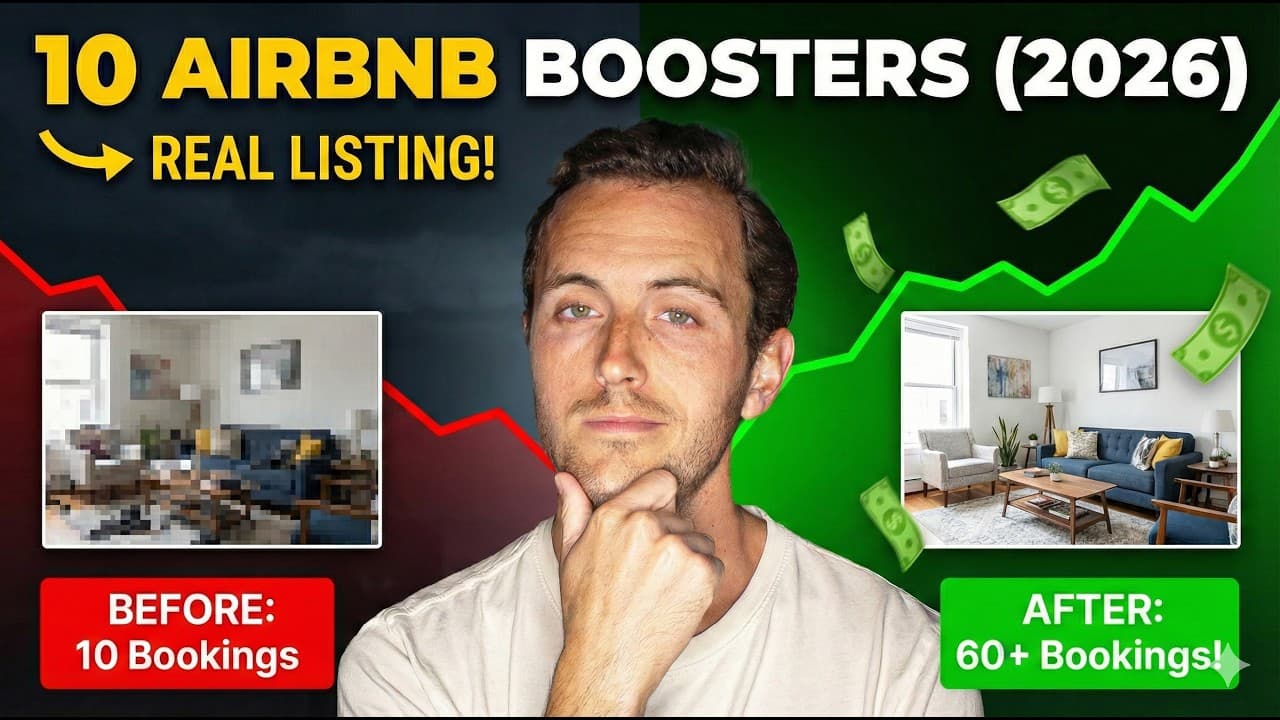
10 ESSENTIAL Steps to Improve Your Airbnb in 2026 (Real Listing Example!)
Most Airbnb listings lose bookings to the same fixable mistakes: bad photos, weak headlines, incomplete amenities, and missed seasonal opportunities. Here are 10 proven strategies to turn any underperforming listing into a consistent booking machine in 2026.
January 1, 2026 · 11 min read
10 Game-Changing Hacks to Improve Your Airbnb
What does it really mean to run a successful Airbnb in 2026? These 10 practical hacks — including a $15 sensor that prevented $44,000 in property damage — show exactly what separates top hosts from average ones.
January 16, 2025 · 9 min read
10 Tips to Get More Views on Airbnb
More views mean more bookings, and more bookings mean more revenue. This guide breaks down 10 actionable Airbnb listing optimization strategies that help hosts climb the search rankings and fill their calendars in 2026.
March 26, 2024 · 14 min read