The 3 A's of Airbnb Performance (EXCLUSIVE TRAINING: Part 2 of 3)
By James Svetec · February 28, 2024 · 9 min read
Part of our Airbnb Hosting 101 guide →
Key Takeaways
- Airbnb is a platform connecting property owners and managers with short-term guests — but understanding how to optimize within it separates profitable hosts from average ones.
- The three core pillars of STR success are property optimization, listing optimization, and pricing optimization — each with three distinct levers to pull.
- Accommodation capacity and income-generating amenities (like hot tubs) typically deliver a far better return than cosmetic upgrades like flooring or appliances.
- A well-optimized listing cover photo and headline are the single most important factors in getting guests to click through — everything else is irrelevant if they don't.
- Hosts who aren't in the top 20% of their local market are often leaving $500–$2,000 per month on the table through poor pricing strategy alone.
To define Airbnb in simple terms: it's an online marketplace that connects people who have space to rent with travelers looking for short-term accommodations. But for hosts, co-hosts, and investors, Airbnb is far more than a booking platform — it's a business system, and how well you operate within it determines whether you earn average returns or exceptional ones.
Watch the full video above or keep reading for the complete breakdown.
What Is Airbnb? A Clear Definition
Airbnb (short for Air Bed and Breakfast) is a peer-to-peer rental marketplace founded in 2008. It allows property owners, renters, and managers to list spaces — from spare bedrooms to entire homes, cabins, treehouses, and unique stays — and accept bookings from guests worldwide.
As of 2026, Airbnb operates in over 220 countries and regions, with millions of active listings. It functions as an online travel agency (OTA) that handles payments, booking infrastructure, and a review system — meaning hosts don't need to build their own booking system to get started.
But here's what most people miss when they try to define Airbnb: the platform itself is just the distribution channel. The real business is in how you set up, manage, and price your property within that channel. Two hosts in the same city, with similar properties, can have dramatically different income outcomes based purely on their approach.
How Airbnb Works for Hosts and Guests
For guests, Airbnb provides an alternative to hotels — often with more space, unique character, kitchen access, and local flavor. They search by location, dates, and filters, browse listings, and book directly through the platform.
For hosts, the process involves:
- Listing creation — uploading photos, writing descriptions, setting house rules, and configuring availability
- Pricing — setting nightly rates, minimum stays, and seasonal adjustments
- Guest communication — managing inquiries, check-in instructions, and reviews
- Property management — coordinating cleaning, maintenance, and restocking between stays
Airbnb charges hosts a service fee (typically 3% of the booking subtotal) and charges guests a separate fee on top of the listed price. This split-fee model means hosts keep the majority of what they charge.
There are also three distinct ways people participate in the Airbnb ecosystem beyond simple hosting. To understand the full picture, this comparison of Airbnb hosting vs. co-hosting vs. investing breaks down each model and who each one is best suited for.
The 3-Pillar Framework for Airbnb Optimization
Whether someone owns a single Airbnb or manages a portfolio of 20 properties, the path to higher income runs through the same three optimization areas: property, listing, and pricing. Each pillar has three actionable levers — what BNB Mastery calls the "3 A's" of each area.
The framework isn't about adding more properties or spending more money. It's about extracting maximum performance from what you already have. One well-optimized property, using all three pillars, can generate $500 or more per month in additional income compared to a similar but unoptimized property — with zero increase in operational costs.
That additional revenue goes straight to the bottom line. There's no extra mortgage, no higher cleaning fees, no additional operational overhead. It's pure margin improvement.
Pillar 1: Property Optimization
At the property level, three factors move the needle more than anything else. They're listed here in order of impact.
Accommodation Capacity
How many guests can your property comfortably sleep? This single variable has an outsized effect on both nightly rate and occupancy. Larger groups pay more per booking, and expanding capacity opens your property to a wider pool of travelers — couples, families, and friend groups alike.
Adding sleeping capacity — whether through a pull-out sofa, a bunk bed setup, or converting an unused space — typically delivers a stronger return than almost any cosmetic upgrade. A better stove won't change your income. Adding a bed that lets you sleep two more guests often will.
Amenities That Enhance the Experience
The second lever is experience-enhancing amenities. Think hot tubs, fire pits, game rooms, kayaks, or anything that gives guests something to do and a reason to choose your property over a comparable one nearby.
The math on this is straightforward. Spending $400 on three targeted amenities that increase average nightly rate by $20 pays for itself in 20 nights — which might be three or four weeks at typical occupancy. A full flooring renovation at $5,000–$10,000 might not move the booking needle at all.
Co-hosts who don't own the property can still raise this with owners. The pitch is simple: propose a low-cost amenity addition and show the projected return. Most property owners will say yes when the numbers make sense.
For more ideas on cost-effective property improvements, these three affordable ways to make more money on Airbnb are worth reviewing.
Aesthetics and Design Cohesion
Third on the list — and third for a reason — is aesthetic quality. An excellent property that looks chaotic, mismatched, or poorly styled in photos will underperform. Guests want to feel something when they look at a listing. Good design creates that emotional pull.
The key word here is cohesion. The property doesn't need to look like a luxury hotel. It needs to feel intentional — a consistent color palette, thoughtful furniture arrangement, and spaces that photograph well. Overspending on aesthetics without addressing capacity or amenities first is a common mistake.
Pillar 2: Listing Optimization
A great property with a weak listing will consistently underperform. The listing is the storefront, and optimization here follows three sequential steps: attract, answer, and acquire.
Attract: Get the Click
The most critical element in any Airbnb listing is the cover photo. It's the first thing a potential guest sees in search results. If it doesn't stop the scroll, nothing else matters — the pricing, the description, the amenities are all invisible until someone clicks through.
The listing headline works the same way. It needs to communicate the property's top selling point immediately — capacity, a standout amenity, a location advantage, or a unique characteristic.
A common mistake: hosts put effort into interior photos and descriptions but leave the cover photo as an afterthought. Reversing that priority can meaningfully increase click-through rates without changing anything else about the listing. For more on this, these 10 tips to get more Airbnb views cover the full picture.
Free Tool
Grab the Airbnb Nightly Pricing Tool
Grab the exact spreadsheet James uses to set profitable nightly rates — plus a step-by-step setup cheatsheet.
Answer: Remove Friction for the Guest
Once a guest clicks through, they're running a mental checklist. Does it have enough beds? Good Wi-Fi? A hot tub? Is it pet-friendly? The job of the listing at this stage is to answer those questions as fast as possible.
A wall of text in the listing description that buries key information forces guests to do work. Guests don't do work — they move on. The solution is clear photo labeling, well-organized amenity lists, and a description structured so that the most important information appears first.
If the listing makes a guest hunt for whether it has parking or not, that guest is booking somewhere else.
Acquire: Convert the Viewer into a Booker
The final step is conversion. This is where pricing, settings, and visual appeal converge. Instant Book, calendar availability, minimum stay settings, and response time all factor into how bookable a listing appears — both to guests and to Airbnb's search algorithm.
Photos also play a role here. The cover photo attracted the click; the full photo gallery needs to make the guest visualize themselves in the space. That's an emotional trigger, not just a logical one. When it works, the guest doesn't compare other listings — they just book.
Hosts who want to expand beyond Airbnb into direct bookings can amplify all of this work. Getting direct bookings for your short-term rental is a natural next step once the listing itself is dialed in.
Pillar 3: Pricing Optimization
Pricing is what BNB Mastery describes as "the fuel you put on the fire." Once the property and listing are optimized, pricing is what unlocks the final tier of income improvement. The 3 A's here are aim, analyze, and adjust.
Aim: Know Your Target
Most hosts don't know what their property should be earning. That's a significant problem. Without a revenue target, there's no way to know how far off the mark you are.
Statistically, hosts who aren't in the top 20% of their local market are typically leaving $500 to $2,000 per month uncaptured. That's not a small gap. Setting a clear monthly revenue goal — based on market data, comp analysis, and seasonal patterns — is the starting point for closing it.
Tools like AirDNA, Rabbu, and Mashvisor can help establish realistic benchmarks for a given market. For a structured approach to market analysis and revenue forecasting, the BNB Investing Blueprint provides a step-by-step framework for running those numbers accurately.
Analyze: Measure Weekly, Not Annually
Knowing your target is only useful if you're tracking progress against it regularly. Analyzing occupancy and rate data once a year gives you information too late to act on. Weekly check-ins — which, once systematized, take 5–10 minutes per listing — allow for real-time course correction.
Dynamic pricing tools can automate much of this analysis. The key is understanding what the software is doing and why, rather than setting it and walking away. Human oversight still matters.
Adjust: Respond to the Data
The final step is simple in theory: if you're behind pace on your revenue target, make adjustments. That might mean lowering the minimum stay to capture last-minute bookings, adjusting rates for an upcoming local event, or opening up calendar availability further in advance.
The system of aim → analyze → adjust, repeated consistently, compounds over time. A host who runs this process weekly across even one property will outperform a host who sets rates once and hopes for the best.
For specific tactics, these three Airbnb pricing hacks are a practical starting point for improving rate strategy immediately.
Airbnb for Co-Hosts and Investors
The three-pillar framework applies regardless of how someone participates in the Airbnb ecosystem. But the model matters when it comes to how optimization translates into income.
Co-hosts — people who manage Airbnb properties on behalf of owners — earn management fees (typically 15–30% of revenue). Every improvement they make to a property's performance increases both the owner's income and their own fee.
Co-host Brendan, who BNB Mastery worked with, grew from zero to managing close to 20 properties and now earns $8,000–$10,000 per month — without owning a single property.
For anyone looking to build that kind of management business, BNB Mastery's Co-Hosting Program provides a structured path from landing a first client to scaling a full portfolio under management.
Investors who own STR properties benefit from optimization differently — every dollar of increased revenue improves cash-on-cash return and property valuation. A property generating $4,000/month versus $2,500/month for comparable costs is a fundamentally different investment. Getting that right from day one matters enormously.
Staying connected with a community of experienced hosts and investors accelerates results in both models. The BNB Tribe community is worth exploring for anyone who wants access to ongoing coaching, advanced strategies, and a network of hosts who are actively optimizing their portfolios in 2026.
For those newer to the investing side of the equation, these three things every Airbnb investor needs to know provide a solid foundation before scaling.
The Bottom Line on Building an Airbnb Business
To define Airbnb purely as a booking website is to miss the point. For hosts who treat it seriously, Airbnb is a revenue system — one that rewards hosts who understand property positioning, listing quality, and dynamic pricing strategy.
The three-pillar framework covered here — property, listing, and pricing optimization — gives any host a clear roadmap for earning more without spending more. Applied consistently, these strategies can add $500 to $2,000 per month per property directly to the bottom line.
The highest-earning hosts in any market aren't necessarily the ones with the nicest properties. They're the ones who've mastered the system. That's an achievable standard for any host willing to put in the work.
Frequently Asked Questions
What does Airbnb mean and how does it work?
Airbnb stands for Air Bed and Breakfast. It's an online marketplace where property owners and managers list spaces for short-term rental, and guests book those spaces directly through the platform. Airbnb handles payments and reviews while hosts manage the property and guest experience.
Is hosting on Airbnb still profitable in 2026?
Yes, Airbnb hosting remains profitable in 2026 for hosts who actively optimize their listings, pricing, and property setup. Hosts in the top 20% of their local market can earn significantly more than the average — often $500 to $2,000 more per month per property than unoptimized listings in the same area.
What is the difference between Airbnb hosting and co-hosting?
A host owns or rents the property being listed on Airbnb. A co-host manages the listing on behalf of the property owner, handling guest communication, pricing, and operations in exchange for a management fee — typically 15–30% of revenue. Co-hosting requires no property ownership.
What are the most important factors for a successful Airbnb listing?
The three most important factors are property setup (capacity and amenities), listing quality (cover photo, headline, and description clarity), and pricing strategy (knowing your revenue target and adjusting rates regularly). Hosts who optimize all three consistently outperform those who focus on only one.
How much money can you make on Airbnb as a host?
Income varies widely by market, property size, and optimization level. A single well-optimized property can generate $2,000–$6,000+ per month. Co-hosts managing multiple properties can earn $8,000–$10,000 per month in management fees without owning any real estate.
If optimizing your Airbnb feels like a lot to tackle alone, connecting with a community of hosts who are actively doing it makes the process faster and far less frustrating. The BNB Tribe community gives hosts access to ongoing coaching, current market strategies, and a network of experienced operators — exactly the kind of support that turns these frameworks into real income gains.
Free Tool
Grab the Airbnb Nightly Pricing Tool
Grab the exact spreadsheet James uses to set profitable nightly rates — plus a step-by-step setup cheatsheet.
Ready to get started with Airbnb?
Join 240+ members in BNB Tribe — the community James built for hosts and investors who want real results.
Join BNB TribeMore Articles
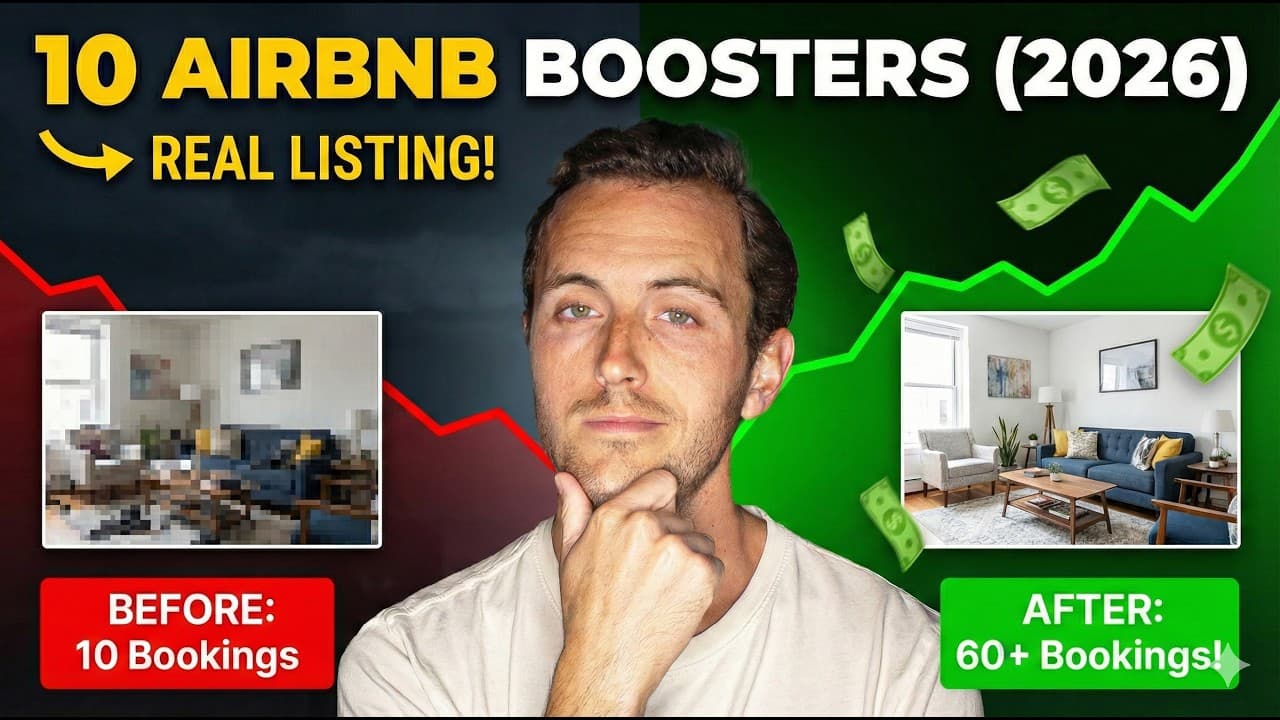
10 ESSENTIAL Steps to Improve Your Airbnb in 2026 (Real Listing Example!)
Most Airbnb listings lose bookings to the same fixable mistakes: bad photos, weak headlines, incomplete amenities, and missed seasonal opportunities. Here are 10 proven strategies to turn any underperforming listing into a consistent booking machine in 2026.
January 1, 2026 · 11 min read

10 Game-Changing Hacks to Improve Your Airbnb
What does it really mean to run a successful Airbnb in 2026? These 10 practical hacks — including a $15 sensor that prevented $44,000 in property damage — show exactly what separates top hosts from average ones.
January 16, 2025 · 9 min read

10 Tips to Get More Views on Airbnb
More views mean more bookings, and more bookings mean more revenue. This guide breaks down 10 actionable Airbnb listing optimization strategies that help hosts climb the search rankings and fill their calendars in 2026.
March 26, 2024 · 14 min read