Top 3 Must-Have Airbnb Tech Tools for STR Hosts in 2026
By James Svetec · September 1, 2022 · 9 min read
Part of our Airbnb Hosting 101 guide →
Key Takeaways
- The August smart lock integrates directly with Airbnb to auto-generate guest access codes — no manual code changes needed.
- NoiseAware monitors decibel levels (not audio recordings) so hosts can address noise issues before neighbors complain.
- A Nest or similar smart thermostat lets hosts control energy costs remotely, especially after guests check out.
- All three tools work together to create a more hands-off, automated hosting operation.
- Disclosing noise monitoring devices in your Airbnb listing is required — always update your listing when adding new tech.
The right Airbnb tech tools can transform a time-consuming short-term rental operation into something far closer to passive income. Whether you're managing one property or ten, automating guest access, noise monitoring, and energy control frees up hours every week — and protects your investment around the clock.
This blog video breaks down the three tools that professional STR operators rely on most.
Watch the full video above or keep reading for the complete breakdown.
Why Tech Tools Matter for Airbnb Hosts
Running a short-term rental without smart technology in 2026 is like managing a business with a paper ledger. It works, technically — but you're leaving efficiency, security, and profit on the table.
The best Airbnb tech tools serve two purposes: they reduce the manual workload on the host, and they create a better guest experience. Fewer manual tasks means fewer mistakes. Better guest experiences mean better reviews. Better reviews mean more bookings and higher nightly rates.
The three tools covered in this article don't require a full smart-home setup or a big technical background. They're practical, proven, and used by experienced hosts managing everything from single condos to multi-property portfolios.
If you're still deciding which path makes the most sense for you — owning STR properties versus managing them for other people — check out this overview of Airbnb hosting vs. co-hosting vs. investing to figure out which model fits your goals.
Tool #1: The August Smart Lock
The August smart lock is widely considered the gold standard for Airbnb property access. At roughly $300–$400 depending on the model and setup, it's not the cheapest option on the market — but the functionality justifies the price for any serious host.
How August Works for Airbnb Hosts
The August lock connects to your home's Wi-Fi and integrates directly with the Airbnb platform. When a guest books your property, the system automatically generates a unique access code tied to that reservation. The code activates at the guest's check-in time and expires at checkout — no manual code creation, no changing locks between stays.
This means guests can unlock the door using their smartphone without any back-and-forth with the host. That's a win for the guest experience and a major time-saver for hosts managing multiple properties.
Remote Access and Security Features
The Wi-Fi Connect version (now standard on new August models) lets hosts lock and unlock the door from anywhere in the world. If a cleaner leaves the door unlocked after a turnover, you'll get a notification and can lock it remotely. If a guest has trouble getting in, you can unlock it instantly without driving to the property.
The optional keypad add-on adds another layer of redundancy. Guests who aren't comfortable using a smartphone app can enter a code directly on the keypad. Like the app codes, keypad codes are time-limited to the guest's stay.
Pro tip: Always keep a physical lockbox with a backup key on-site. Electronics fail — batteries die, Wi-Fi goes down, power outages happen. A $30 lockbox can save a guest experience when everything else goes wrong.
Why August Beats the Competition
Plenty of smart locks offer remote access. What separates August is the native Airbnb integration. The automated code generation alone eliminates one of the most tedious recurring tasks in short-term rental management. Combined with the keypad option and remote access, it creates a truly hands-off check-in experience.
For hosts building a co-hosting or property management business, this kind of automation is essential. Connecting with other hosts who've systemized their operations is one reason many join a community like the BNB Tribe — sharing what works saves months of trial and error.
Tool #2: NoiseAware Noise Monitor
Noise complaints are one of the biggest threats to an Airbnb host's relationship with neighbors — and one of the fastest ways to end up on the wrong side of a city ordinance or HOA dispute. NoiseAware was built specifically to solve this problem.
What NoiseAware Actually Does
NoiseAware is a decibel-monitoring device, not a recording device. This distinction matters both legally and ethically. The device measures sound levels inside and outside the property without capturing any audio content — so there are no privacy violations to worry about.
When noise exceeds a threshold you set (in both volume and duration), NoiseAware sends an alert. The system is smart enough to filter out brief spikes — a dropped pan, a door slamming — and only triggers when sustained loud noise is detected. That means fewer false alarms and more accurate monitoring.
Why Noise Monitoring Protects Your Investment
Think about a scenario most hosts have dealt with: guests hosting an impromptu gathering at 11pm on a Tuesday. The neighbors are sleeping. Your guests are on vacation mode. Without a monitoring tool, you have no idea anything is happening until you get a complaint — or worse, a call from the city.
With NoiseAware, you get an alert in real time. You can then send an automated or manual message asking guests to keep the volume down, long before the neighbors have to get involved. That proactive approach protects both your neighbor relationships and your hosting reputation.
- Set indoor and outdoor decibel thresholds separately
- Pair with automated guest messaging for hands-off noise management
- Available in indoor and outdoor versions for full property coverage
- No audio recording — fully compliant with guest privacy standards
Important: Airbnb requires hosts to disclose the presence of noise monitoring devices in their listing. Always update your listing description when you add NoiseAware to a property.
The Business Case for NoiseAware
A single bad-neighbor incident can spiral into a formal complaint, a permit review, or even a listing suspension in regulated markets. The cost of NoiseAware — a few hundred dollars — is trivial compared to those outcomes. For hosts operating in markets with strict noise ordinances or dense neighborhoods, it's a non-negotiable piece of the tech stack.
Hosts who want to attract consistent, high-quality bookings (rather than party crowds) can also pair noise monitoring with smart listing practices. This guide on Airbnb listing must-dos covers how to set expectations upfront to attract the right guests in the first place.
Tool #3: The Nest Smart Thermostat
The Nest thermostat isn't Airbnb-specific the way NoiseAware is, but it's one of the most practical tools in a host's arsenal. At under $100 for the basic model, it offers a strong return for a relatively small upfront cost.
Free Tool
Grab the Airbnb Nightly Pricing Tool
Grab the exact spreadsheet James uses to set profitable nightly rates — plus a step-by-step setup cheatsheet.
Remote Temperature Control
The core benefit is simple: you can control your property's temperature from your phone, anywhere. This matters in two scenarios that come up constantly in STR management.
First, guests occasionally crank the heat or AC to extremes. If a guest sets the heat to 80°F in January and forgets, that's a significant utility cost running 24/7. With Nest, hosts can monitor temperature settings and adjust if something looks unreasonable.
Second — and more impactful for most hosts — is the period between stays. After a guest checks out and before the cleaners arrive, there's no reason to heat or cool the property at full blast. Nest lets hosts set an away temperature the moment checkout happens, saving real money on electricity and gas costs at scale.
Scheduling and Automation
Nest also supports scheduling, so hosts can program automatic temperature adjustments around check-in and checkout times. Set it to warm up an hour before check-in, and cool down to an away setting an hour after checkout. Over dozens of reservations per year, those automated adjustments add up to meaningful savings.
The Nest's interface is widely regarded as one of the most intuitive among smart thermostats, which matters when you're setting it up across multiple properties. That said, there are other quality options — Ecobee is another popular choice among STR operators — so the key recommendation here is any smart thermostat, not necessarily one specific brand.
Example: A host running an STR in a northern climate might spend $200–$400 per month on heating during winter. Even a 15–20% reduction from smarter thermostat management saves $30–$80 per month — enough to cover the device cost in the first year.
How These Three Tools Work Together
The real power of these tools comes from combining them into a cohesive system. Here's what a fully automated guest experience looks like when all three are in place:
- Guest books → August lock automatically generates a time-limited access code tied to their reservation
- Guest checks in → Code activates, guest enters via smartphone or keypad; Nest adjusts to a comfortable welcome temperature
- During the stay → NoiseAware monitors decibel levels; any sustained noise triggers an automated message to keep things neighborly
- Guest checks out → August code deactivates automatically; Nest switches to away mode to minimize energy costs
- Between stays → Host can monitor everything remotely, with no need to visit the property for routine tasks
This setup doesn't eliminate the need for a good cleaner or occasional in-person attention. But it dramatically reduces the day-to-day management burden — which is exactly what makes STR investing scalable.
For hosts looking to build a full co-hosting business managing other people's properties, this kind of system is the operational backbone that makes managing 10, 15, or 20 properties realistic. BNB Mastery's Co-Hosting Program covers exactly how to build and systematize an operation like this from the ground up.
Additional Tech Considerations for STR Hosts
These three tools cover the most critical areas — access, noise, and energy. But a complete Airbnb tech stack often includes a few additional layers worth knowing about.
Property Management Software (PMS)
If you're managing more than one or two listings, a PMS like Guesty, Hostaway, or Lodgify becomes increasingly valuable. These platforms centralize your calendars, messaging, pricing, and cleaning schedules across multiple listings and OTAs. They also integrate with tools like August lock, creating a more unified automation layer.
Dynamic Pricing Tools
Tools like PriceLabs, Wheelhouse, or Beyond Pricing use market data to automatically adjust your nightly rates based on demand, seasonality, and local events. In competitive markets, static pricing leaves significant revenue on the table. Dynamic pricing can increase annual revenue by 10–30% for many operators.
Security Cameras (Exterior Only)
Exterior security cameras add peace of mind without raising privacy concerns. They're fully compliant with Airbnb's policies when disclosed — and they act as a deterrent against unauthorized gatherings. Pair with NoiseAware for a comprehensive property protection setup.
If you're evaluating whether the numbers work before investing in any of this infrastructure, start with a proper deal analysis. This walkthrough on how to analyze a short-term rental property's cash-on-cash return gives you a clear framework for determining whether a property justifies the investment in setup and tech.
Investors who want a structured approach to analyzing STR deals and building a rental portfolio can also explore the BNB Investing Blueprint for a more complete framework.
Final Thoughts on Airbnb Tech Tools
The three Airbnb tech tools covered in this blog video — the August smart lock, NoiseAware, and the Nest thermostat — aren't flashy. They're not complicated. But they solve real, recurring problems that cost hosts time, money, and guest satisfaction every single week.
Start with the August lock if you're picking just one. The Airbnb integration and automated guest codes alone justify the price. Add NoiseAware next, especially if you're in a neighborhood-sensitive market. Then layer in a smart thermostat to capture the energy savings over time.
Combined, these three tools form the foundation of a well-run, scalable STR operation. They're not optional extras — for any host serious about growing their Airbnb business in 2026, they're table stakes.
Frequently Asked Questions
What is the best smart lock for Airbnb hosts in 2026?
The August smart lock is widely regarded as the top choice for Airbnb hosts due to its direct Airbnb integration, which automatically generates and expires guest access codes for each reservation. It also supports remote locking via smartphone and an optional keypad for guests who prefer not to use an app.
Is NoiseAware legal to use in an Airbnb rental?
Yes, NoiseAware is legal because it monitors decibel levels only — it does not record audio. However, Airbnb requires hosts to disclose the presence of any noise monitoring device in their listing description, so hosts should update their listing when installing NoiseAware.
How much does it cost to set up smart tech for an Airbnb?
A basic smart tech setup — August lock ($300–$400), NoiseAware ($100–$200), and a Nest thermostat (under $100) — runs approximately $500–$700 total. Most hosts recoup this cost quickly through energy savings, fewer in-person visits, and improved guest experience leading to better reviews.
Do Airbnb tech tools really make a difference for hosts?
Yes, significantly. Smart locks eliminate manual key exchanges and code management. Noise monitors help prevent neighbor complaints before they escalate. Smart thermostats reduce utility costs between stays. Together, they reduce the time spent managing a property and improve the guest experience.
Can Airbnb tech tools help me manage multiple properties in 2026?
Absolutely. Tools like the August lock and Nest thermostat can be managed remotely across multiple properties from a single smartphone. Adding property management software like Guesty or Hostaway allows hosts to centralize calendars, messaging, and pricing for an entire portfolio.
If this blog video sparked ideas about scaling your STR operation or getting into the business without owning property, the next step is connecting with hosts who are already doing it. The BNB Tribe community brings together active Airbnb operators sharing real strategies, tools, and market insights — the kind of peer learning that compresses years of trial and error into months. It's one of the most practical resources available for hosts at any stage.
Free Tool
Grab the Airbnb Nightly Pricing Tool
Grab the exact spreadsheet James uses to set profitable nightly rates — plus a step-by-step setup cheatsheet.
Ready to get started with Airbnb?
Join 240+ members in BNB Tribe — the community James built for hosts and investors who want real results.
Join BNB TribeMore Articles
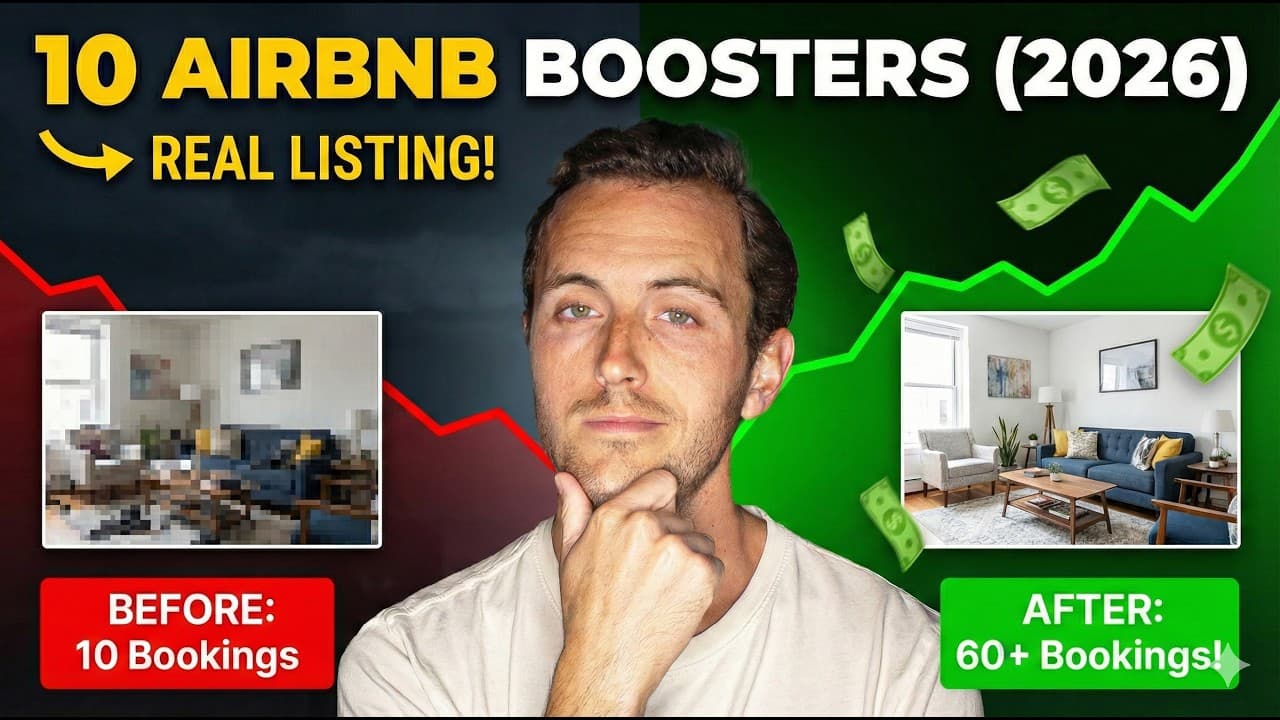
10 ESSENTIAL Steps to Improve Your Airbnb in 2026 (Real Listing Example!)
Most Airbnb listings lose bookings to the same fixable mistakes: bad photos, weak headlines, incomplete amenities, and missed seasonal opportunities. Here are 10 proven strategies to turn any underperforming listing into a consistent booking machine in 2026.
January 1, 2026 · 11 min read

10 Game-Changing Hacks to Improve Your Airbnb
What does it really mean to run a successful Airbnb in 2026? These 10 practical hacks — including a $15 sensor that prevented $44,000 in property damage — show exactly what separates top hosts from average ones.
January 16, 2025 · 9 min read

10 Tips to Get More Views on Airbnb
More views mean more bookings, and more bookings mean more revenue. This guide breaks down 10 actionable Airbnb listing optimization strategies that help hosts climb the search rankings and fill their calendars in 2026.
March 26, 2024 · 14 min read