Why a Bad Economy is GREAT for Airbnb
By James Svetec · January 2, 2024 · 9 min read
Part of our Airbnb Hosting 101 guide →
Key Takeaways
- A bad economy shifts travelers toward Airbnb over hotels — especially for groups and longer stays where STRs are significantly cheaper.
- Staycations and local travel surge during downturns, and Airbnb properties win that segment decisively over traditional hotels.
- Top-performing hosts (top 10-25%) often see occupancy and revenue hold steady or even increase when weaker listings exit the market.
- Economic downturns can create buying opportunities — distressed sellers may list STR-friendly properties at a discount while the underlying rental income stays strong.
- Demand for Airbnb co-hosting and property management services rises during downturns, creating a business opportunity even for hosts who don't own property.
The idea of an Airbnb bad economy scenario sending short-term rental revenue off a cliff makes intuitive sense — until you look at what actually happens when household budgets tighten. Far from collapsing, the STR market tends to absorb and redirect travel demand in ways that benefit well-run listings over hotels and weaker competitors alike.
Watch the full video above or keep reading for the complete breakdown.
Why a Bad Economy Actually Helps Airbnb
The first reaction most people have when they hear "recession" or "economic downturn" is to assume that travel spending collapses. And while luxury travel and international trips do take a hit, the short-term rental market sits in a different position entirely.
Airbnb has long been criticized for cleaning fees and higher per-night costs compared to budget hotels. That reputation is partly deserved — but it misses the full picture.
When you factor in group size, length of stay, and the value of amenities like full kitchens and private outdoor space, Airbnb is often dramatically cheaper than hotels for the types of trips most families and groups take.
A bad economy doesn't kill travel. It reshapes it. People trade international flights for road trips. They trade five-star resorts for comfortable homes with private pools. That reshaped demand flows directly toward well-managed STR properties.
Connecting with other hosts who've navigated market cycles is one of the fastest ways to sharpen your strategy. The BNB Tribe community brings together experienced STR investors and hosts who share real data, not headlines, about what's actually happening in their markets.
Airbnb vs. Hotels: The Real Cost Comparison
Here's where the math gets interesting. The cost comparison between Airbnb and hotels isn't a single answer — it depends entirely on how many people are traveling and for how long.
When Hotels Win
A solo traveler booking one night in a city? A hotel is almost certainly cheaper. Hotels benefit from economies of scale: bulk linen purchasing, on-site housekeeping staff, and lower per-room operational costs. A solo STR booking has to absorb all those fixed costs — including a cleaner's travel time — against just one guest paying one night's rate.
When Airbnb Wins — Decisively
The math flips fast once you add people or nights. Consider a group of eight travelers. Finding four hotel rooms that are adjacent, comfortable, and available? That's difficult and expensive. An Airbnb sleeping eight people in a single property is not only easier to find — it's a fraction of the cost.
- A family of four paying for two hotel rooms at $180/night each spends $360/night. A comparable Airbnb property might run $220-$280/night with a full kitchen, backyard, and living room.
- Cleaning fees feel steep on a one-night stay but become negligible spread across a week. A $150 cleaning fee over seven nights adds just $21/night.
- Hotels provide daily housekeeping — a service most families don't need and are effectively forced to pay for anyway.
The longer the stay and the larger the group, the stronger Airbnb's value proposition becomes. In a tighter economy, travelers do the math more carefully. That's good news for STR hosts.
Understanding exactly how to price your Airbnb listing strategically becomes even more critical when budget-conscious travelers are comparison shopping intensely.
The Staycation Effect: Local Travel Surges in Downturns
When international flights become a luxury people can't justify, something predictable happens: they travel closer to home. The staycation — a short trip within driving distance — explodes in popularity during economic slowdowns.
This matters enormously for the Airbnb hosting service model. Unique, experience-driven properties within two to three hours of major population centers become the primary beneficiaries of this shift.
What Staycation Travelers Want
Someone taking a three-day staycation isn't settling for less. They're choosing an experience that feels genuinely different from their everyday environment. A lakefront cabin, a mountain A-frame, a renovated farmhouse with a hot tub — these properties offer something a local Hampton Inn simply cannot match.
The two factors that drive staycation bookings:
- Location appeal — proximity to nature, water, hiking, skiing, or other outdoor amenities that create a genuine sense of escape.
- Property quality and amenities — the actual place someone is staying becomes a destination in itself. A stunning kitchen, a fire pit, a game room. These aren't nice-to-haves. For staycation travelers, they're the point.
Airbnb's inventory is specifically designed to deliver on both. Local hotels rarely can. This structural advantage becomes a competitive moat during downturns when staycation demand spikes.
If you're looking to maximize your property's appeal for this kind of traveler, the guide on maximizing your Airbnb during peak seasons covers practical upgrades that drive bookings and reviews.
How Top Airbnb Hosts Win While Others Panic
Here's the part that most headlines miss entirely. During a downturn, the overall supply of STR listings often shrinks. Hosts who bought at high prices with thin margins, or who relied on every single booking to break even, start exiting the market. They panic-sell. They pull listings. They stop investing in their properties.
This is where the top 10-25% of Airbnb hosts actually see an opportunity.
When weaker listings disappear from the market, the available demand concentrates toward the listings that remain. A host with a well-photographed, well-reviewed, strategically priced property doesn't just survive — they can see occupancy rates hold steady or improve because they're absorbing bookings that previously went to listings that no longer exist.
A well-managed STR in a good market can maintain performance through economic uncertainty — while poorly managed competitors exit. The gap between top and bottom performers widens in a downturn.
What separates hosts who thrive from those who struggle comes down to fundamentals: strong listing optimization, competitive pricing, consistent five-star reviews, and driving more visibility to their Airbnb listing through every available channel.
Accessing your Airbnb host login dashboard regularly to monitor your performance metrics, adjust pricing, and respond promptly to inquiries is a basic but underrated habit. Hosts who treat their STR like an active business — not a passive income stream that manages itself — are the ones who weather downturns intact.
Free Tool
Grab the Airbnb Nightly Pricing Tool
Grab the exact spreadsheet James uses to set profitable nightly rates — plus a step-by-step setup cheatsheet.
The Co-Hosting Opportunity in a Tough Economy
Economic downturns create a specific and often overlooked opportunity for people who want to build income through Airbnb without owning property: co-hosting.
When the economy tightens, more property owners start looking at their real estate differently. Homeowners with a spare property, accidental landlords with a vacant unit, investors who need cash flow to cover mortgages — all of these people become potential clients for an Airbnb co-host who can manage their property professionally.
As more properties enter the STR market seeking management, the demand for skilled co-hosts and property managers rises. And because a good Airbnb co-host earns a percentage of revenue (typically 15-30%), there's no capital required to get started. The business model scales with the number of properties under management.
The key is knowing how to land those first clients, set up operations efficiently, and deliver results that keep property owners coming back. For hosts who want to build this into a full-time income, BNB Mastery's Co-Hosting Program provides a step-by-step framework for doing exactly that — from pitching your first property owner to managing a portfolio of listings.
If you want context on why this model is growing fast right now, the post on why Airbnb co-hosting is booming breaks down the structural forces driving demand for professional property managers.
Investing in STRs During an Economic Downturn
For investors with capital and patience, economic downturns historically create some of the best buying windows in real estate. STR investing during a downturn isn't about ignoring risk — it's about understanding which risks are real and which are noise.
The Case for Buying When Others Are Selling
When property values drop in STR-friendly markets, panicked sellers often list at prices they wouldn't have considered twelve months earlier. But here's the key insight: if the property's rental income holds steady, the return on investment actually improves as the purchase price falls.
A property that generated $48,000 in annual STR revenue at a $400,000 purchase price (a 12% gross yield) becomes significantly more attractive at $320,000 (a 15% gross yield). The income didn't change. The price did.
What to Look For
- Markets with genuine travel demand — not markets that were oversupplied even before the downturn.
- Properties with strong amenity profiles — unique features that attract staycation and experience-driven travelers.
- Conservative underwriting — model scenarios at 60-65% occupancy, not the 80%+ you might see during boom periods.
- Motivated sellers — owners who need to sell, not testing the market. These are the deals worth pursuing.
For a structured approach to analyzing STR investment deals with real data, the BNB Investing Mastery walks through the exact framework for evaluating properties before you buy — including how to stress-test assumptions in uncertain markets.
It's also worth understanding what can go wrong. The piece on the biggest mistakes in Airbnb investing covers the pitfalls that trip up investors who move too fast or skip proper due diligence.
What Smart Hosts Should Do Right Now
Understanding the opportunity is one thing. Acting on it is another. Here's what hosts and investors should be focusing on in 2026 to position themselves well regardless of broader economic conditions.
For Current Hosts
- Audit your listing — photos, title, description, amenity list. Are you showcasing every feature that matters to a budget-conscious traveler choosing between you and a hotel?
- Sharpen your pricing strategy — dynamic pricing tools are non-negotiable at this point. Leaving money on the table during peak demand is as damaging as being overpriced in slow periods.
- Stack your reviews — in a competitive environment, a 4.6-star listing loses to a 4.9-star listing almost every time. Focus obsessively on the guest experience.
- Reduce operational costs — tighter margins require tighter operations. Review your cleaning costs, supply purchases, and management overhead. Small savings per booking add up fast across hundreds of nights.
For Aspiring Co-Hosts
- Start identifying property owners in your area who might benefit from professional management.
- Build a simple pitch around the income you can generate for them versus what they're currently earning (often zero, from a vacant property).
- Consider reaching out through real estate investor groups, property management forums, or directly to listings on Airbnb that show signs of poor management.
For Potential Investors
- Get pre-approved for financing so you can move quickly when the right deal appears.
- Run the numbers on markets that have seen price corrections — a 15-20% drop in property values with stable rental income significantly changes the math.
- Don't wait for certainty. Good deals don't come with all-clear signals. They come with noise and uncertainty, which is precisely what creates the opportunity.
Conclusion: Opportunity Hides Where Others See Risk
The narrative around an Airbnb bad economy scenario tends to assume that all travel demand disappears when times get tough. It doesn't. It shifts — toward local, toward affordable, toward experiences that justify the spend. STR properties are uniquely positioned to capture that shifted demand, especially properties with strong amenities, smart pricing, and genuine hospitality.
The hosts who come out ahead during economic uncertainty aren't the ones who panic. They're the ones who understand the structural dynamics at play and double down on what they can control: listing quality, pricing strategy, guest experience, and operational efficiency.
Whether the goal is to build income through co-hosting or to acquire STR properties at a discount while others exit, 2026 presents real opportunities for hosts who stay informed and stay active.
Frequently Asked Questions
Is Airbnb still profitable during a bad economy in 2026?
Yes — and often more so than during boom periods. Economic downturns push travelers toward cost-effective options for groups and longer stays, where Airbnb significantly undercuts hotel pricing. Top-performing hosts frequently maintain or improve occupancy as weaker listings exit the market.
Why is Airbnb cheaper than hotels for group travel?
Hotels charge per room, so a group of six or eight travelers needs multiple rooms at full price each. A single Airbnb property sleeps the whole group under one roof, often for less than two hotel rooms combined. Add full kitchen access and a living room, and the value gap widens further.
Does a recession increase demand for Airbnb co-hosts?
Generally yes. Economic pressure pushes more property owners to explore short-term rental income, but many lack the time or expertise to manage listings themselves. This creates direct demand for professional Airbnb co-hosts who can manage properties on an owner's behalf.
What types of Airbnb properties perform best during a downturn?
Properties in driveable leisure markets — near lakes, mountains, national parks, or other natural attractions — tend to perform strongest. They capture the staycation demand that surges when budgets shrink and international travel becomes impractical.
Should I invest in Airbnb properties when the economy is bad?
A downturn can create strong buying opportunities if you underwrite conservatively and focus on markets with durable travel demand. Falling property prices against stable rental income improves returns. The key is buying based on real cash flow projections, not optimistic peak-market assumptions.
The gap between hosts who thrive in uncertain markets and those who struggle comes down to preparation, not luck. If building a co-hosting business sounds like the right path, BNB Mastery's Co-Hosting Program gives you the exact playbook for landing clients and running profitable managed properties — without needing to own a single one. And for investors eyeing the current market for discounted STR deals, the BNB Investing Mastery provides the analytical framework to separate a genuine opportunity from a money pit.
Free Tool
Grab the Airbnb Nightly Pricing Tool
Grab the exact spreadsheet James uses to set profitable nightly rates — plus a step-by-step setup cheatsheet.
Ready to get started with Airbnb?
Join 240+ members in BNB Tribe — the community James built for hosts and investors who want real results.
Join BNB TribeMore Articles
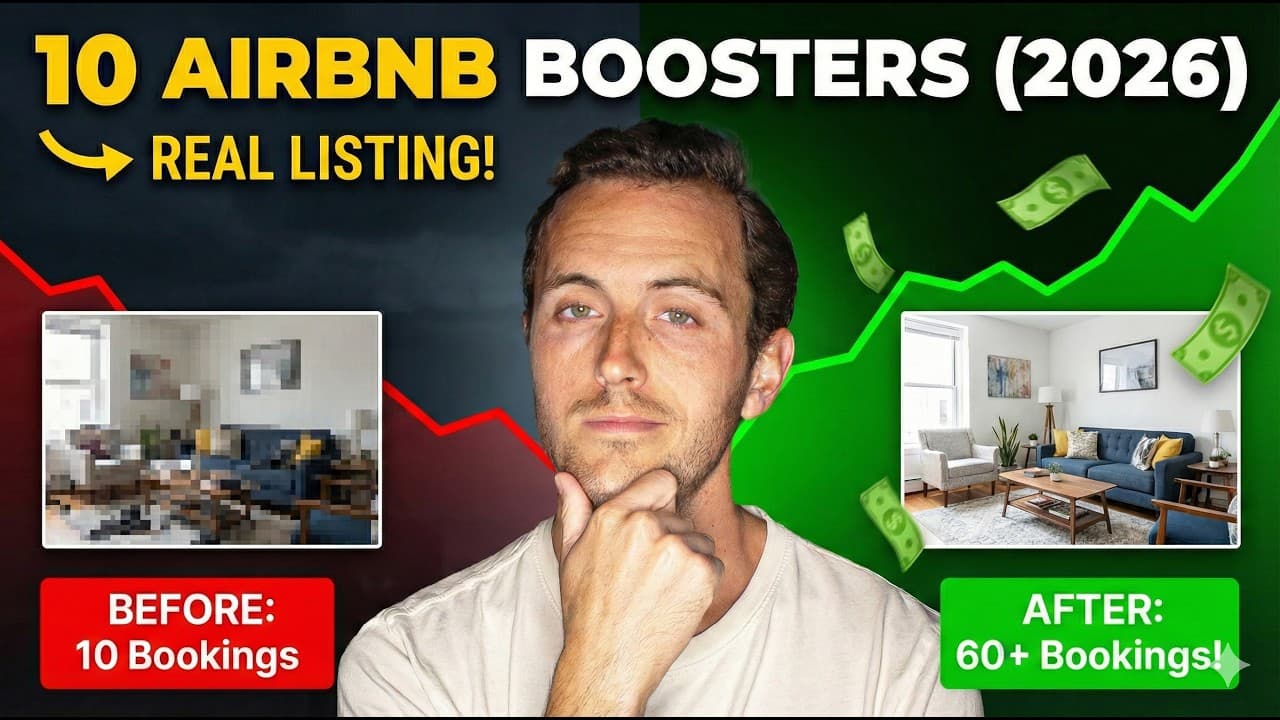
10 ESSENTIAL Steps to Improve Your Airbnb in 2026 (Real Listing Example!)
Most Airbnb listings lose bookings to the same fixable mistakes: bad photos, weak headlines, incomplete amenities, and missed seasonal opportunities. Here are 10 proven strategies to turn any underperforming listing into a consistent booking machine in 2026.
January 1, 2026 · 11 min read

10 Game-Changing Hacks to Improve Your Airbnb
What does it really mean to run a successful Airbnb in 2026? These 10 practical hacks — including a $15 sensor that prevented $44,000 in property damage — show exactly what separates top hosts from average ones.
January 16, 2025 · 9 min read

10 Tips to Get More Views on Airbnb
More views mean more bookings, and more bookings mean more revenue. This guide breaks down 10 actionable Airbnb listing optimization strategies that help hosts climb the search rankings and fill their calendars in 2026.
March 26, 2024 · 14 min read