Why your Airbnb isn't making money...
By James Svetec · October 24, 2024 · 8 min read
Part of our Airbnb Hosting 101 guide →
Key Takeaways
- A poor listing launch can permanently damage your Airbnb SEO — first impressions with the algorithm matter enormously
- Guests in 2026 have more options than ever; your listing needs a compelling reason to book over competitors
- Pricing errors can cost hosts $70,000+ per year compared to similar properties in the same market
- Hospitality mindset matters — negative reviews from poor guest interactions will sink your ranking over time
- Your own review data is a free, underused goldmine for improving bookings and guest satisfaction
If your Airbnb isn't making money, the problem is almost never bad luck or a tough market — it's a handful of specific, fixable mistakes that quietly drain revenue month after month.
BNB Mastery founder James Svetec has worked with over 1,800 Airbnb hosts over the past six years, helping turn around properties that were losing thousands and guiding hundreds to six-figure profits. The patterns are consistent. The same five mistakes show up again and again.
Watch the full video above or keep reading for the complete breakdown.
Mistake #1: Rushing Your Listing Launch
It feels logical to get your listing live as fast as possible and optimize later. In practice, this approach can cost you thousands — and the damage can be permanent.
Here's why it matters so much: when a new listing first goes live on Airbnb, it receives a surge of initial traffic. How well that listing converts that traffic into actual bookings accounts for roughly 80% of your Airbnb SEO score.
Perform well in that window and you climb the search rankings. Perform poorly and you slide — sometimes all the way to the bottom, where almost no one will ever find you organically.
This is the hidden trap that catches so many new hosts. They think they'll fix the photos and description after a few bookings come in. But those early bookings never materialize, and the listing gets buried before it ever had a real chance.
What a Strong Launch Actually Looks Like
The 80/20 of launching correctly comes down to four things:
- Professional photos: This is non-negotiable. Guests make snap decisions based on visuals. Amateur photos signal an amateur host.
- Complete listing details: Fill out every single section. Airbnb rewards completeness, and guests trust listings that feel thorough.
- Discounted launch pricing: Drop your rates 10–20% below market for the first few weeks to accelerate early bookings and build momentum with the algorithm.
- Strong amenities from day one: More on this in the next section, but don't launch with a bare-bones setup and plan to add things later.
If you want a step-by-step guide to nailing your launch, the BNB Tribe community has an entire section dedicated to exactly this — covering photos, descriptions, pricing strategy, and launch sequencing.
For more on why listings suddenly stop performing, this breakdown of why Airbnb listings stop getting booked covers the algorithm dynamics in detail.
Mistake #2: Not Giving Guests a Reason to Book
A few years ago, demand on Airbnb was so high that hosts could throw up nearly any listing and get bookings. The market has fundamentally shifted. In 2026, guests have more options than ever — and they're not desperate to travel. They're selective.
If your listing looks and feels exactly like every other property in your market, there's no compelling reason for a guest to choose yours. This is one of the most common reasons an Airbnb isn't making money — the listing blends into the background instead of standing out.
How to Identify Your Unique Guest Appeal
Start by getting specific about your ideal guest. Ask yourself:
- Is this listing best suited for a solo business traveler, a couple on a romantic weekend, a family on vacation, or a group of friends?
- What would make their stay genuinely memorable?
- What could you offer that they'd feel compelled to tell others about?
- What would make them want to come back?
Once you have answers, act on them. Some improvements are cheap and fast — adding a Netflix account, upgrading the coffee setup, stocking a welcome basket. Others require more investment but deliver serious returns: a hot tub, a fire pit, a game room, high-end linens.
Example: If a $3,000 hot tub installation increases your nightly rate by $30 and adds 15% more bookings per year on a property already generating $40,000 annually, the ROI is substantial — often recovering that cost within a single season.
Think about it this way: if you've already spent hundreds of thousands of dollars to buy or furnish a property, spending a few thousand more to generate 10–20% more bookings isn't a cost. It's an investment with a clear return.
For budget-friendly ideas, these three affordable ways to make more money on Airbnb are worth reviewing. And if you want a full amenity checklist, this guide to 30 Airbnb amenities under $100 is a practical starting point.
Mistake #3: Getting Your Pricing Wrong
Pricing is where most hosts either win or lose — and most don't realize how much money is on the table. Consider this: two hosts with nearly identical properties in the same market, both doing most things right. The one with better pricing made $74,000 more last year than the other. Same market. Same property type. Wildly different results.
That's the reality of what bad pricing costs you. And it's one of the clearest explanations for why your Airbnb isn't making money in 2026 the way it should be.
A Simple 3-Step Pricing Framework
Pricing doesn't have to be complicated. Here's the 80/20 that actually moves the needle:
- Check AirDNA for your market's average occupancy rate. This tells you whether demand in your area supports higher or lower pricing and helps you set a realistic baseline.
- Look up your market's booking lead time. This tells you how far in advance guests typically book, which helps you know when to adjust rates and when to wait.
- Track your own occupancy weekly. This takes about five minutes. If you're consistently overbooked, raise your rates. Consistently underbooked? Lower them. That's it.
Most hosts overcomplicate this. The goal isn't to find the perfect algorithm — it's to stay responsive. A simple spreadsheet updated weekly beats an expensive pricing tool that you never actually review.
For more advanced strategies, these three Airbnb pricing hacks cover dynamic pricing tactics that most hosts overlook. And if pricing errors are already costing you, this list of 11 pricing mistakes is worth a careful read.
Hosts who want built-in tools to make this tracking easier — plus about 50 other hosting resources — will find them inside the BNB Tribe community.
Free Tool
Grab the Airbnb Nightly Pricing Tool
Grab the exact spreadsheet James uses to set profitable nightly rates — plus a step-by-step setup cheatsheet.
Mistake #4: Forgetting What Business You're In
This one is harder to talk about, but it matters just as much as photos and pricing. Airbnb hosting is a hospitality business. The literal definition of hospitality is being friendly and welcoming to guests. Not everyone is naturally wired for that — and that's okay — but it's something every host needs to honestly assess.
Constantly assuming the worst of guests, arguing over minor issues, or imposing aggressive fees for small infractions might feel justified in the moment. Long term, it produces negative reviews. And negative reviews are one of the fastest ways to destroy a listing's search ranking.
How to Think About Guest Interactions Strategically
The mental reframe that helps most hosts: hosting is a marathon, not a sprint. There will be guests who test your patience. Some complaints will feel unfair. Sometimes you'll have to bite your tongue and side with a guest even when you don't feel like it.
But stepping over dollars to pick up pennies — fighting a guest over a $50 issue and earning a one-star review that costs you thousands in lost bookings — is a losing trade every time.
This doesn't mean letting guests walk all over you. It means choosing your battles wisely, taking the high road consistently, and thinking about the long-term health of your listing rather than winning an individual argument.
Mistake #5: Ignoring Your Review Data
This is the easiest mistake to fix once you know to look for it — and working it in your favor gives you a genuine competitive edge. Your past reviews are a free, direct line to exactly what your guests value and exactly where your listing falls short.
Most hosts either don't read their reviews carefully or, worse, reflexively dismiss any criticism. That's a costly habit.
How to Turn Reviews Into Bookings
Here's a simple process that takes 30–45 minutes and can meaningfully improve your listing:
- Log into your hosting dashboard and open the Insights tab.
- Read every recent review — both the public comments and any private notes guests left.
- Make two lists: everything guests loved, and every complaint or concern, no matter how small.
Once you have those lists, act on both of them. Everything guests consistently praise should be front and center in your listing — in your headline, your description, your photos. If guests rave about the mountain views or the hot tub or the walking distance to restaurants, make sure potential guests see that immediately.
Every complaint that can be fixed should be fixed. If something can't be changed — like the location or noise from a nearby road — set better expectations upfront in the listing description so guests aren't surprised.
Pro tip: Going through this process recently on one listing produced an immediate 10% increase in bookings. No new amenities. No pricing changes. Just better alignment between what guests valued and what the listing communicated.
If you're finding patterns in your reviews around ratings, this guide to hidden mistakes that destroy your Airbnb rating covers the most common culprits in detail.
Connecting with other hosts who've been through the same optimization process can also accelerate your results. The BNB Tribe community brings together experienced Airbnb hosts, investors, and property managers who share exactly this kind of practical, tested knowledge.
The Bottom Line
If your Airbnb isn't making money the way it should, the answer is almost always hiding in plain sight: a weak launch that tanked your search ranking, a listing that doesn't stand out, prices set too high or too low, guest interactions that are generating bad reviews, or feedback sitting in your dashboard that you've never acted on.
None of these are unfixable. In fact, most can be addressed within a week. The hosts who consistently earn more aren't operating in better markets or with more expensive properties — they're just more deliberate about these fundamentals.
Start with your reviews. That's the fastest, cheapest, and most impactful place to begin. Then work backward through the list: pricing, amenities, hospitality mindset, and if you haven't launched yet, build that launch plan before you go live. Each fix compounds on the others.
For a broader look at what separates profitable listings from struggling ones, this deep look at why Airbnb listings fail to generate profit is a useful companion resource.
And if you want to understand how to optimize your listing from the ground up, these 10 essential steps to improve your Airbnb in 2026 walk through the process with a real listing example.
Frequently Asked Questions
Why is my Airbnb not making money in 2026?
The most common reasons are a poor listing launch that hurt your search ranking, uncompetitive pricing, lack of standout amenities, and unaddressed guest complaints in reviews. Each of these is fixable with targeted changes to your listing and pricing strategy.
How do I fix my Airbnb listing to get more bookings?
Start by auditing your reviews for patterns — what guests love and what they complain about. Then update your listing to highlight what guests value most, fix any recurring complaints, and check that your pricing is aligned with current market occupancy rates using a tool like AirDNA.
Does the Airbnb launch strategy really affect long-term rankings?
Yes, significantly. Airbnb's algorithm weighs early booking conversion heavily — roughly 80% of your SEO positioning is shaped by how well your listing converts during its initial traffic surge. A weak launch can push a listing to the bottom of search results permanently.
How much can better pricing improve Airbnb revenue?
The difference can be substantial. Two nearly identical properties in the same market can generate over $74,000 difference in annual revenue based on pricing strategy alone. Tracking occupancy weekly and adjusting rates accordingly is the most straightforward approach.
What amenities should I add to make my Airbnb more competitive?
Start with low-cost upgrades like streaming services, quality coffee setups, and welcome baskets. For higher ROI, consider a hot tub, fire pit, or game room — amenities that give guests a reason to choose your listing over competitors and something worth mentioning in reviews.
The gap between a struggling Airbnb and a profitable one usually comes down to execution on fundamentals that most hosts overlook. If you want to work through these fixes alongside thousands of experienced hosts, property managers, and investors who share strategies that actually work in 2026, the BNB Tribe community is the fastest way to shortcut the learning curve and stop leaving money on the table.
Free Tool
Grab the Airbnb Nightly Pricing Tool
Grab the exact spreadsheet James uses to set profitable nightly rates — plus a step-by-step setup cheatsheet.
Ready to get started with Airbnb?
Join 240+ members in BNB Tribe — the community James built for hosts and investors who want real results.
Join BNB TribeMore Articles
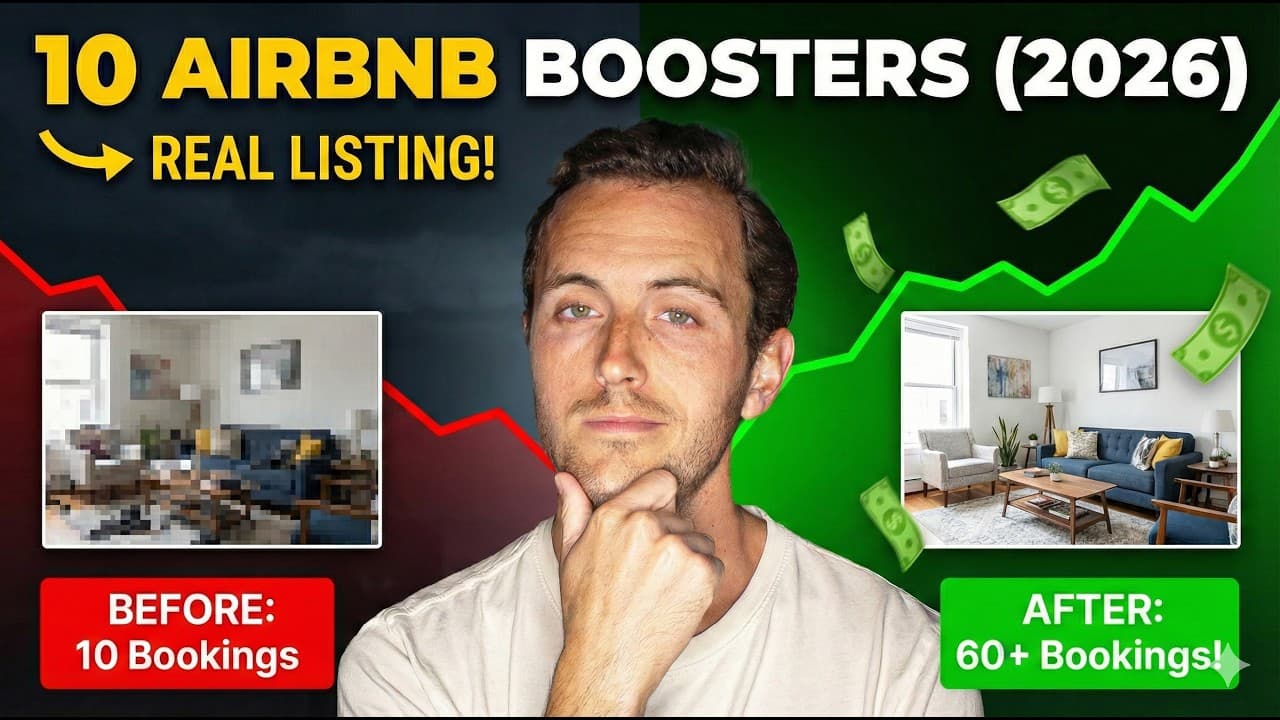
10 ESSENTIAL Steps to Improve Your Airbnb in 2026 (Real Listing Example!)
Most Airbnb listings lose bookings to the same fixable mistakes: bad photos, weak headlines, incomplete amenities, and missed seasonal opportunities. Here are 10 proven strategies to turn any underperforming listing into a consistent booking machine in 2026.
January 1, 2026 · 11 min read

10 Game-Changing Hacks to Improve Your Airbnb
What does it really mean to run a successful Airbnb in 2026? These 10 practical hacks — including a $15 sensor that prevented $44,000 in property damage — show exactly what separates top hosts from average ones.
January 16, 2025 · 9 min read

10 Tips to Get More Views on Airbnb
More views mean more bookings, and more bookings mean more revenue. This guide breaks down 10 actionable Airbnb listing optimization strategies that help hosts climb the search rankings and fill their calendars in 2026.
March 26, 2024 · 14 min read