Are Airbnbs Slowing Down?
By James Svetec · August 1, 2023 · 7 min read
Part of our Airbnb Hosting 101 guide →
Key Takeaways
- Airbnb bookings didn't slow down so much as they artificially spiked during the pandemic — some markets are simply returning to normal levels.
- 'Normal' STR performance is still highly profitable for investors who ran proper analysis before buying.
- Not all listings feel a slowdown equally — top-tier listings often see little to no impact while weaker ones lose bookings fast.
- Listing quality — photos, pricing strategy, SEO, amenities — is now the biggest factor separating thriving hosts from struggling ones.
- There are actually more great STR investment deals available in 2026 than there were 12-24 months ago.
If you've been wondering whether Airbnbs are slowing down, you're not alone. It's one of the most common questions hosts and investors ask in 2026 — and the honest answer is more nuanced than a simple yes or no. The short answer: yes, some markets are seeing slower booking volumes.
But whether that actually affects your bottom line depends almost entirely on what you do next.
Watch the full video above or keep reading for the complete breakdown.
Yes, Airbnbs Are Slowing Down — But Here's the Context
Saying that Airbnb bookings are slowing down is technically true. But framing it that way misses the bigger picture entirely. A more accurate statement is that Airbnb bookings sped up dramatically during the pandemic — and some markets are simply returning to pre-pandemic baselines.
When international travel shut down in 2020, millions of travelers couldn't visit Europe for the summer or fly overseas for vacation. Instead, they poured into domestic destinations: cottages, national park cabins, beach houses within driving distance. The result was a staggering 50 to 100% increase in bookings and revenue in many major STR markets.
That surge was not sustainable forever. Any experienced investor who was watching the data knew that. What we're seeing now in many markets isn't a crash — it's a correction back toward something closer to historical norms.
For broader context on how the STR market has reacted to economic pressures, the post on Airbnb and the upcoming recession is worth reading alongside this one.
Why 'Normal' STR Performance Is Still Profitable
Here's what too many hosts miss when they panic about slowing bookings: normal was always good. Pre-pandemic STR performance, in most markets with smart property selection, generated solid cash-on-cash returns and positive monthly cashflow.
If you ran proper investment analysis before buying — modeled conservative occupancy rates, accounted for rising interest rates, stress-tested your numbers — then returning to normal doesn't hurt you. Your projections already baked it in.
The hosts who are struggling right now are often the ones who bought at peak prices, projected peak revenue forward indefinitely, and never stress-tested their assumptions. That's an underwriting problem, not an Airbnb problem.
Investors who want a structured approach to running those numbers before committing to a purchase can explore the BNB Investing Mastery, which covers deal analysis, market selection, and cash-on-cash return modeling in detail.
Not All Markets Are Slowing Down Equally
Even within the broader slowdown narrative, the picture varies significantly by market, property type, and location. Three distinct patterns are playing out right now:
- Markets returning to baseline: Bookings have pulled back from pandemic highs but remain healthy at pre-2020 levels. Properties with solid fundamentals are performing fine.
- Markets holding strong at new levels: Some destinations saw massive demand increases and have maintained much of that elevated revenue — meaning the pandemic didn't just spike demand temporarily, it permanently expanded the market.
- Markets still growing: Certain property types in specific niches — unique properties, luxury tiers, purpose-built STRs — are actually seeing year-over-year revenue increases in 2026 compared to last year.
This means there is no single answer that applies to every host. A well-located mountain cabin and a generic urban apartment will have completely different trajectories right now. Market-level data is a starting point — but your individual listing's performance is what actually matters.
The Real Split: Top Listings vs. Bottom Listings
This is the most important concept to understand about what happens during a market slowdown — and most people get it completely wrong.
When headlines say a market is down 10% in bookings, people assume every listing will drop 10%. That is not how it works.
Think about it this way: if there are 1,000 properties in a market but only 500 travelers booking, those 500 bookings don't distribute evenly across all 1,000 properties. The best 500 listings get booked. The other 500 sit empty.
A market-wide 10% drop might mean the top listings see a 1-2% dip while weaker listings see a 20-30% decline. The average is misleading.
BNB Mastery has worked with hosts who have beautifully designed properties sitting at under 40% occupancy — not because the market is terrible, but because their listings weren't optimized. Weak listing SEO, poor pricing strategy, subpar photos. Fix those, and the same property in the same market starts performing at 70%+ occupancy.
If your bookings have dropped unexpectedly, the post on why your Airbnb listing suddenly stopped getting booked covers the specific factors that cause a previously well-performing listing to stall.
Free Tool
Grab the Airbnb Nightly Pricing Tool
Grab the exact spreadsheet James uses to set profitable nightly rates — plus a step-by-step setup cheatsheet.
How to Make Sure You're in the Top 25%
During the pandemic booking surge, you could post blurry smartphone photos, write a two-sentence description, and still get booked out. That era is over. In 2026, being good at the fundamentals is non-negotiable.
Here's what separates the top 25% of listings from the rest:
Professional-Quality Photography
Photos are the single highest-leverage improvement most hosts can make. Guests decide whether to click — or keep scrolling — in about two seconds. Professional photos that showcase the space accurately and attractively can dramatically increase click-through rates from search results.
Listing SEO and Search Ranking
Airbnb's search algorithm rewards listings with strong booking history, high response rates, competitive pricing, and well-written titles and descriptions. A listing buried on page three of results gets a fraction of the views of one on page one — regardless of how nice the property actually is.
Check out the guide on 10 tips to get more views on Airbnb for tactical improvements you can make today.
Smart Pricing Strategy
Static pricing is a revenue killer. Dynamic pricing — adjusting rates based on demand, seasonality, local events, and competitor availability — is what keeps top listings both fully booked and maximizing nightly rate simultaneously. The post on Airbnb pricing hacks that boost bookings goes deeper on this.
Amenities That Guests Actually Want
Fast WiFi, a well-stocked kitchen, quality linens, and a workspace aren't luxury extras anymore — they're table stakes. Properties that go beyond the basics (think: hot tub, EV charger, dedicated workstation) stand out in search filters and generate higher nightly rates.
Compelling Listing Copy
Your headline and description need to sell the experience, not just describe the space. Highlight what makes your property unique. Lead with the best feature. Use specific, vivid language that helps guests picture themselves there.
For a full breakdown of what makes a listing perform at the top of its market, the post covering 7 keys to a great Airbnb listing is essential reading.
Hosts who want to keep improving their skills and stay current on what's working right now can also benefit from connecting with peers inside the BNB Tribe community — it's an active group of hosts and investors sharing real-time strategies.
What This Means for STR Investors Right Now
Here's the silver lining that most people aren't talking about: the current market environment is actually creating better buying opportunities than existed 12 to 24 months ago.
During peak pandemic demand, properties were being snapped up at inflated prices with unrealistic revenue projections. Bidding wars, waived inspections, and FOMO-driven purchases dominated. That made it genuinely hard to find deals that penciled out conservatively.
Now, with some sellers spooked by softening bookings and rising rates, acquisition prices have moderated in many markets. Buyers who do their homework — model realistic occupancy, account for current interest rates, identify the right property type and location — can find deals with solid fundamentals that would have been impossible to close two years ago.
The key is doing that analysis rigorously. Investors who cut corners on underwriting in a forgiving market paid for it when conditions normalized. See the post on the harsh truth about Airbnb investing for an honest look at what separates successful STR investors from those who struggle.
The Bottom Line on Airbnb's Slowdown
Are Airbnbs slowing down? In some markets, yes — compared to pandemic-era highs. But the hosts and investors who did things right are largely not feeling it. The properties sitting at 40% occupancy aren't struggling because the market collapsed. They're struggling because they were never optimized to compete.
The STR market in 2026 rewards quality. Strong photos, smart pricing, solid listing SEO, and the right amenities still generate excellent occupancy and revenue — even as weaker listings stagnate. The gap between well-run properties and poorly-run ones is widening, not closing.
If your bookings have slipped, the fix is almost always within your control. Audit your listing honestly against the top performers in your market. Raise your standards. The demand is still there — it's just becoming more selective about where it goes.
Frequently Asked Questions
Are Airbnb bookings actually slowing down in 2026?
Yes, some markets have seen a slowdown compared to pandemic-era highs — but that spike was an anomaly. Many markets are returning to normal pre-pandemic performance levels, which still represents solid profitability for well-run STRs.
Why are some Airbnb hosts seeing fewer bookings while others are fully booked?
Listing quality is the biggest differentiator. During a demand slowdown, the best listings capture a disproportionate share of available bookings. Hosts with weak photos, poor pricing strategy, or low search rankings feel the drop much harder than optimized listings.
Should I sell my Airbnb if bookings are slowing down?
Not necessarily. If your property was purchased with conservative underwriting and still generates positive cashflow at normal occupancy levels, the slowdown may not require action. Focus first on improving your listing's performance before making any exit decisions.
Is Airbnb investing still worth it in 2026?
Yes — particularly because acquisition prices have moderated in many markets, creating better deals than existed at peak. The key is rigorous deal analysis: modeling realistic occupancy, factoring in current rates, and selecting the right market and property type.
What's the fastest way to improve a slow Airbnb listing?
Start with pricing strategy and photos — these two factors have the highest impact on bookings. Ensure your listing ranks well in Airbnb search by maintaining a strong response rate, competitive pricing, and an optimized title and description.
If your Airbnb bookings are down and you're not sure why, the answer is almost always in your listing's fundamentals. Connecting with experienced hosts inside the BNB Tribe community is one of the fastest ways to get a second set of eyes on your setup and find out exactly what's holding your numbers back. Investors looking to buy in the current market can also use the BNB Investing Mastery to make sure the numbers actually work before committing to a purchase.
Free Tool
Grab the Airbnb Nightly Pricing Tool
Grab the exact spreadsheet James uses to set profitable nightly rates — plus a step-by-step setup cheatsheet.
Ready to get started with Airbnb?
Join 240+ members in BNB Tribe — the community James built for hosts and investors who want real results.
Join BNB TribeMore Articles
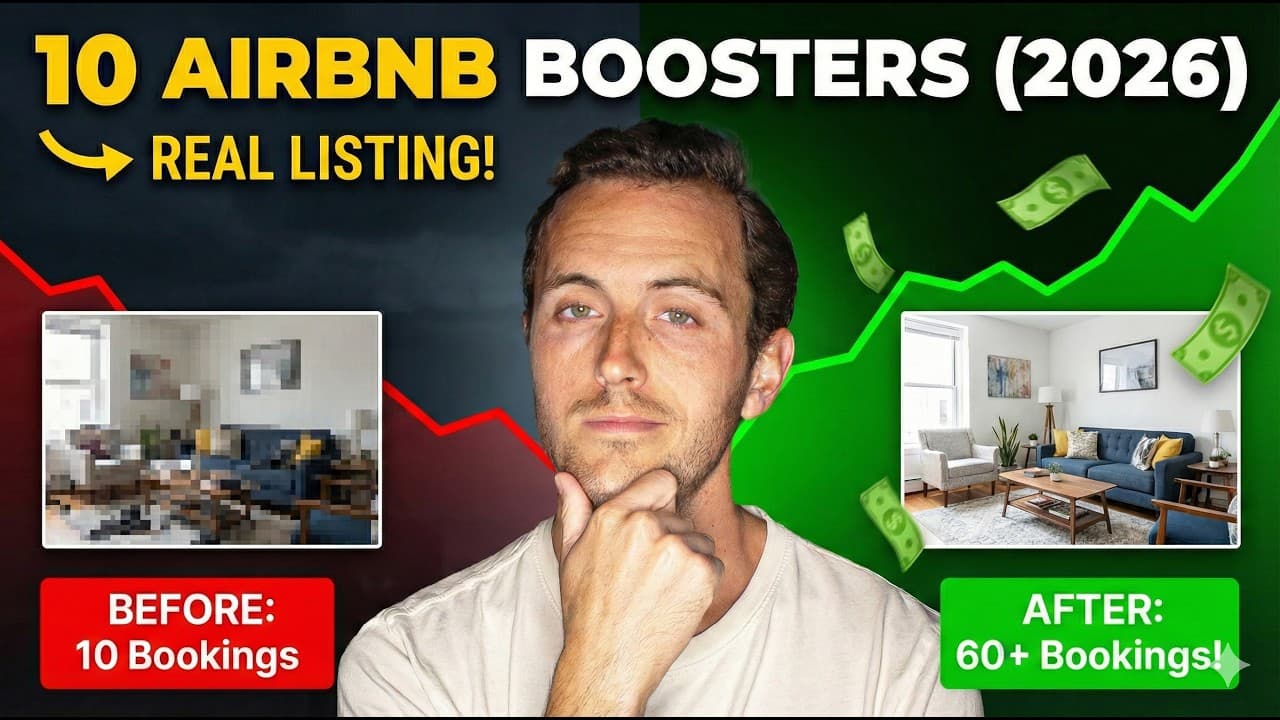
10 ESSENTIAL Steps to Improve Your Airbnb in 2026 (Real Listing Example!)
Most Airbnb listings lose bookings to the same fixable mistakes: bad photos, weak headlines, incomplete amenities, and missed seasonal opportunities. Here are 10 proven strategies to turn any underperforming listing into a consistent booking machine in 2026.
January 1, 2026 · 11 min read

10 Game-Changing Hacks to Improve Your Airbnb
What does it really mean to run a successful Airbnb in 2026? These 10 practical hacks — including a $15 sensor that prevented $44,000 in property damage — show exactly what separates top hosts from average ones.
January 16, 2025 · 9 min read

10 Tips to Get More Views on Airbnb
More views mean more bookings, and more bookings mean more revenue. This guide breaks down 10 actionable Airbnb listing optimization strategies that help hosts climb the search rankings and fill their calendars in 2026.
March 26, 2024 · 14 min read